Tag Archives: time travel

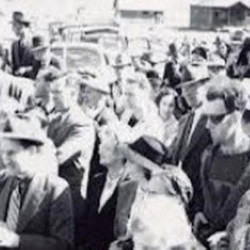
Black and white photo of a large crowd of people gathered outdoors, many wearing hats and coats.

Is This Photographic Evidence of a Time Traveler?

Is This Photographic Evidence of a Time Traveler? This post is based on material from chapter 2 of my new book, How to Time Travel.

If you do an Internet search with Google using the keyword phase “time travel evidence” (without the quotes), you will get about 258,000,000 search returns. Most of the “evidence” is not scientific evidence. It is anecdotal. However, the sheer volume of time travel anecdotal evidence on the internet makes it hard to ignore.

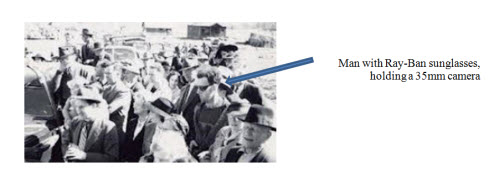
One category of evidence is old photographs. Many sites include old photographs that show people out of context, for example, wearing clothing that does not fit the time, such as modern sunglasses, or using devices, such as a 35mm camera, that did not exist at the time the photograph was taken. To see these results do a Google search using the phrase “time travel photo evidence” (without the quotes). You can find several websites that have a number of good examples such as the 1941 photograph of a person with Ray-Ban sunglasses,  a screen-print T-shirt and a 35mm camera (below).

10-18-2013 11-25-53 AM photo evidence

Let us  examine some of the photographic evidence. I have made two observations:

  1. Many of the old photographs are fuzzy. This is typical of old photographs, since cameras in the early part of the twentieth century were crude.
  2. The claims that something or someone is “out of context” are a bit of a stretch. For example, consider the man in the 1941 photograph. Some suggest he is wearing Ray-Ban sunglasses and a screen-print T-shirt, and holding a modern 35mm camera. I think the photograph is too fuzzy to make a solid case for these assertions, but that is just my opinion. I suggest you view the photograph and draw your own conclusion.

In addition, with today’s computer technology and state-of-the-art photograph-editing programs, such as Photoshop, it is possible to manipulate a photograph and have Elvis shaking hands with Albert Einstein. Only a highly trained computer photographic expert would be able to determine that the photograph is a computer-generated manipulation of pixels—in other words, a fake. The technology is that good. This makes me suspicious of all photographic evidence that has not been analyzed by a highly trained expert.

Although the photograph is intriguing, it is not conclusive. Therefore, you will have to be the judge. Is this photograph evidence of a time traveler?


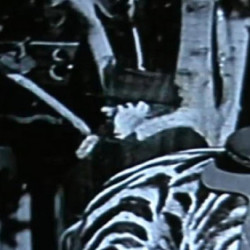
Black and white image of people in vintage clothing, one person wearing a patterned outfit and a hat.

Time Travel Anecdotal Evidence from the Internet

This post is based on material from chapter 2 of my new book, How to Time Travel.

Let us start with a word of caution. Anecdotal evidence is not scientific evidence. It may be bogus, and all anecdotal evidence should be treated with skepticism. However, the sheer volume of time travel anecdotal evidence on the internet makes it hard to ignore. For example, if you do an Internet search with Google using the keyword phase “time travel evidence” (without the quotes), you will get about 258,000,000 search returns. Most of the evidence falls into three categories:

  1. Old movie clips: There are a number of YouTube videos of old movies showing people using devices, such as a cell phone, that would not have existed when the movie was made.
  1. Old photographs: Many sites include old photographs that show people out of context, for example, wearing clothing that does not fit the time, such as modern sunglasses, or using devices, such as a 35mm camera, that did not exist at the time the photograph was taken.
  1. Archaeological finds: There are archaeological finds of modern devices, such as a one-hundred-year-old Swiss-made watch found in a four-hundred-year-old Ming dynasty tomb in Shangsi County, Guangxi, in southern China.

Let us examine one piece of anecdotal evidence, from category 1, old movie clips. One example that comes up numerous times is Charlie Chaplin’s 1928 film The Circus, featuring a woman who appears to be talking on her cell phone. Just do a YouTube search using the keyword phrase “time travel evidence Chaplin film” (without the quotes). You will get back about a 100,000 search returns. The first page or two of search results have clips of this video, typically with some commentary.

Debunkers argue that the woman was just holding a primitive hearing aid known as an ear trumpet. Surprisingly, a 1928-ear trumpet looks like a cell phone from a distance. Proponents dismiss this as an explanation because the woman is talking into it. However, you see some people talking aloud to themselves all the time. This does not mean they are crazy. This is just how they process information and think. Almost all of us talk to ourselves privately in our minds. It is called thinking. Does this explain the film clip? Obviously, this explanation does not satisfy everyone.

Where does this leave us regarding time travel evidence from the Internet? In a phrase, it leaves us on “shaky ground.” I examined only one of the most popular pieces of time travel evidence on the Internet, and it is far from conclusive. Evidence that is more conclusive may lie buried in the 258,000,000 Google search returns for the keyword phrase “time travel evidence.” The challenge is finding it. A true scholarly effort would likely take a lifetime. However, in my opinion, the real world, and the universe, is stranger than any work of fiction. Therefore, I am keeping an open mind.

Remember, at the beginning of this article I clearly stated that anecdotal evidence is not scientific evidence. However, I also stated the sheer volume of time travel anecdotal evidence on the internet makes it hard to ignore. Is this an example of real time travel evidence caught on film? I suggest you do the Google search, view the clip and make up your own mind.

A silhouette of a person with a blank face in front of a large clock, set against a swirling cosmic background.

How to Time Travel: Explore the Science, Paradoxes, and Evidence

Here is the entire introduction from my new book, How to Time Travel. Enjoy!

Introduction

Few subjects evoke more emotion than time travel, the concept of moving between different points in time in a manner analogous to moving between different points in space. Humankind’s fascination with time travel dates back thousands of years. Although there is no consensus recognizing which written work was the first to discuss time travel, many scholars argue that the Mahabharata, from Hindu mythology, is the first, dating between 700 BCE (Before the Common/Current/Christian Era) and 300 CE (Common/Current/Christian Era). The Mahabharata, which is one of the two major Sanskrit epics of ancient India, relates the story of King Revaita, who travels to heaven to meet the deity Brahma. When King Revaita returns to Earth, he is shocked to learn that many ages have passed. In today’s science, we would assert King Revaita experienced time dilation.

What is time dilation? It is a scientific fact that time moves slower for any mass accelerated near the speed of light. If that mass were a clock, for example, the hands of the clock would appear to be moving slower than a clock in the hand of an observer at rest. That phenomenon is termed time dilation. If King Revaita used a spaceship capable of speeds near the speed of light to visit Brahma, a roundtrip journey that would appear to King Revaita to take one year would result in a time passage of thirty years on Earth. This may seem like science fiction, but time dilation is a well-established, experimentally verified aspect of Einstein’s special theory of relativity; more about this later.

Arguably, the greatest single written work that laid the foundation to fire the imagination of today’s generation regarding time travel is H. G. Wells’s classic novel, The Time Machine, published in 1895. It has inspired numerous popular movies, television programs, novels, and short stories. Why are we humans so obsessed with time travel? It appears to be an innate longing. How many times have you wished that you could go back to a specific point in time and select a different action? We all do it. Consider the number of times you have replayed a specific situation in your mind. Psychologists tell us we replay an event in our minds when the outcome is not finished to our satisfaction. This has accounted for numerous nights of tossing and turning. Another common need is to seek answers to important questions from a firsthand perspective. Perhaps you would like to be a witness during the resurrection of Christ, or be a witness behind the grassy knoll during the Kennedy assassination. Perhaps you miss a loved one who has passed on, and you would like to go back in time to embrace that loved one again.

Some of us also dream about time travel to the future. What outcomes will result from our decisions? Imagine the prosperity and happiness that could be ours if we were able to travel to the future. We would be able to witness the outcome of any decision, return to the present, and guide our lives accordingly. Picking the right profession or choosing the right mate would be a certainty. We could ensure there would be no missteps in our life. A life of leisure and prosperity would be ours for the taking.

It is little wonder that many people ask this deceptively simple question: Is time travel possible? The majority of the scientific community, including myself, says a resounding yes. The theoretical foundation for time travel, based on the solutions to Einstein’s equations of relativity, is widely accepted by the scientific community. The next question, which is the most popular question, is how to time travel. Of all the questions in science, the keyword phrase “how to time travel” is close to the top of Internet search engine searches. According to Google, the largest search engine in the world, there are 2,240,000 worldwide monthly searches for the keyword phrase “how to time travel,” as of this writing. Unfortunately, it is the most difficult question to answer.

Obviously, interest in time travel is high, and what people want to know most is how to time travel. This high interest, combined with the intriguing real science behind time travel, is what inspired me to write this book.

At this point, I would like to set your expectations. We are going to embark on a marvelous journey. We will examine the real science of time travel, the theoretical foundation that has most of the scientific community united that time travel is possible. We will also examine the obstacles to time travel, and there are many. However, even in the face of all the obstacles, most of the scientific community agrees it is theoretically possible to time travel. The largest issue in time travel is not the theoretical science. It is the engineering. Highly trained theoretical physicists understand the theoretical science of time travel. However, taking the theory and building a time machine capable of human time travel has proved a formidable engineering task. It has not been done, but we are amazingly close. We have already built time machines capable of sending subatomic particles into the future. If you will pardon the pun, it is just a matter of time before we engineer our way through the time travel barrier and enable human time travel.

In setting your expectations, I promise you significant insight into the real science of time travel and an equally incredible insight into the obstacles to time travel. I cannot promise that with this knowledge you will be able to overcome the obstacles and engineer how to time travel. However, you may be the one person destined to harness the science, glean the engineering simplicity, and journey in time. There is only one way to find out, namely, read on.

To browse the book free on Amazon, click this link: https://amzn.to/1dWyEkp

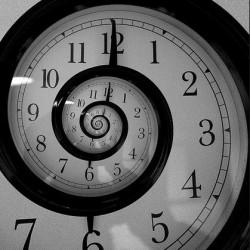
A black and white clock face with a spiral effect distorting the numbers inward.

What Is Time? – The Existence Equation Conjecture – Part 2/3

This three part post is based on original theoretical research presented in my book, Unraveling the Universe’s Mysteries, 2012, Louis A. Del Monte (available at Amazon https://amzn.to/Zo1TGn)

The empirical evidence demonstrates that time dilates, slows down, by adding kinetic energy or gravitational energy. Does this help us interpret the Existence Equation Conjecture we have developed to determine the kinetic energy of a mass as it moves in the fourth dimension? Yes! However, the interpretation is going to be speculative and imaginative. With this caveat, here is one interpretation: Movement in the fourth dimension is associated with existence, and requires negative kinetic energy. This is similar to the positive kinetic energy required for movement in the typical three spatial dimensions. The difference is movement in the three spatial coordinates requires positive kinetic energy, while movement in the fourth spatial coordinate (existence) requires enormous negative energy, as suggested by the Existence Equation Conjecture (KEX4 = -.3mc2). When we add kinetic energy or gravitational energy to a particle, we feed the negative energy that it requires to exist with the positive kinetic energy or gravitational energy. The negative kinetic energy of existence may be syphoning a portion of its energy from the particle. For a relatively small unstable particle at rest, such as a muon, we describe this existence as the expected life of the particle. If we add kinetic or gravitational energy to the particle, the negative kinetic energy of existence consumes less of the particle. Therefore, it increases its life.

This theoretical interpretation appears to fit the evidence presented regarding time dilation. For example, a muon at rest has an expected life in the order of 10-6 seconds. However, when muons naturally form via comic-ray collisions with our atmosphere, the resultant muon travels at speeds close to the speed of light before it reaches the ground. Therefore, its kinetic energy (KE) becomes extremely high. According to this interpretation, this high kinetic energy is providing the muon a portion of the energy required to exist. Therefore, it is increasing its expected life. This is consistent with the Rossi and Hall experiment performed in 1941, and the 1963 Frisch and Smith confirmation of their findings.

What does this suggest about the nature of time? According to our interpretation above, time is a measure of existence—and existence requires negative kinetic energy. Therefore, a relationship between time and energy exists. Is this too far out to be believable? I agree it stretches credibility to the limit. However, although the special theory of relativity has provided excellent equations to calculate time dilation, insight into the physical process behind time dilation remains elusive. The Existence Equation Conjecture may provide a framework to understand the actual physics behind time dilation.

It’s still a dilemma. Where does the energy come from if existence requires negative energy? A simple examination of the Existence Equation Conjecture suggests the energy required for even a small mass, like an apple, to exist, would be equivalent to a nuclear bomb. In addition to that dilemma, the Existence Equation Conjecture suggests the energy expended to exist is negative. Theoretical physics has postulated the existence of negative energy. In 1930, the Dirac sea was postulated to reconcile the negative-energy quantum states, as predicted by Dirac in his mathematical modeling of electrons. However, science has not found a way to create negative energy. Currently, scientists are exploring the Casimir-Polder effect as a potential generator for negative energy. This may eventually yield fruitful results. This leaves us with a significant unanswered question. Where does the enormous negative energy required for existence come from?

Stay tuned for part 3 (conclusion).

science of time & time dilation

The Philosophy of Time and Time Travel – Part 2/2 (Conclusion)

This is taken from Appendix 4 of my new book, How to Time Travel, to be published by early September 2013.

Let us examine the three major philosophical schools on the nature of time and their implications regarding time travel.

1. Presentism theory of time

The presentism theory of time holds that only the present is real. The past is over. Therefore, it is no longer real. The future has yet to occur. Therefore, the future is not real. Presentists argue that our mind remembers a past and anticipates a future, but neither is real. They are mental constructs.

Arguably, the most famous presentist is Augustine of Hippo (a.k.a. St. Augustine), who compared time to a knife edge. The present represents a knife edge cutting between the past and future. Ironically, this means Augustine of Hippo is not real, since he lived and died in the past. Therefore, should we study Augustine of Hippo, who, by his own philosophy, is not real? Of course, I am only being contentious to make a point.

Presentism has a large following, especially among Buddhists. Fyodor Shcherbatskoy (1866–1942), often referred to as the foremost Western authority on Buddhist philosophy, summed up the Buddhist view of presentism with these few words: “Everything past is unreal, everything future is unreal, everything imagined, absent, mental…is unreal…Ultimately real is only the present moment of physical efficiency.” Uncountable millions of Buddhists still ascribe to this view of time and reality.

A cogent philosophical argument can be made for presentism, but presentism is problematic from a scientific viewpoint. When we discussed the special theory of relativity, we learned that the present is a function of the position and speed of the observer. Therefore, what is the present to one observer may be the past to another.

From the standpoint of time travel, presentism renders the question “how to time travel” moot. If we embrace presentism, there is no past or future, and time travel is meaningless. Fortunately, though, other philosophies of time open the door to time travel. Let us examine the next one.

2. Growing universe theory of time

This theory of time is also referred to as “growing block universe” and “the growing block view.” However, regardless of the name, they all hold the same philosophy of time. The past is real, and the present is real. The future is not real. The logic goes something like this: The past is real because it actually happened. We experience it, and we document it. We call it history. The present is real because we experience it. We often share the present with others. The future is not real because it has not occurred.

Why do all the names for this theory of time start with the word “growing”? The concept is that the passage of time continually expands the history of the universe. Actually, this is logical. The history of the world, and the universe, continues to expand with the passage of time. The history section of any library is destined to grow with time.

In this philosophy of time, only time travel to the past makes sense, since for growing-universe philosophers, the past is real. We cannot time travel to the future, since the future has yet to occur. Therefore, it is not real.

As logical as this theory of time may appear, there is scientific evidence that the future is real and can influence the present. We discussed this evidence in the section titled “Twisting the arrow of time” in chapter 1. Now, let us examine the last significant philosophy of time.

3. Eternalism theory of time

The eternalism theory of time holds that the past, present, and future are real. The philosophy of this theory rests on Einstein’s special theory of relativity. Essentially, the special theory of relativity holds that the past, present, and future are functions of the speed and position of an observer.

While Einstein never equated time with the fourth dimension, Minkowski’s geometric interpretation of Einstein’s special theory of relativity gave birth to four-dimensional space, with time as part of the fourth dimension. In Minkowski’s interpretation, often termed “Minkowski space” or “Minkowski spacetime,” the fourth dimension includes time and is on equal footing with the normal three-dimensional space we currently encounter. However, Minkowski’s fourth dimension borders on the strange. In Minkowski spacetime, the fourth dimension, X4, is equal to ict, where i = √-1, an imaginary number, c is the speed of light in a vacuum, and t is time as measured by clocks. The mathematical expression ict is dimensionally correct, meaning that it is a spatial coordinate, not a temporal coordinate, but is essentially impossible to visualize, since it includes an imaginary number. What is an imaginary number? It is a number that when squared (multiplied by itself) gives a negative number. This is not possible to do with real numbers. If you multiply any real number, even a negative real number like minus one, by itself, you always get a positive number. Therefore, it is impossible to solve for the square root of minus one.

Although we can express it mathematically as √-1, it has no solution, and it is termed an imaginary number. Does that mean Minkowski was wrong about the fourth dimension? Actually, it does not. It does say that it is a mathematical construct, and intuitively, for most of us, impossible to visualize. However, the special theory of relativity continues to be taught using Minkowski spacetime, which the bulk of the scientific community considers a valid geometric interpretation. In either its algebraic form, as first presented by Einstein, or its geometric form, as interpreted by Minkowski, the majority of the scientific community considers the special theory of relativity the single most successful theory in science. It has withstood over a century of experimental investigation, and it is widely considered verified.

Because of its scientific underpinnings, the eternalism theory of time is widely accepted in the scientific community. If we adopt the eternalism theory of time, then time travel to the past or future becomes equally valid. In addition, no scientific theory contradicts or prohibits time travel. Said more positively, based on Einstein’s theories of relativity, which lay a theoretical foundation for time dilation (i.e., time travel to the future) and closed timelike curves (i.e., time travel to the past), most of the scientific community would support the scientific possibility of time travel.