Tag Archives: louis del monte

Aliens and UFOs

Warp Drive – Time Travel to the Future – Science or Science Fiction?

Is a warp drive spaceship feasible? Mexican theoretical physicist Miguel Alcubierre thinks it is.

In 1994, Dr. Alcubierre published a 1994 paper, “The Warp Drive: Hyper-Fast Travel Within General Relativity,” in the science journal Classical and Quantum Gravity.

The Alcubierre drive appears to allow a spaceship to travel faster than light, but it requires the existence of negative mass to make the Alcubierre drive work. In principle, the drive works by contracting the space in front of the spaceship and expanding the space behind the spaceship faster than the speed of light. In this fashion, the spaceship rides like a surfer on a wave. As the space behind the spaceship expands faster than the speed of light, the spaceship appears to move faster than the speed of light. However, it does not. Only the space behind the ship is expanding faster than the speed of light. In this way, Dr. Alcubierre avoids violating the laws of special relativity, namely, that no mass can exceed the speed of light.

There is no law in physics that prohibits space from expanding faster than the speed of light. From this viewpoint, the Alcubierre drive has merit. The Alcubierre drive is a mathematically valid solution to Einstein’s field equations. However, requiring negative mass as part of the mechanism for the Alcubierre drive makes the theory highly speculative and, once again, beyond the reach of today’s science. As a side note, Dr. Alcubierre got this idea by watching Star Trek and its use of the warp drive.

Often today’s science fiction becomes tomorrow’s science fact.

This post is based on my new book, How to Time Travel (2013), Louis A. Del Monte.

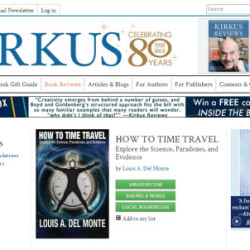
A website homepage featuring a book titled How to Time Travel by Louis A. Del Monte with a clock image on the cover.

Kirkus Book Review of How to Time Travel

Kirkus Book Review of How to Time Travel

Kirkus Reviews (or Kirkus Media) is an American book review magazine founded in 1933 by Virginia Kirkus (1893–1980). Kirkus Reviews is published on the 1st and 15th of each month. Kirkus reviews over 7,000 titles per year, and their reviews are widely regarded by librarians and bookstores, which regularly peruse their lists for the “best” books to order. Therefore, a Kirkus review can significantly influence book sales. Recently, my new book, How to Time Travel, was reviewed by Kirkus and is live on their Website at https://bit.ly/1eTpFAv. If you are considering purchasing and reading How to Time Travel, I thought you would be interested in their review, which is is presented below in its entirety:

“Time travel—its possibilities, potential and primary obstacles—gets a levelheaded review from a physicist in this lucid, optimistic book.

Throughout Del Monte’s book, which focuses on how time travel might be accomplished and the major issues that stand in the way of its realization, he takes care to emphasize the scientific method, not just for time travel but in evaluating the theories and evidence behind it. By necessity, much of the book discusses various theories and speculations, beginning with Einstein’s Theory of Relativity and extending forward to modern formulations, ranging from Alcubierre’s space-warp proposal to Mallet’s space-time twist theory. Given that many in the scientific community believe time travel is at least theoretically possible, Del Monte focuses in later chapters on the engineering challenges, discussing what would be needed to achieve it and how civilization might go about reaching those milestones. While some of the ideas along the way are the stuff of conspiracy theorists and late-night talk radio—UFOs, the Philadelphia Experiment, etc.—Del Monte never condescends in his examinations, taking a rational, methodical approach to evaluating the possibilities and explaining why he thinks they do or don’t merit further examination. In his refreshingly even-keeled, forthright approach—particularly in his discussion of scientific and anecdotal evidence and the place of both in any thought process—Del Monte does an excellent job of exemplifying the scientific method in action. He clearly favors certain conclusions, but he takes pains to allow room for readers to develop their own interpretations, and he includes appendixes with further information to assist readers in digging deeper.

This articulate, principled use of scientific methodology offers a clear, rational examination of an intriguing concept.”


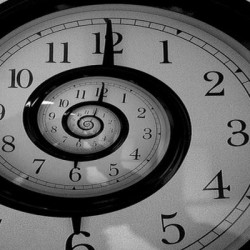
A black and white image of a clock face with a spiral effect distorting the numbers and hands.

Explore Two Famous Time Travel Paradoxes – The Grandfather Paradox & Twin Paradox

Time Travel Paradoxes – The Grandfather Paradox & Twin Paradox

What is a time travel paradox? It is an occurrence that apparently violates some aspect of causality (i.e., cause precedes effect) typically associated with time travel. Although there are numerous time travel paradoxes, let us explore two famous ones: The grandfather paradox and the twin paradox.

  • The grandfather paradox—Science fiction writer René Barjavel, in his 1943 book, Le Voyageur Imprudent (Future Times Three), originally proposed the grandfather paradox. It goes something like this. A person goes back in time and meets his grandfather before his grandfather meets his grandmother. The person in some way interferes with his grandfather meeting his grandmother. Consequently, the grandfather and grandmother never meet. The question becomes, what happens to the person? In theory, the person will never be born.  Is this just some illogical premise, similar to asserting that a square circle exists? Most of the scientific community considers it a valid concern regarding causality violations due to time travel. Some physicists believe that it actually presents a barrier to time travel. However, numerous theories exist to resolve time travel paradoxes. We will discuss those theories in the next section, but first let us explore another famous paradox.
  • The twin paradox—The is one of the most famous time travel paradoxes. It goes something like this: On Earth live a pair of twins. They are almost the same age, differing only by the order in which they were born. One twin boards a spacecraft capable of traveling near the speed of light. In the spacecraft, the twin embarks on a one-year journey, measured by the clock within the spacecraft. During the one-year journey, the spacecraft travels at 99.94% the speed of light. When the spacecraft returns to Earth, the twin on the spacecraft has aged one year, but learns his twin has aged almost thirty years. Although the example is fictitious, the science is real. The twin paradox has been experimentally verified using highly accurate atomic clocks, one on a jet plane and the other at the airport. There have been many variations of the twin paradox. The scientific community considers it a valid effect of Einstein’s special theory of relativity regarding time dilation.

There is a laundry list of time travel paradoxes. I discuss many of them in my critically acclaimed best selling new book, How to Time Travel. The paradoxes above are sufficient to illustrate causality issues. It is important to note that the time travel paradoxes are not simply in the category of thought experiments. Numerous time travel paradoxes, like the twin paradox and the double-slit delayed-choice paradox (discussed in a previous post), are experimental facts. They are real. The important question is: Do time travel paradoxes form a barrier to time travel? We will address this question in an up coming post.


Multiple overlapping clock faces with various times, creating a surreal and abstract time concept in blue tones.

What Is the Science of Time Travel?

The science of time travel is real. There is experimental evidence that proves time travel is real. Yet, with but a few exceptions, most of my colleagues in the scientific community avoid discussing or doing serious time travel research. Why is this?

The theory regarding time travel is relatively easy to understand on a technical basis if you have or are pursuing a degree in the physical sciences, or on a conceptual basis, for the layperson. For example, professors teach time dilation (i.e., forward time travel) in undergraduate physics classes. Professors also teach general relativity in both undergraduate and graduate physics classes. The general theory of relativity embodies, along with Einstein’s theory of gravity, the science of time travel to the past. Both the special and general theories of relativity are easy to grasp for a person with the proper scientific background. However, designing and engineering experiments to demonstrate time travel is an extremely difficult task. In fact, building particle accelerators capable of demonstrating even the simplest form of time travel, time dilation, requires the participation of numerous institutions, numerous nations, and a huge financial investment. An example of this is the Large Hadron Collider (LHC), which is the world’s largest high-energy particle accelerator. The European Organization for Nuclear Research (CERN), a collaboration of ten thousand scientists and engineers from over one hundred countries, built the LHC over a ten-year period, 1998 to 2008, at an estimated cost of $9 billion. Scientists hail it as one of the greatest scientific achievements. It is able to perform time dilation experiments, among many other important scientific tasks. However, even with highly sophisticated scientific instruments, research regarding particle acceleration and detection is a difficult endeavor. For example, in 2011, scientists using the Oscillation Project with Emulsion-tRacking Apparatus (OPERA) reported accelerating neutrinos faster than the speed of light, which later proved incorrect and due to faulty cable connections.  The main point is that the apparatus proposed to perform time travel research, even using subatomic particles, is extraordinarily expensive, difficult to build, and difficult to use. The energy required, even when dealing with subatomic particles, is enormous.

In summary, here are the salient elements of the science of time travel:

  • Einstein’s special theory of relativity provides a strong theoretical foundation for forward time travel, which is termed “time dilation.”
  • There is a wealth of scientific data proving time dilation is real and can occur when a frame of reference accelerates near the speed of light, or when a frame of reference is in a strong gravitational field.
  • Even though there is general agreement regarding time dilation, no one has built a machine that enables a human to experience significant time dilation. It is true, however, that people traveling at high speeds, like astronauts, experience some time dilation. To date, the amount of time dilation experienced by any humans is only a small fraction of a second, and not noticeable to the humans involved.
  • Particle accelerators, such as the Large Hadron Collider, are able to accelerate subatomic particles near the speed of light, and time dilation is a measurable effect.
  • Einstein’s general theory of relativity predicts gravitational time dilation. The scientific community generally agrees time dilation occurs in strong gravitational fields.
  • Some solutions to Einstein’s equation of general relativity result in closed timelike curves, which theoretically suggest backward time travel.
  • The scientific community is not in agreement regarding the practicality and reality of backward time travel. In fact, the entire subject of backward time travel is contentious.

The above material is based on my critically acclaimed new book, How to Time Travel, available at Amazon.com.