Category Archives: Universe Mysteries

Digital illustration of a human face composed of blue lines and circuitry patterns, symbolizing artificial intelligence and technology.

Will Time Have Meaning in the Post Singularity World? Part 2 and 3 (Conclusion)

In our last post (part 1) we discussed the scientific nature of time. In reality, there is no widely agreed on scientific definition of time. We humans typically measure time with regard to change. For example, one day is the amount of time it takes the Earth to rotate one complete revolution on its axis. One year is typically equal to 365 days, and so on. For humans, a day or a year can be a significant amount of time. In fact, as of 2010, the latest data available, the life expectancy for American men of all races is 76.2 years and 81.1 years for American women. However, let’s put that into perspective. The universe is estimated to 13.8 billion years old. The Earth and our entire solar system is estimated to be approximately 4.6 billion years old. Humans, as a species, have only been around for approximately 200,000 years. Viewed in cosmic terms, human existence is in its infancy, and the life span of a typical human is so small in cosmic terms that it would be lost in rounding errors. My point is that time is relative. We humans have personalized time and describe it in terms meaningful to us. However, how would our view of time change if human life expectancy were doubled, tripled, or even extended indefinitely?

To answer this question, let us begin by defining what we mean by the singularity. Mathematician John von Neumann first used the term “singularity” in the mid-1950s, referring to the “ever accelerating progress of technology and changes in the mode of human life, which gives the appearance of approaching some essential singularity in the history of the race beyond which human affairs, as we know them, could not continue.” Science-fiction writer Vernor Vinge further popularized the term and even coined the phrase “technological singularity.” Vinge argues that AI, human biological enhancement, or brain-computer interfaces could result in the singularity. Renowned author, inventor, and futurist Ray Kurzweil has used the term in his predictions regarding AI and cited von Neumann’s use of the term in a foreword to von Neumann’s classic book The Computer and the Brain.

In this context “singularity” refers to the emergence of SAMs (i,e,, strong artificially intelligent machines)and/or AI-enhanced humans (i.e., cyborgs). Most predictions argue the scenario of an “intelligence explosion,” in which SAMs design successive generations of increasingly powerful machines that quickly surpass the abilities of humans.

Almost every AI expert has his or her own prediction regarding when the singularity will occur, but the average consensus is that the singularity will occur between 2040 – 2045.  There is also widespread agreement that when it does occur, it will change humankind’s evolutionary path forever.

With the emergence of SAMs and SAH cyborgs (i.e., SAH means strong artificially intelligent human, typically via technology brain implants), whose existence may approach immortality,  it is not clear how they will view time. Rotation of the Earth around it axis and the rotation of the Earth around the Sun may have little meaning to them. For example, cosmologist forecast our Sun is will burnout in approximately another 5 billion years. To immortal entity, they may choose to base time on a more cosmic basis of change. This would imply that entropy (i.e., a thermodynamic quantity representing the unavailability of a system’s thermal energy for conversion into mechanical work, often interpreted as the degree of disorder or randomness in the system) and changes in entropy may become their measure of time. From both theory and experimental observation, we know that the entropy of the universe proceed in only one direction. It increases. This appears to correlate well with how we humans view time as change, from the present to the future., and continually increasing.

It may well turnout that entropy is the only true measure of change. However, theoretically the entropy of the universe will reach a maximum at some point in the far distant future and cease to change. That will imply the end of the universe. Cosmologist argue the universe began with a big bang (i.e., a theory in astronomy: the universe originated billions of years ago in an expansion from a single point of nearly infinite energy density). It appears the universe will end when the entropy of the universe reaches a maximum. This is sometimes referred to as “heath death.”

I judge that time will have meaning in the post singularity world and will continue to be a measure of change. However, it will not be the type of change we humans typically are aware of, like days or years. I offer for your consideration that SAMs and SAH cyborgs will adopt changes in entropy as their measure of time. What do you think?

science of time & time dilation

Will Time Have Meaning in the Post Singularity World? Part 1/3

Will time have meaning in the post singularity world? Let’s start by understanding terms. The first term we will work at understanding is “time.”

Almost everyone agrees that time is a measure of change, for example, the ticking of a clock as the second hand sweeps around the dial represents change. If that is true, time is a measure of energy because energy is required to cause change. Numerous proponents of the “Big Bang” hold that the Big Bang itself gave birth to time. They argue that prior to the Big Bang, time did not exist. This concept fits well into our commonsense notion that time is a measure of change.

Our modern conception of time comes from Einstein’s special theory of relativity. In this theory, the rates of time run differently, depending on the relative motion of observers, and their spatial relationship to the event under observation. In effect, Einstein unified space and time into the concept of space-time. According to this view of time, we live on a world line, defined as the unique path of an object as it travels through four-dimensional space-time, rather than a timeline. At this point, it is reasonable to ask: what is the fourth dimension?

The fourth dimension is often associated with Einstein, and typically equated with time. However, it was German mathematician Hermann Minkowski (1864-1909), who enhanced the understanding of Einstein’s special theory of relativity by introducing the concept of four-dimensional space, since then known as “Minkowski space-time.”

In the special theory of relativity, Einstein used Minkowski’s four dimensional space—X1, X2, X3, X4, where X1, X2, X3 are the typical coordinates of the three dimensional space—and X4 = ict, where i = square root of -1, c is the speed of light in empty space, and t is time, representing the numerical order of physical events measured with “clocks.” (The mathematical expression i is an imaginary number because it is not possible to solve for the square root of a negative number.) Therefore, X4 = ict, is a spatial coordinate, not a “temporal coordinate.” This forms the basis for weaving space and time into space-time. However, this still does not answer the question, what is time? Unfortunately, no one has defined it exactly. Most scientists, including Einstein, considered time (t) the numerical orders of physical events (change). The forth coordinate (X4 = ict) is considered to be a spatial coordinate, on equal footing with X1, X2, and X3 (the typical coordinates of three-dimensional space).

However, let’s consider a case where there are no events and no observable or measurable changes. Does time still exist? I believe the answer to this question is yes, but now time must be equated to existence to have any meaning. This begs yet another difficult question: How does existence give meaning to time?

We are at a point where we need to use our imagination and investigate a different approach to understand the nature of time. This is going to be speculative. After consideration, I suggest understanding the nature of time requires we investigate the kinetic energy associated with moving in four dimensions. The kinetic energy refers to an object’s energy due to its movement. For example, you may be able to bounce a rubber ball softly against a window without breaking it. However, if you throw the ball at the window, it may break the glass. When thrown hard, the ball has more kinetic energy due to its higher velocity. The velocity described in this example relates to the ball’s movement in three-dimensional space (X1, X2, and X3). Even when the ball is at rest in three-dimensional space, it is it still moving in the fourth dimension, X4. This leads to an interesting question. If it is moving in the fourth dimension, X4, what is the kinetic energy associated with that movement?

To calculate the kinetic energy associated with movement in the fourth dimension, X4, we use relativistic mechanics, from Einstein’s special theory of relativity and the mathematical discipline of calculus. Intuitively, it seems appropriate to use relativistic mechanics, since the special theory of relativity makes extensive use of Minkowski space and the X4 coordinate, as described above. It provides the most accurate methodology to calculate the kinetic energy of an object, which is the energy associated with an object’s movement.

If we use the result derived from the relativistic kinetic energy, the equation becomes:

KEX4 = -.3mc2

Where KEX4is the energy associated with an object’s movement in time, m is rest mass of an object, and c is the speed of light in a vacuum.

For purposes of reference, I have termed this equation, KEX4 = -.3mc2, the “Existence Equation Conjecture.” (Note: With the tools of algebra, calculus, and Einstein’s equation for kinetic energy, along with the assumption that the object is at rest, the derivation is relatively straightforward. The complete derivation is presented in my books, Unraveling the Universe’s Mysteries, appendix 1, and How to Time Travel, appendix 2.)

According to the existence equation conjecture, existence (i.e., movement in time) requires negative kinetic energy. This is fully consistent with our observation that applying (positive) kinetic or gravitational energy to elementary particles extends their existence. There may also be a relationship between entropy (a measure of disorder) and the Existence Equation Conjecture. What is the rationale behind this statement? First, time is a measure of change. Second, any change increases entropy in the universe. Thus, the universe’s disorderliness is increasing with time. If we argue the entropy of the universe was at a minimum the instant prior to the Big Bang—since it represented an infinitely dense-energy point prior to change—then all change from the Big Bang on, served to increase entropy. Even though highly ordered planets and solar systems formed, the net entropy of the universe increased. Thus, any change, typically associated with time, is associated with increasing entropy. This implies that the Existence Equation Conjecture may have a connection to entropy.

What does all of the above say about the nature of time? If we are on the right track, it says describing the nature of time requires six crucial elements, all of which are simultaneously true.

  1. Time is change. (This is true, even though it was not true in our “thought experiment” of an isolated atom at absolute zero. As mentioned above, it is not possible for any object to reach absolute zero. The purpose of the thought experiment was to illustrate the concept of “existence” separate from “change.”)
  2. Time is a measure of energy, since change requires energy.
  3. Time is a measure of existence. (The isolated atom, at absolute zero, enables us to envision existence separate from change.)
  4. Movement in time (or existence) requires negative energy.
  5. The energy to fuel time (existence) is enormous. It may be responsible for the life times associated with unstable elementary particles, essentially consuming them, in part, to satisfy the Existence Equation Conjecture. It may be drawing energy from the universe (dark energy). If correct, it provides insight into the nature of dark energy. Essentially the negative energy we call dark energy is required to fuel existence (please see my posts: Dark Matter, Dark Energy, and the Accelerating Universe – Parts 1-4).
  6. Lastly, the enormousness changes in entropy, creating chaos in the universe, may be the price we pay for time. Since entropy increases with change, and time is a measure of change, there appears to be a time-entropy relationship. In addition, entropy proceeds in one direction. It always increases when change occurs. The directional alignment, and the physical processes of time, suggests a relationship between time and entropy.

This view of time is speculative, but fits the empirical observations of time. A lot of the speculation rests on the validity of the Existence Equation Conjecture. Is it valid? As shown in appendix 2 of Unraveling the Universe’s Mysteries (2012) and appendix 2 of How to Time Travel (2013), it is entirely consistent with data from a high-energy particle-accelerator experiment involving muons moving near the speed of light. The experimental results agree closely with predictions of the Existence Equation Conjecture (within 2%). This data point is consistent with the hypothesis that adding kinetic energy can fuel the energy required for existence. The implications are enormous, and require serious scientific scrutiny. I published the Existence Equation Conjecture in the above books to disseminate information, and enable the scientific scrutiny.

The Existence Equation Conjecture represents a milestone. If further evaluation continues to confirm the validity of the Existence Equation Conjecture, we have a new insight into the nature of time. Existence (movement in time) requires enormous negative energy. The Existence Equation Conjecture, itself, provides insight into the physical processes underpinning time dilation (i.e., why time slows down when a mass is moving close to the speed of light or is in a high gravitational field). It answers the question why a subatomic particle’s life increases with the addition of kinetic or gravitational energy. It offers a solution path to a mystery that has baffled science since 1998, namely the cause of the accelerated expansion of the universe (please see my posts: Dark Matter, Dark Energy, and the Accelerating Universe – Parts 1-4). Lastly, it may contain one of the keys to time travel.

In the next post (part 2), we will explore what the technological singularity and the post singularity world in our quest to determine if time has meaning in the post singularity world.

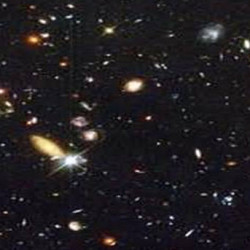
A deep space image showing numerous galaxies and stars scattered across the dark universe.

Dark Matter, Dark Energy, and the Accelerating Universe – Part 4/4 (Conclusion)

In the last post (part 3), I put forward a hypothesis why the space between galaxies expands. In summary, the galaxies drain energy from the vacuums of space to sustain their (i.e., the galaxies) existence. As energy is removed from the vacuums of space, so is mass (based on Einstein’s mass energy equivalence formula E = mc^2). With less energy/mass in the vacuums, the gravitational force defining the vacuum is diminished, which in turn causes the vacuum to expand.

The above hypothesis would explain the expansion of space between galaxies, but does not explicitly address the question: Why do the galaxies furthest from us appear to be moving away from us the fastest, even to the point of exceeding the speed of light?

To address the above question, let us assume we are located in the Milky Way galaxy, which is true, and we measuring the speed that another galaxy is moving away from us. Let us call our galaxy #1 (Milky Way) and the galaxy we are observing #2. From our point of reference, galaxy #2 is moving away from us, galaxy #1. However, what is really happening? Both galaxies, #1 and #2, are moving away from each other due to the expansion of space between them. Because we are considering our position in galaxy #1 fixed, it appears only galaxy #2 is moving away. For the sake of this example, let assume the velocity we measure for  galaxy #2 as it appears to be moving away from us is V1.

Next, let’s consider another galaxy, galaxy #3, that is more distant from us than galaxy #2. If we were on galaxy #2, we could measure the apparent velocity of galaxy #3 moving away from galaxy #2. Again, for the sake of this example, let us assume we measure it and its value is V2. However, from our position on galaxy #1, galaxy #2 is moving away from us at a velocity of V1 and galaxy #3 is moving away from us at the combine velocity of V1 +V2. Let assume the sum of V1 + V2 = V3. The observation of the velocity of galaxies moving away from us  will appear greater for galaxies further away from us. However, this is actually not true. If we were on galaxy #2,  we would measure galaxy #1 (Milky Way) moving away from us at the rate of V1 and galaxy #3 at the rate of V2. However, since we consider galaxy #1 (Milky Way) our fixed point of reference, we measure galaxy #2 moving away from us at a velocity of V1 and galaxy #3 moving away at a velocity of V3 (V1 + V2).  Using this simple example, we can argue that as the space between galaxies expands, from any fixed measuring point on any galaxy, the speed of galaxies moving away from our fixed measuring point will increase the further a galaxy is from our fixed measuring point.

If we consider the vastness of space and the billions (essentially uncountable) galaxies, from our fixed measuring point within the Milky Way galaxy, all galaxies will appear to be moving away from us (as the space between our galaxies expands) and the more distance a galaxy is from us, the faster it will appear to be moving away from us. The important word is the last sentence is “appear.” In reality all galaxies are moving away from each other at a velocity proportional to the expansion of space between the galaxies. However, from a fixed measuring point, the furthest galaxy from our measuring point would appear to be moving at sum of all galaxies we measure between us and the galaxy we measure  moving “away” from us. If there are billions of galaxies between us and the furthest galaxy, the sum of velocities could appear to exceed the speed of light, which would violate Einstein’s theory of special relativity.

Einstein’s theory of relativity is considered the “gold standard” among theories. It has stood scientific scrutiny for over one hundred years. According to Einstein’s theory of special relativity, no mass (for example a galaxy) can move faster than the speed of light. To get around this, current cosmology theories argue that it is the space between these distance galaxies that is expanding faster than the speed of light. However, they offer no reason why we should accept this hypothesis. In fact, it is illogical to argue that as we look at more distant galaxies, the space of those galaxies is expanding faster in proportion to the distance from our measuring point. My explanation above, removes this illogical premise and provides a relatively simple way to understand the phenomena.

As far as I know, this series of posts (parts 1-4), is the only body of work that explains and ties together the role of dark matter, the nature of dark energy and the accelerating universe. It is completely consistent with all observed phenomena and does not violate any known physical laws.


Universe's Accelerated Expansion

Dark Matter, Dark Energy, and the Accelerating Universe – Part 3/4

In the last two posts, we established five facts.  First,  the universe is expanding (i.e., the space between galaxies) and the expansion is accelerating. Second, there is no expansion of space within a galaxy. Third, science believes that the accelerating expansion of the universe is caused by a mysterious new force, dark energy. Fourth, it appears galaxies are glued together via another mysterious entity, dark matter. Lastly, dark matter only exists within a galaxy and not between galaxies. These facts have been confirmed and are widely accepted in the scientific community.

In the last post (part 2), I suggested that  a galaxy on a cosmic level acts essentially like a particle. This view of a galaxy as a particle is based on the observation that dark matter, which makes up over 90% of the matter of a galaxy, acts like a “glue” holding all the celestial bodies (stars, planets, etc.) in place. As odd as this may sound, most cosmologists accept this view of dark matter.  

Lastly, we asked the key question. What is really causing the space between these “particles” (i.e., galaxies) to expand. In other words, we are back to the question: What is dark energy? This post will endeavor to address that question. However, while the first two posts provided factual information, the nature of dark energy is speculative. This post will delineate my view, which has been published in my first book, Unraveling the Universe’s Mysteries, and in an article for the Huffington Post (https://www.huffingtonpost.com/louis-a-del-monte/dark-energy-explained_b_2853962.html). However, let me emphasize that this is my view (i.e., theory). While it has been published in both my books and in the Huffington Post, it has not be adequately peer reviewed. Therefore, you should treat this as a conjecture (i.e., an opinion). To delineate my view, I will quote (in part) from the article I published in the Huffington Post: 

In my book, I put forward a new theory that explains both the fundamental cause of time dilation and accelerating universe. I name the theory “The Existence Equation Conjecture.”

What is the Existence Equation Conjecture? It is a mathematical equation I derived using Einstein’s special theory of relativity and Minkowski space-time coordinates. It delineates the energy required for a mass to move in the fourth dimension of Minkowski space. Unfortunately, this sounds more like science fiction than science fact. In addition, all the scientific jargon tends to confuse the explanation. Rather than going through the derivation and experimental verification, which are in the appendices of my book, let me just get to the punch line. Here is the Existence Equation Conjecture:

KEX4 = -.3mc^2

Where KEX4 is the kinetic energy associated with an object’s movement in the fourth dimension of Minkowski space, m is the rest mass of an object, and c is the speed of light in a vacuum.

What does all this mean? The interpretation is speculative. With this caveat, I interpret the equation to imply that a mass requires energy to move in the fourth dimension of Minkowski space. Although, Einstein never called the fourth dimension time, it includes a time component, and I interpret the mass’ movement in the fourth dimension to equate to its existence. The equation is dimensionally correct (expressible in units of energy), but highly unusual from two standpoints. First, the kinetic energy is negative, which suggests a mass requires energy to move in the fourth dimension. Second, the amount of negative kinetic energy suggested by the equation is enormous. Although, the equation’s roots extend to special relativity, and it correlates well with experimental time dilation data, I termed it a conjecture. It requires further peer review and additional experimental verification.

If the Existence Equation Conjecture actually models the energy a mass needs to exist, how does this explain the accelerating universe? If correct, the amount of energy required for existence is enormous, and it has to come from somewhere. I looked at a number of potential candidates. In the end, I concluded the most likely candidate is the vacuum of space. We know from our experiments with vacuums in the laboratory that vacuums contain energy. An example of this is virtual particle production, which gives rise to the Casimir effect, where two closely spaced electrically neutral plates are pushed together in a vacuum. Although counter intuitive, a laundry list of effects demonstrates vacuums contain energy.

If we think of galaxies as masses, we can postulate to exist they are removing energy from the vacuums that surround them. We know from Einstein’s famous mass energy equivalence (E = mc^2), that removing energy is equivalent to removing mass. This suggests that as the mass/energy density decreases, the gravitational attraction within the vacuum decreases, which in turn causes the vacuum to expand.

While the Existence Equation Conjecture does mathematically express the energy required for a mass to move in time, how do we know it is correct? Here are some facts for consideration:

1. The derivation of the equation follows from Einstein’s special theory of relativity and its expression in Minkowski’s vector space. The derivation was first delineated in Appendix 1 of my book, Unraveling the Universe’s Mysteries (2012), and further refined in Appendix 2 of my book, How to Time Travel (2013).

2. Verification of the equation to accurately predict experimental time dilation results was provided in Appendix 2 of my book, Unraveling the Universe’s Mysteries (2012), and further discussed in Appendix 3 of my book, How to Time Travel (2013).

If you accept that the Existence Equation Conjecture is correct, it implies that existence, movement in time, continually requires energy. In a sense, this should not surprise us. Elementary physics teaches that a mass moving in three-dimensional space has kinetic energy. The energy to start the mass moving results in its kinetic energy. Intuitively, we should expect a mass moving in the fourth dimension of Minkowski space to also require energy. We already know from numerous time dilation experiments that adding significant kinetic energy to a mass. such as a muon (i.e., an unstable subatomic particle of the same class as an electron, but with a mass around 200 times greater), increases its decay time by more than an factor of ten (i.e., an order of magnitude). Many books on special and general relativity provide time dilation formulas, but do not explain the fundamental scientific mechanism. I judge, based on this work, that the fundamental mechanism is that existence requires energy and supplying energy to a mass will extend it life (i.e., dilate time).

The above discussion provides a theory why the space between galaxies expands. In summary, the galaxies drain energy from the vacuums of space to sustain their (i.e., the galaxies) existence. As energy is removed from the vacuums of space, so is mass (based on Einstein’s mass energy equivalence formula E = mc^2). With less energy/mass in the vacuums, the gravitational force defining the vacuum is diminished, which in turn causes the vacuum to expand.

As I said at the beginning of this post, the above is the result of my original research, published in my books and the Huffington Post. I welcome peer reviewed. However, until the Existence Equation Conjecture gains widespread scientific acceptance, I will continue to label it a conjecture (i.e., an opinion). In the next post, concluding this series, I will explain (my view) why galaxies more distant from us appear to be moving away from us the fastest.

dark matter

Dark Matter, Dark Energy, and the Accelerating Universe – Part 2/4

In the last post (part 1), we discussed the phenomenon of the accelerating universe, namely  that the universe is expanding and all galaxies are moving away from all other galaxies. Based on the paradigm of “cause and effect,” mainstream science argued a mysterious new force was causing the expansion. The force was named dark energy.

We also noted, that the accelerating universe was characterized by two unusual features:

1. The more distant a galaxy, the faster it is accelerating away from us.

2. There is no expansion of space occurring within a galaxy.

We ended the last post with questions: Why was there no expansion of space within a galaxy? Was the space between stars and other celestial bodies within our galaxy somehow different than the space between galaxies? In this post we will address those questions. Let’s start at the beginning.

In 1933, Fritz Zwicky (California Institute of Technology) made a crucial observation. He discovered the orbital velocities of galaxies were not following Newton’s law of gravitation (every mass in the universe attracts every other mass with a force inversely proportional to the square of the difference between them). They were orbiting too fast for the visible mass to be held together by gravity. If the galaxies followed Newton’s law of gravity, the outermost stars would be thrown into space. He reasoned there had to be more mass than the eye could see, essentially an unknown and invisible form of mass that was allowing gravity to hold the galaxies together. Zwicky’s calculations revealed that there had to be 400 times more mass in the galaxy clusters than what was visible. This is the mysterious “missing-mass problem.” It is normal to think that this discovery would turn the scientific world on its ear. However, as profound as the discovery turned out to be, progress in understanding the missing mass lags until the 1970s.

In 1975, Vera Rubin and fellow staff member Kent Ford, astronomers at the Department of Terrestrial Magnetism at the Carnegie Institution of Washington, presented findings that re-energized Zwicky’s earlier claim of missing matter. At a meeting of the American Astronomical Society, they announced the finding that most stars in spiral galaxies orbit at roughly the same speed. They made this discovery using a new, sensitive spectrograph (a device that separates an incoming wave into a frequency spectrum). The new spectrograph accurately measured the velocity curve of spiral galaxies. Like Zwicky, they found the spiral velocity of the galaxies was too fast to hold all the stars in place. Using Newton’s law of gravity, the galaxies should be flying apart, but they were not. Presented with this new evidence, the scientific community finally took notice. Their first reaction was to call into question the findings, essentially casting doubt on what Rubin and Ford reported. This is a common and appropriate reaction, until the amount of evidence (typically independent verification) becomes convincing.

In 1980, Rubin and her colleagues published their findings (V. Rubin, N. Thonnard, W. K. Ford, Jr, (1980). “Rotational Properties of 21 Sc Galaxies with a Large Range of Luminosities and Radii from NGC 4605 (R=4kpc) to UGC 2885 (R=122kpc).” Astrophysical Journal 238: 471.). It implied that either Newton’s laws do not apply, or that more than 50% of the mass of galaxies is invisible. Although skepticism abounded, eventually other astronomers confirmed their findings. The experimental evidence had become convincing. “Dark matter,” the invisible mass, dominates most galaxies. Even in the face of conflicting theories that attempt to explain the phenomena observed by Zwicky and Rubin, most scientists believe dark matter is real. None of the conflicting theories (which typically attempted to modify how gravity behaved on the cosmic scale) was able to explain all the observed evidence, especially gravitational lensing (the way gravity bends light).

Currently, the scientific community believes that dark matter is real and abundant, making up as much as 90% of the mass of the universe. However, the nature of dark matter itself is still a mystery. Just what is this mysterious substance that appears to glue a galaxy together?

The most popular theory of dark matter is that it is a slow-moving particle. It travels up to a tenth of the speed of light. It neither emits nor scatters light. In other words, it is invisible. However, its effects are detectable, as I will explain below. Scientists call the mass associated with dark matter a “WIMP” (Weakly Interacting Massive Particle).

For years, scientists have been working to find the WIMP particle to confirm dark matter’s existence. All efforts have been either unsuccessful or inconclusive. The Department of Energy Fermi National Accelerator Laboratory Cryogenic Dark Matter Search (CDMS) experiment is ongoing, in an abandoned iron mine about a half mile below the surface, in Soudan, Minnesota. The Fermilab is a half mile under the earth’s surface to filter cosmic rays so the instruments are able to detect elementary particles without the background noise of cosmic rays. In 2009, they reported detecting two events that have characteristics consistent with the particles that physicists believe make up dark matter. They may have detected the WIMP particle. However, they are not making that claim at the time of this writing. The Fermilab stopped short of claiming they had detected dark matter because of the strict criteria that they have self-imposed, specifically there must be less than one chance in a thousand that the event detected was due to a background particle. The two events, although consistent with the detection of dark matter, do not pass that test. Where does that leave us? To date, we are without conclusive evidence that the WIMP exists.

Does the WIMP particle exist? Consider the facts.

1)   The Standard Model of particle physics does not predict a WIMP particle. The Standard Model, refined to its current formulation in the mid-1970s, is one of science’s greatest theories. It successfully predicted bottom and top quarks prior to their experimental confirmation in 1977 and 1995, respectively. It predicted the tau neutrino prior to its experimental confirmation in 2000, and the Higgs boson prior to its experimental confirmation in 2012. Modern science holds the Standard Model in such high regard that a number of scientists believe it is a candidate for the theory of everything. Therefore, it is not a little “hiccup” when the Standard Model does not predict the existence of a particle. It is significant, and it might mean that the particle does not exist. However, to be totally fair, the Standard Model has other issues. For example, it doesn’t explain gravity. Because of these issues, numerous variations of the Standard Model have been proposed, but none have gained wide acceptance.

2)   All experiments to detect the WIMP particle have to date been unsuccessful, including considerable effort by Stanford University, University of Minnesota, and Fermilab.

That is all the evidence we have. Where does this leave us? The evidence is telling us the WIMP particle might not exist. We have spent about ten years, and unknown millions of dollars, which so far leads to a dead end. This appears to beg a new approach.

To kick off the new approach, consider the hypothesis that dark matter is a new form of energy. We know from Einstein’s mass-energy equivalence equation (E = mc2), that mass always implies energy, and energy always implies mass. For example, photons are massless energy particles. Yet, gravitational fields influence them, even though they have no mass. That is because they have energy, and energy, in effect, acts as a virtual mass.

If dark matter is energy, where is it and what is it? Consider these properties of dark-matter energy:

  • It is not in the visible spectrum, or we would see it.
  • It does not strongly interact with other forms of energy or matter.
  • It does exhibit gravitational effects, but does not absorb or emit electromagnetic radiation.

Based on these properties, we should consider M-theory (the unification of string theories discussed in previous posts). Several prominent physicists, including one of the founders of string theory, Michio Kaku, suggest there may be a solution to M-theory that quantitatively describes dark matter and cosmic inflation. If M-theory can yield a superstring solution, it would go a long way to solving the dark-matter mystery. I know this is like the familiar cartoon of a scientist solving an equation where the caption reads, “then a miracle happens.” However, it is not quite that grim. What I am suggesting is a new line of research and theoretical enquiry. I think the theoretical understanding of dark matter lies in M-theory. The empirical understanding lies in missing-matter experiments.

What is a missing-matter experiment? Scientists are performing missing-matter experiments as you read this post. They involve high-energy particle collisions. By accelerating particles close to the speed of light, and causing particle collisions at those speeds, they account for all the energy and mass pre- and post-collision. If any energy or mass is missing post-collision, the assumption would be it is in one of non-spatial dimensions predicted by M-theory.

Why would this work? M-theory has the potential to give us a theoretical model of dark matter, which we do not have now. Postulating we are dealing with new unknown form of energy would explain why we have not found the WIMP particle. Postulating that the energy resides in the non-spatial dimensions of M-theory would explain why we cannot see or detect it. Real-world phenomena take place in the typical three spatial dimensions and one temporal dimension. If dark matter is in a different dimension, it cannot interact with “real”-world phenomena, except to exhibit gravity. Why is dark matter able to exhibit gravity? That is still a mystery, as is gravity itself. We have not been able to find the “graviton,” the mysterious particle of gravity that numerous particle physicists believe exists. Yet, we know gravity is real. It is theoretically possible that dark matter (perhaps a new form of energy) and gravity (another form of energy) are both in a different dimension. This framework provides an experimental path to verify some of the aspects of M-theory and the existence of dark matter (via high-energy particle collisions).

Although dark matter is a mystery, we know from scientific observation it is real. Without dark matter our galaxy would fly apart. In fact, dark matter makes up most of the mass of a galaxy, over 90%. In a sense, you can think of a galaxy similar to the way we think of an atom. An atom can act like a single particle, an entity unto itself. However, we know the atom is composed of subatomic particles, like electrons, protons and neutrons. We also know that some of those particles are composed of other subatomic particles, which I will not go into detail here. The point is a galaxy may act on a cosmic scale as though it is particle, similar to an atom, with subatomic particles we call stars, planets and other celestial bodies. I know this is mind boggling, but it fits the observable evidence. It provides insight into the difference regarding space between galaxies and the space within a galaxy. It is consistent with our observations of the accelerated expansion of the universe.

Let us summaries our understanding from the first two post. First, the universe is expanding and the expansion is accelerating. Second, there is no expansion of space within a galaxy. Third, science believes that the accelerating expansion of the universe is caused by a mysterious new force, dark energy. Fourth, it appears galaxies are glued together via another mysterious entity, dark matter. Lastly, dark matter only exists within a galaxy and not between galaxies.

If we are willing to accept that a galaxy on a cosmic level acts essentially like a particle, as discuss above, we are still left with a mystery. What is really causing the space between these “particles” (i.e., galaxies) to expand. In other words, we are back to the question: What is dark energy? In the next post we will discuss a new theory, first proposed in my book Unraveling the Universe’s Mysteries, that seeks to explain the fundamental nature of dark energy.