Category Archives: Universe Mysteries

M-theory

Are There Any Real Time Machines? Part 2/2 (Conclusion)

Are there any real time machines?

In my opinion, we are in about the same place space travel was at the beginning of the twentieth century. At the beginning of the twentieth century, all we knew about space travel came from science fiction. We knew that birds could fly, and this observation provided hope that human air flight would eventually be possible. However, at this point we could only fly using balloons, which was a long way from controlled air flight. We knew about projectiles, such as cannonballs and simple rockets, and this provided hope that one day humankind would be able to travel into space. However, at the beginning of the twentieth century we were still three years away from building the first successful airplane. The first successful airplane did not come from a well-respected theory or formal scientific investigation. Most early attempts at air flight tended to focus on building powerful engines, or they attempted to imitate birds. The early attempts at air flight were dismal failures. The first successful heavier-than-air machine, the airplane, was invented in 1903 by two brothers, Orville and Wilbur Wright. They were not scientists, nor did they publish a scholarly paper in a scientific journal delineating their plans. Quite the contrary, the two brothers had a background in printing presses, bicycles, motors, and other machinery. Clearly, their background would not suggest they would invent the first airplane and lead humankind into space. However, their experience in machinery enabled them to build a small wind tunnel and collect the data necessary to sustain controlled air flight. From the beginning, the Wright brothers believed that the solution to controlled air flight lay hidden in pilot controls, rather than powerful engines. Based on their wind tunnel work, they invented what is now the standard method of all airplane controls, the three-axis control. They also invented efficient wing and propeller designs. It is likely that many in the scientific community in the beginning of the twentieth century would have considered aeronautics similar to the way the scientific community in the early part of the twenty-first century considers time travel—still something outside the fold of legitimate science. However, on December 17, 1903, at a small, remote airfield in Kitty Hawk, North Carolina, the two brothers made the first controlled, powered, and sustained heavier-than-air human flight. They invented the airplane. It was, of course, humankind’s first step into the heavens.

I believe the invention of the airplane is a good analogy to where we are regarding time travel. We have some examples, namely, time dilation data, and a theoretical basis that suggests time travel is potentially real. However, we have not reached the “Kitty Hawk” moment. If Dr. Mallett makes his time machine work, and that is a big “if,” numerous physicists will provide the theoretical foundation for its success, essentially erasing any errors that Dr. Mallett may have made in his calculations. He will walk as another great into the history of scientific achievement.

My point is a simple one. The line between scientific genius and scientific “crank” is a fine one. When Einstein initially introduced his special theory of relativity in 1905, he was either criticized or ignored. Few in the scientific community appreciated and understood Einstein’s special theory of relativity in 1905. It took about fifteen years for the scientific community to begin to accept it. Einstein was aware of the atmosphere that surrounded him. In 1919, he stated in the Times of London, “By an application of the theory of relativity to the taste of readers, today in Germany I am called a German man of science, and in England I am represented as a Swiss Jew. If I come to be represented as a bête noire, the descriptions will be reversed, and I shall become a Swiss Jew for the Germans and a German man of science for the English!”

Dr. Mallett is on record predicting a breakthrough in backward time travel within a decade. Only time and experimental evidence will prove if his prediction becomes reality. Even if the Mallett time machine works, it would still represent only a baby step. We would still be a long way from human time travel, but we would be one step closer.

Source: How to Time Travel (2013), Louis A. Del Monte
science of time & time dilation

Are There Any Real Time Machines? Part 1/2

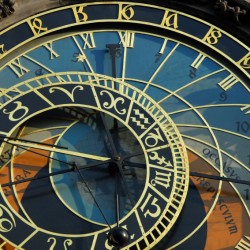
There are no existing time machines capable of sending humans forward or backward in time. The closest we have come to time travel is using particle accelerators to cause subatomic particles to experience time dilation (i.e., forward time travel). There is a significant amount of time dilation data available. Particle accelerators succeed in achieving time dilation by accelerating subatomic particles close to the speed of light. Unfortunately, though, backward time travel has no similar body of experimental data. The major problems with creating backward time travel appear to fall into three categories:

  1. Backward time travel appears to require negative energy, based on arguments made by American theoretical physicist Kip Thorne and British theoretical physicist/cosmologist Stephen Hawking. Many in the scientific community acknowledge that negative energy likely exists, and point to the Casimir effect, discussed previously, as an example in nature. However, today’s science is unable to harness negative energy in any meaningful way to make a time machine.
  2. Many in the scientific community, like physicists Dr. Olum and Dr. Everett, believe the amount of energy required to twist space sufficiently for spacetime manipulation and enable Dr. Mallett’s time machine to work is enormous. Conceptually, we may be talking about the amount of energy provided by a star, similar to our own sun. Harnessing this level of energy is far beyond today’s science. Science’s best efforts to study high-energy physics has to date been confined to particle accelerators, such as the Large Hadron Collider. There is no experimental evidence that Dr. Mallett has succeeded in manipulating spacetime.
  3. Many in the scientific community are concerned with causality violations, especially regarding backward time travel. However, as we learned in the section titled “Twisting the arrow of time,” there can also be causality violations regarding forward time travel. The causality violations are generally termed “time travel paradoxes,” which we will discuss in detail in the next chapter.

Having made the above points, I think it is important to point out that some physicists believe subatomic antimatter particles travel in the opposite direction in time (i.e., backward in time) versus their matter counterparts. For example, some physicists assert that positrons, the antimatter equivalent of electrons, travel backward in time, while electrons travel forward in time. In solid-state physics, if we consider a current flowing in a semiconductor, electrons in a semiconductor move as a current in one direction, while the “holes” (i.e., the position the electron occupied in the semiconductor, which becomes vacant when the electron moves as a current) move in the opposite direction. Physicists differ on whether the “holes” represent positrons (i.e., actual physical antimatter particles). I mention this for completeness. There is no scientific consensus that antimatter travels backward in time.

Where does this leave us? I think this question deserves a complete answer. Stay tuned for part 2.

Source: How to Time Travel (2013), Louis A. Del Monte
A bright comet with a glowing white nucleus and a blue-green tail streaks across a starry night sky.

Ten Key Facts About Comets

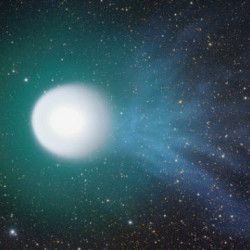
Comets are sometimes called “dirty snowballs” or “snowy dirtballs.”  There is a lot we don’t know about comets, but here are ten facts we do know:

  1. Comets orbit the Sun, similar to the way planets in our solar system orbit the Sun.
  2. Comets contain dust, ice, carbon dioxide, ammonia and methane originating from the early formation of the solar system (about 4.5 billion years ago).
  3. Comets are  are generally thought to come from two areas – 1) the Oort Cloud and 2) the Kuiper Belt. Both areas are in the outer regions of our solar system. These are areas containing materials left over from the formation of our solar system, which have condensed into icy objects. Although these regions extend beyond the orbits of planets in our solar system, they are still considered part of our solar system.
  4. Comet have elliptical orbits, which brings them close to the sun and takes them far away.
  5. Comets have obits around the Sun that range at the extremes from about 20 years to 200 years. Comets with obits between the extremes are called Halley-type comets.
  6. Comets have three parts:
    1. The nucleus, which is the solid center component made of ice, gas and rocky debris
    2. The coma, the gas and dust atmosphere around the nucleus, which results when the Sun heats the comet’s surface
    3. The tails, which are formed when energy from the Sun turns the coma so that it flows around the nucleus and forms a fanned out tail behind it. Comet tails can extend millions of miles and point away from the Sun, not the direction the comet is moving
  7. We are able to see a comet’s coma and tail when the sunlight reflects off the dust and when it excites some molecules so that they form a bluish tail called an ion tail and a yellow one made of neutral sodium atoms.
  8. Comets range in size from less than 1 km (about 3000 feet) in diameter to as much as 300 km (over 186 miles) in diameter.
  9. A a comet could impact Earth. It is important to understand the nature of comets so we can design better methods to protect ourselves should a large one be on a collision path with Earth.
  10. From NASA’s Deep Impact mission (2005) with the Tempel 1 comet, we now know:
    • The comet’s nucleus is spongy, with holes inside
    • Parts of the surface are fragile and weak
    • The surface of the nucleus is covered with fine dust, like baby powder
    • The surface is composed of carbon-based black material
    • Some parts of the nucleus are smooth and young (likely due to the Sun melting effects), while other areas are cratered and old (likely due to celestial impacts)
    • The nucleus seems to have formed from overlapping layers of different materials, similar to the way the Earth is formed in layers of different materials
    • There is water ice just below the surface and carbon dioxide ice (also known as “dry ice”) farther down
    • The Tempel 1 comet contains materials from the outer, middle, and inner parts of the solar system. We are not sure why or how this occurred

One last point: Comets lose ice and dust each time they come near the sun, leaving behind trails of debris. Eventually, they can lose all their ices, with some turning into fragile, inactive objects similar to asteroids.

Sources:

1) Comets: “Formation, Discovery and Exploration,” by Charles Q. Choi, SPACE.com Contributor, November 15, 2010

2) https://solarsystem.nasa.gov/deepimpact/educ/CometFacts.html

3) https://www.wisegeek.org/what-is-the-difference-between-a-comet-and-a-meteor.htm

Image: Wikimedia Commons – Comet Holmes (17P/Holmes) in 2007, showing blue ion tail on right

A black and white aerial image showing a rough, cratered surface with several raised mounds or small hills.

Life on Mars? NASA News Conference January 24, 2014

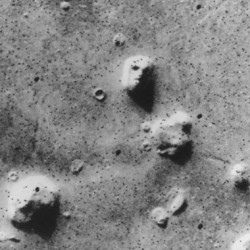
Is there or has there been life on Mars? Conspiracy theorists say yes and that NASA is covering it up. Often, conspiracy theorists argue that Mars photos (taken by NASA), such as the face on Mars, Pyramids on Mars, and a photo of what appears to be an ape like figure sitting on a rock are proof of a past civilization. While mainstream science debunks these photos as “tricks of light,” they have also admitted that they believe liquid oceans once covered the surface of Mars before its magnetic field disappeared. Did those ancient oceans harbor life?

NASA’s Opportunity rover, one of NASA’s twin Mars Exploration Rovers, reached the Red Planet Jan. 24, 2004 (PST), and has continued to transmit valuable scientific data. It landed three weeks after its twin, named Spirit. Both rovers made important discoveries that suggests a wet environment may have once existed on Mars, and that environment could have supported microbial life on ancient Mars. Spirit stopped communicating in 2010, but Opportunity continues to communicate with Earth.

According to NASA’s Jet Propulsion Laboratory, “NASA will reflect on the rover’s work in a news conference at 11 a.m. PST (2 p.m. EST) Thursday, Jan. 23, 2014.

The event will originate from NASA’s Jet Propulsion Laboratory in Pasadena, Calif., and be carried live on NASA Television and streamed online.

Participants will be: — Michael Meyer, lead scientist, Mars Exploration Program, NASA Headquarters, Washington — Ray Arvidson, Mars Exploration Rovers deputy principal investigator, Washington University, St. Louis, Mo. — John Callas, Mars Exploration Rovers project manager, JPL — Steve Squyres, Mars Exploration Rovers principal investigator, Cornell University, Ithaca, N.Y.”

Will we get an irrefutable answer to the question of life on Mars? Let’s tune in on the news conference and find out.

Sources: NASA JPL Website: https://www.jpl.nasa.gov/news/news.php?release=2014-018

Image: Wikimedia Commons – Small part of the Cydonia region, taken by the Viking orbiter and released by NASA/JPLon July 25, 1976

A digital blue background with glowing horizontal lines and light flares creating a futuristic effect.

The Mysterious Nature of Light

To almost everyone, there is nothing mysterious about light. In fact, the opposite is true. When we are in the dark and mystery abounds, the first thing we do is turn on the lights. So, why is “The Mysterious Nature of Light” the title of this post?

The first thing that makes light mysterious is that it can exhibit both the properties of a wave and a particle. For all of the Nineteenth Century, and for the early part of the Twentieth Century, most scientists considered light “a wave,” and most of the experimental data supported that “theory.” However, classical physics could not explain black-body radiation (the emission of light due to an object’s heat). A light bulb is a perfect example of black-body radiation. The wave theory of light failed to describe the energy (frequency) of light emitted from a black body. The energy of light is directly proportional to its frequency. To understand the concept of frequency, consider the number of ocean waves that reach the shore in a given length of time. The number of ocean waves than reach the shore, divided by the length of time you measure them, is their frequency. If we consider the wave nature of light, the higher the frequency, the higher the energy.

In 1900, Max Planck hypothesized that the energy (frequency) of light emitted by the black body, depended on the temperature of the black body. When the black body was heated to a given temperature, it emitted a “quantum” of light (light with a specific frequency). This was the beginning of Quantum Mechanics. Max Planck had intentionally proposed a quantum theory to deal with black-body radiation. To Planck’s dismay, this implied that light was a particle (the quantum of light later became known as the photon in 1925). Planck rejected the particle theory of light, and dismissed his own theory as a limited approximation that did not represent the reality of light. At the time, most of the scientific community agreed with him.

If not for Albert Einstein, the wave theory of light would have prevailed. In 1905, Einstein used Max Planck’s black-body model to solve a scientific problem known as the photoelectric effect. In 1905, the photoelectric effect was one of the great unsolved mysteries of science. First discovered in 1887 by Heinrich Hertz, the photoelectric effect referred to the phenomena that electrons are emitted from metals and non-metallic solids, as well as liquids or gases, when they absorb energy from light. The mystery was that the energy of the ejected electrons did not depend on the intensity of the light, but on its frequency. If a small amount of low-frequency light shines on a metal, the metal ejects a few low-energy electrons. If an intense beam of low-frequency light shines on the same metal, the metal ejects even more electrons. However, although there are more of them, they possess the same low energy. To get high-energy electrons, we need to shine high-frequency light on the metal. Einstein used Max Planck’s black-body model of energy, and postulated that light, at a given frequency, could solely transfer energy to matter in integer (discrete number) multiples of energy. In other words, light transferred energy to matter in discrete packets of energy. The energy of the packet determines the energy of the electron that the metal emits. This revolutionary suggestion of quantized light solved the photoelectric mystery, and won Einstein the Nobel Prize in 1921. You may be surprised to learn that Albert Einstein won the Nobel Prize for his work on quantizing light—and not on his more famous theory of relativity.

The second property of light that makes it mysterious is its speed in a vacuum. The speed of light in a vacuum sets the speed limit in the universe. Nothing travels faster than light in a vacuum. In addition, this is a constant, independent of the speed of the source emitting the light. This means that the light source can be at rest or moving, and the speed of light will always be the same in a vacuum. This is counterintuitive. If you are in an open-top convertible car speeding down the highway, and your hat flies off, it begins to move at the same speed as the car. It typically will fall behind the car due to wind resistance that slows down its speed. If you are in the same car, and throw a ball ahead of the car, its velocity will be equal to the speed of the car, plus the velocity at which you throw it. For example, if you can throw a ball sixty miles per hour and the car is going sixty miles per hour, the velocity of the ball will be one hundred twenty miles per hour. This is faster than any major league pitcher can throw a fastball. Next, imagine you are in the same car and have a flashlight. Whether the car is speeding down the highway or parked, the speed of light from the flashlight remains constant (if we pretend the car is in a vacuum). The most elegant theory of all time, Einstein’s special theory of relativity, uses this property of light as a fundamental pillar in its formulation.

  • Why does light have a wave-particle duality?
  • Why is the speed of light in a vacuum the upper limit of anything we observe in the universe?
  • Why is the speed of light a constant independent of the movement of the source emitting the light?

No one knows. We learned an enormous amount about light in the last hundred years. We know it is composed of photons (packets of energy) that have no mass, and when emitted instantaneously, they travel at exactly 299,792,458 meters per second—about 186,000 miles per second. This means they do not accelerate to that speed. They instantaneously exist at that speed. We know the speed of light is a constant independent of the velocity of the source that emits the light. Lastly, we know photons can exhibit the properties of a wave and a particle. The one thing we do not know is “why.”

Reference: Unraveling the Universe’s Mysteries, available at Amazon.com