All posts by admin

Abstract digital art featuring a radiant white light at the center surrounded by intricate geometric patterns and electric green lines.

Where Is the Missing Antimatter? Part 1/2

Where Is the Missing Antimatter? One of the great mysteries of our universe, and a weakness of the Big Bang theory, is that matter, not antimatter, totally makes up our universe. According to the Big Bang theory, there should be equal amounts of matter and antimatter. If there were any quantities of antimatter in our galaxy, we would see radiation emitted as it interacted with matter. We do not observe this. It is natural to ask the question: where is the missing antimatter? (Recall, that antimatter is the mirror image of matter. For example, if we consider an electron matter, the positron is antimatter. The positron has the same mass and structure as an electron, but the opposite charge. The electron has a negative charge, and the positron has a positive charge. Antimatter bears no relationship to dark matter. (Dark matter is discussed in other posts.)

Several theories float within the scientific community to resolve the missing antimatter issue. The currently favored theories (baryogenesis theories) employ sub-disciplines of physics and statistics to describe possible mechanisms. The baryogenesis theories start out with the same premise, namely the early universe had both baryons (an elementary particle made up of three quarks) and antibaryons (the mirror image of the baryons). At this point, the universe underwent baryogenesis. Baryogenesis is a generic term for theoretical physical processes that produce an asymmetry (inequality) between matter and antimatter. The asymmetry, per the baryogenesis theories, resulted in significant amounts of residual matter, as opposed to antimatter. The major differences between the various baryogenesis theories are in the details of the interactions between elementary particles. Baryogenesis essentially boils down to the creation of more matter than antimatter. In other words, it requires the physical laws of the universe to become asymmetrical. We need to understand what this means.

The symmetry of physical laws is widely accepted by the scientific community. What does “symmetry” mean in this context?

  • First, it means that the physical laws do not change with time. If a physical law is valid today, it continues to be valid tomorrow, and any time in the future. This is a way of saying that a time translation of a physical law will not affect its validity.
  • Second, it means that the physical laws do not change with distance. If the physical law is valid on one side of the room, it is valid on the other side of the room. Therefore, any space translation of a physical law will not affect its validity.
  • Lastly, it means that the physical laws do not change with rotation. For example, the gravitational attraction between two masses does not change when the masses rotate in space, as long as the distance between them remains fixed. Therefore, any rotational translation of a physical law will not affect its validity.

This is what we mean by the symmetry of physical laws.

Next, we will address the asymmetry of physical laws. In this context, “asymmetry” means that the symmetry of physical laws no longer applies. For example, a law of physics may be valid in a specific location, but not in another, when both locations are equivalent. Is this possible? Maybe. There has been experimental evidence that the asymmetry is possible (a violation of the fundamental symmetry of physical laws). For example, radioactive decay and high-energy particle accelerators have provided evidence that asymmetry is possible. However, the evidence is far from conclusive. Most importantly, it does not fully explain the magnitude of the resulting matter of the universe.

This casts serious doubt on the baryogenesis theories. In addition, the baryogenesis theories appear biased by our knowledge of the outcome. By making certain (questionable) assumptions, and using various scientific disciplines, they result in the answer we already know to be true. The universe consists of matter, not antimatter. Therefore, baryogenesis theories may not be an objective explanation. However, apart from the Big Bang Duality theory, it is science’s best theory of the missing antimatter dilemma.

The Big Bang Duality theory provides a simpler explanation, which does not violate the fundamental symmetry of physical laws. From this viewpoint, it deserves consideration, and we will discuss it in Part 2.

This post is based on material from my book, Unraveling the Universe’s Mysteries (2012)
A row of black server racks with multiple network cables and hardware components in a data center.

Are We All Just Trapped in a Self-Conscious Supercomputer?

Are We All Just Trapped in a Self-Conscious Supercomputer?

Two words: Artificial Intelligence. Most people have heard about it. Perhaps you have read science-fiction books or seen science-fiction movies about it. What is it in the ideal fictional case? A computer that is able to learn and adapt on its own. If it becomes self-aware, it can legitimately be considered another life form or even another universe.

Science fiction? No! Look at real-life results from the last 15 years.

In 1997, IBM’s chess-playing computer “Deep Blue” became the first computer to beat world-class chess champion, Garry Kasparov. In a six-game match, Deep Blue prevailed by two wins to one with three draws. Until this point, no computer was able to beat a chess grandmaster. This garnered headlines worldwide, and was a milestone that embedded the reality of artificial intelligence into the consciousness of the average person.

In 2005, a robot conceived and developed at California’s Stanford University, was able to drive autonomously for 131 miles along an unrehearsed desert trail, winning the DARPA Grand Challenge (the government’s Defense Advanced Research Projects Agency prize for a driverless vehicle).

In 2007, Carnegie Mellon University’s self-driving SUV called Boss made history by swiftly and safely driving 55 miles in an urban setting while sharing the road with human drivers. It, too, won the DARPA Urban Challenge.

In 2011, on an exhibition match on the popular TV quiz show, Jeopardy! , IBM’s computer “Watson,” defeated both of Jeopardy! greatest champions, Brad Rutter and Ken Jennings.

Today, we take artificial intelligence (AI) for granted. For example, computers and even smart phones have sophisticated chess-playing software. AI is part of the Xbox 360’s algorithms for games. However, have we reached the point where a computer replicates a human mind? Not yet. One test held as the “gold standard” for this is the Turing test, proposed in 1950 by Alan Turing, an English mathematician, logician, cryptanalyst, and computer scientist. Turing is widely acknowledged as the father of computer science and artificial intelligence. In fact, Turing developed an electromechanical machine during WWII that helped break the German Enigma machine’s code. The Turing test, which a computer must pass to demonstrate the computer replicates the human mind. The test requires that a machine (for example, a computer with voice synthesis) carry on a conversation with a human, and that other humans are able to hear the conversation (and not see the participants), and cannot distinguish the machine from the human.

Apple’s Seri application for the iPhone is a small step in that direction. If you see Apple’s TV commercials, people are talking to their phones, and phones are talking back. The conversations consist of the phone owners asking questions or giving simple commands to their iPhones. The commercial makes it appear that the iPhone passes the Turing test, but in reality, the conversations are limited to simple questions and simple commands. However, imagine what conversations with the iPhone will be like in about 20 years. The iPhone, and smart phones like it, will almost certainly pass the Turing test.

How close are we to a true artificial life form (similar to Lt. Commander Data in Star Trek: The Next Generation)? Most scientists believe we are extremely close. In fact, Ray Kurzweil (American author, scientist, inventor and futurist) has used Moore’s law to calculate that desktop computers will be equivalent to human brains by the year 2029. Moore’s law states the number of transistors that can be placed inexpensively on an integrated circuit doubles approximately every two years. By 2045, Kurzweil predicts, artificial intelligence will be able to improve itself faster than anything we can conceive. If this is true, by the mid Twenty-First Century, we may appear no smarter than insects to those machines. This is sometimes the theme of “how-will-the-world-end” type of documentaries, science-fiction books and movies. This is the whole premise behind the popular Terminator movies.

Now, we will return to our main point of a supercomputer universe. If indeed, computers one day will replicate a human mind, one can postulate that with time, it can replicate millions and eventually billions of such minds, each with its own self-awareness and personality. The minds inside the “machine” think they are real, and are in a universe. As more time passes, the machine can create another “universe.” This scenario can continue forever, or until an unknown entity pulls the plug.

Could we be those people (minds inside a computer)? If you have a religious belief in a supreme being, in effect, we are those people in God’s computer. If you do not hold religious beliefs, we could be those people in a race of advanced aliens’ computer. In this scenario, a supernatural being or technology-advanced aliens gave the command to begin our existence. The command was simply, “Let there be light,” and the super-computer program, simulating our existence and reality, began to run. If this is true, do we exist? The answer to that question depends on your viewpoint. We do not exist in the way we think we exist. We are all part of a sophisticated computer program in a supercomputer. If this is our reality, we are trapped in a supercomputer capable of replicating human minds, and imposing the construct of a universe on those minds.

At this point, I am going back to Occam’s razor, namely, the simplest of two competing theories is to be preferred. With that as my guiding premise, I postulate our universe is real (exactly the way we experience it), we are real, and this post is real.

Source: Unraveling the Universe’s Mysteries (2012) Louis A. Del Monte
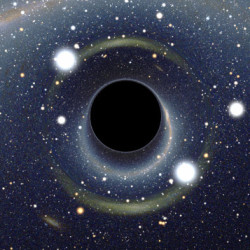
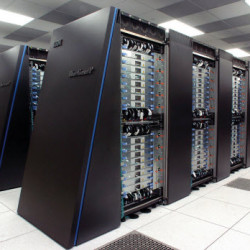
Image: Wikimedia Commons – The Blue Gene/P supercomputer at Argonne National Labruns over 250,000 processors using normal data center air conditioning, grouped in 72 racks/cabinets connected by a high-speed optical network


A black hole in space surrounded by stars and a glowing gravitational lensing effect.

Using a Black Hole to Time Travel!

Using a black hole to time travel!

What is a black hole? A black hole is a point in space where gravity pulls so much that not even light can escape. We cannot see black holes, but we can infer their existence by how they influence stars around them.

There are numerous types of black holes. Some are small, about the size of an atom. Yet, they can have a mass equal to a mountain. Some are supermassive, like the black hole theorized to exist at the center of our galaxy, a mere twenty-six thousand light-years from us. It is the single heaviest object in our galaxy. In between the atom-size black holes and the supermassive black holes are the “stellar” black holes. They are roughly up to twenty times the mass of our sun.

You may wonder: How do black holes form? Physicists think that the atom-size black holes formed during the early stages of the big bang, and that the supermassive black holes formed when the galaxies formed. Physicists also think the stellar black holes form when a star dies and collapses on itself.

What makes a black hole interesting from the standpoint of time travel is that the gravitational attraction is so great that time dilation due to gravity (as predicted by Einstein’s general theory of relativity) would be enormous. In fact, a supermassive black hole, like the one at the center of our galaxy, would slow down time far more than anything else in the galaxy would. This makes a black hole a natural type of time machine.

You may worry that a black hole may swallow the Earth. However, I have good news for you. Black holes do not move around, and there are none close to the Earth. In short, we do not have to worry about being swallowed by a black hole.

Is there any practical way to use a black hole as a time machine? The answer is no, not via today’s science. The scientists at CERN using the Large Hadron Collider are attempting to make small black holes. Perhaps, in time, they will succeed, and we will be able to use its properties as a time machine. This, however, is speculation.

This material is from my new book, How to time Travel (2013).

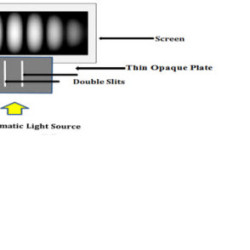
Diagram of a double-slit experiment setup with light source, thin opaque plate, double slits, and screen.

A Classic Time Travel Paradox – Double-Slit Experiment Demonstrates Reverse Causality!

Almost the entire scientific community has held for hundreds of years that for every effect, there must have been a cause. Another way of saying this is cause precedes effect. For example, if you hit a nail with a hammer (the cause), you can drive it deeper into the wood (the effect). However, some recent experiments are challenging that belief. We are discovering that what you do after an experiment can influence what occurred at the beginning of the experiment. This would be the equivalent of the nail going deeper into the wood prior to it being hit by the hammer. This is termed reversed causality. Although, there are numerous new experiments that illustrate reverse causality, science has been struggling with a classical experiment called the “double-slit” that illustrates reverse causality for well over half a century.

There are numerous versions of the double-slit experiment. In its classic version, a coherent light source, for example a laser, illuminates a thin plate containing two open parallel slits. The light passing through the slits causes a series of light and dark bands on a screen behind the thin plate. The brightest bands are at the center, and the bands become dimmer the farther they are from the center. See image below to visually understand this.

The series of light and dark bands on the screen would not occur if light were only a particle. If light consisted of only particles, we would expect to see only two slits of light on the screen, and the two slits of light would replicate the slits in the thin plate. Instead, we see a series of light and dark patterns, with the brightest band of light in the center, and tapering to the dimmest bands of light at either side of the center. This is an interference pattern and suggests that light exhibits the properties of a wave. We know from other experiments—for example, the photoelectric effect (see glossary), which I discussed in my first book, Unraveling the Universe’s Mysteries—that light also exhibits the properties of a particle. Thus, light exhibits both particle- and wavelike properties. This is termed the dual nature of light. This portion of the double-slit experiment simply exhibits the wave nature of light. Perhaps a number of readers have seen this experiment firsthand in a high school science class.

The above double-slit experiment demonstrates only one element of the paradoxical nature of light, the wave properties. The next part of the double-slit experiment continues to puzzle scientists. There are five aspects to the next part.

  1. Both individual photons of light and individual atoms have been projected at the slits one at a time. This means that one photon or one atom is projected, like a bullet from a gun, toward the slits. Surely, our judgment would suggest that we would only get two slits of light or atoms at the screen behind the slits. However, we still get an interference pattern, a series of light and dark lines, similar to the interference pattern described above. Two inferences are possible:
    1. The individual photon light acted as a wave and went through both slits, interfering with itself to cause an interference pattern.
    2. Atoms also exhibit a wave-particle duality, similar to light, and act similarly to the behavior of an individual photon light described (in part a) above.
  2. Scientists have placed detectors in close proximity to the screen to observe what is happening, and they find something even stranger occurs. The interference pattern disappears, and only two slits of light or atoms appear on the screen. What causes this? Quantum physicists argue that as soon as we attempt to observe the wavefunction of the photon or atom, it collapses. Please note, in quantum mechanics, the wavefunction describes the propagation of the wave associated with any particle or group of particles. When the wavefunction collapses, the photon acts only as a particle.
  3. If the detector (in number 2 immediately above) stays in place but is turned off (i.e., no observation or recording of data occurs), the interference pattern returns and is observed on the screen. We have no way of explaining how the photons or atoms know the detector is off, but somehow they know. This is part of the puzzling aspect of the double-slit experiment. This also appears to support the arguments of quantum physicists, namely, that observing the wavefunction will cause it to collapse.
  4. The quantum eraser experiment—Quantum physicists argue the double-slit experiment demonstrates another unusual property of quantum mechanics, namely, an effect termed the quantum eraser experiment. Essentially, it has two parts:
    1. Detectors record the path of a photon regarding which slit it goes through. As described above, the act of measuring “which path” destroys the interference pattern.
    2. If the “which path” information is erased, the interference pattern returns. It does not matter in which order the “which path” information is erased. It can be erased before or after the detection of the photons.

This appears to support the wavefunction collapse theory, namely, observing the photon causes its wavefunction to collapse and assume a single value.

If the detector replaces the screen and only views the atoms or photons after they have passed through the slits, once again, the interference pattern vanishes and we get only two slits of light or atoms. How can we explain this? In 1978, American theoretical physicist John Wheeler (1911–2008) proposed that observing the photon or atom after it passes through the slit would ultimately determine if the photon or atom acts like a wave or particle. If you attempt to observe the photon or atom, or in any way collect data regarding either one’s behavior, the interference pattern vanishes, and you only get two slits of photons or atoms. In 1984, Carroll Alley, Oleg Jakubowicz, and William Wickes proved this experimentally at the University of Maryland. This is the “delayed-choice experiment.” Somehow, in measuring the future state of the photon, the results were able to influence their behavior at the slits. In effect, we are twisting the arrow of time, causing the future to influence the past. Numerous additional experiments confirm this result.

Let us pause here and be perfectly clear. Measuring the future state of the photon after it has gone through the slits causes the interference pattern to vanish. Somehow, a measurement in the future is able to reach back into the past and cause the photons to behave differently. In this case, the measurement of the photon causes its wave nature to vanish (i.e., collapse) even after it has gone through the slit. The photon now acts like a particle, not a wave. This paradox is clear evidence that a future action can reach back and change the past.

To date, no quantum mechanical or other explanation has gained widespread acceptance in the scientific community. We are dealing with a time travel paradox that illustrates reverse causality (i.e., effect precedes cause), where the effect of measuring a photon affects its past behavior. This simple high-school-level experiment continues to baffle modern science. Although quantum physicists explain it as wavefunction collapse, the explanation tends not to satisfy many in the scientific community. Irrefutably, the delayed-choice experiments suggest the arrow of time is reversible and the future can influence the past.

This post is based on material from my new book, How to Time Travel, available at Amazon in both paperback and Kindle editions.

Image: Figure 3, from How to Time Travel (2013)

A black and white image of a clock face with a spiral effect distorting the numbers and hands.

The Mallett Time Machine – Time Travel to the Past May Become Possible!

Thanks to particle accelerators, like the Large Hadron Collider (LCH) 175 meters (574 ft) beneath the Franco-Swiss border near Geneva, Switzerland, physicist have been able to routinely demonstrate forward time travel (i.e., time dilation) using subatomic particles. In a sense, you can think of the Large Hadron Collider as a time machine. It is capable of sending subatomic particles to the future. Unfortunately, we do not have a similar machine that can send subatomic particles to the past. However, Dr. Ronald Mallett is attempting to change that.

Dr. Ronald Mallett is an American theoretical physicist and the author of Time Traveler: A Scientist’s Personal Mission to Make Time Travel a Reality (2007). Dr. Mallett is a full professor at the University of Connecticut, where he has taught physics since 1975.

Dr. Mallett is attempting to twist spacetime using a ring laser (i.e., a laser that rotates in a circle) by passing it through a through a photonic crystal (i.e., a crystal that only allows photons of a specific wavelength to pass through it). The concept behind spacetime twisting by light (STL) is that by twisting space via the laser, closed timelike curves will result (i.e., time will also be twisted). In this way, Dr. Mallett hopes to observe a violation of causality when a neutron is passed through the twisted spacetime. Dr. Mallett also believes he will be able to send communication by sending subatomic particles that have spin up and spin down. Note, the spin of a subatomic particle is part of the particle’s quantum description. As a simple example, we can consider spin up equal to 1 and spin down equal to 0. Using this technique, Dr. Mallett can send a binary code, similar to the binary codes used in computing.

Few scientists openly discuss their work on time machines. They fear ridicule. In this regard, Dr. Mallett is a pioneer. When Dr. Mallett was ten years old, his father died at age thirty-three from a heart attack. Dr. Mallett has shared that his initial drive to invent a time machine was to go back in time and visit with his father. Unfortunately, the science of time travel only allows a person to go back in time to the point when the time machine is first turned on. Dr. Mallett acknowledges this, but continues his quest.

Dr. Mallett’s concept of twisting space is close to the concept of creating a wormhole, as discussed in my last post. Dr. Mallett is using laser light as means of creating the mouth of the wormhole. In a publication (R. L. Mallett, “The Gravitational Field of a Circulating Light Beam,” Foundations of Physics 33, 1307–2003), Dr. Mallett argued that with sufficient energies, the circulating light beam might produce closed timelike lines (i.e., time travel to the past).

Is Dr. Mallett’s theoretical foundation solid? According to physicists Dr. Olum and Dr. Everett, it is fatally flawed. In a paper published in 2005 (Ken D. Olum and Allen Everett, 2005, “Can a Circulating Light Beam Produce a Time Machine?”, Foundations of Physics Letters 18 (4): 379–385), they argue three points:

  1. Dr. Mallett’s analysis contains unusual spacetime (i.e., mathematical) issues, even when the power to the machine is off.
  2. The energy required to twist spacetime would need to be much greater than lasers available to today’s science.
  3. They note a theorem proven by Stephen Hawking (chronology protection conjecture—1992), namely, it is impossible to create closed timelike curves in a finite region without using negative energy.

Although Dr. Mallett did not address their criticism in a formal publication, he did argue in his book, Time Traveler, that he was forced to simplify the analysis due to difficulties in modeling the photonic crystal. This, however, is far from a complete response.

Who is right? In the physical sciences, we are judged by the weakest link in our theories. If I use this criterion, I would say the argument favors Dr. Mallett, since the chronology protection conjecture, which we will discuss in the next chapter, has come under serious criticism, and it is not clear that it presents a valid challenge. Nonetheless, Dr. Olum and Dr. Everett are highly regarded physicists. Therefore, at this point, it is hard to know who is right, and right about what. Perhaps the mathematical analysis is flawed, and the approach published by Dr. Mallett requires more energy than is available via today’s technology. However, we are witnessing a significant event in science. A respected physicist, Dr. Mallett, is openly publishing his work on building a backward time travel machine. Other respected physicists, Dr. Olum and Dr. Everett, are entering into a scientific debate regarding Dr. Mallett’s theoretical basis. From my point of view, this is how it should be in science. The debate is healthy. As a theoretical physicist, I know that the debate will end only when either:

  1. The Mallett time machine works, or
  2. The Mallett time machine enters the rubbish pile of scientific failures, along with astronomer Ptolemy’s Earth-centered model of the solar system and the flat Earth theories.

This material is based on my new book, How to Time Travel.