All posts by admin

A cosmic spiral clock with a bright center, blending space and time elements with a rainbow arc.

Is Time Travel to the Future Possible?

Since the future doesn’t exist, how would it be possible to travel into the future? This question has been debated by both philosophers and scientists. However, time travel to the future is the only experimental evidence we have of time travel. To understand this, we will need to understand Einstein’s theories of special and general relativity.

The science of time travel was launch in 1905,  when Einstein published his special theory of relativity in the prestigious Annalen der Physik (i.e., Annals of Physics), one of the oldest scientific journals (established in 1790). The paper that Einstein submitted regarding his special theory of relativity was titled “On the Electrodynamics of Moving Bodies.” By scientific standards, it was unconventional. It contained little in the way of mathematical formulations or scientific references. Instead, it was written in a conversational style using thought experiments. If you examine the historical context, Einstein had few colleagues in the scientific establishment to bounce ideas off. In fact, Einstein essentially cofounded, along with mathematician Conrad Habicht and close friend Maurice Solovine, a small discussion group, the Olympia Academy, which met on a routine basis at Solovine’s flat to discuss science and philosophy. It is also interesting to note that Einstein’s position as a patent examiner related to questions about transmission of electric signals and electrical-mechanical synchronization of time. Most historians credit Einstein’s early work as a patent examiner with laying the foundation for his thought experiments on the nature of light and the integration of space and time (i.e., spacetime).

Einstein’s special theory of relativity gave us numerous new important insights into reality, among them the famous mass equivalence formula (E = mc2) and the concept and formula for time dilation. Time dilation lays the foundation for forward time travel, so let’s understand it in more depth.

According to special relativity’s time dilation, as a clock moves close to the speed of light, time slows down relative to a clock at rest. The implication is that if you were able to travel in a spaceship that was capable of approaching the speed of light, a one-year round trip journey as measured by you on a clock within the spaceship would be equivalent to approximately ten or more years of Earth time, depending on your exact velocity. In effect, when you return to Earth, you will have traveled to Earth’s future. This is not science fiction. As I mentioned above, time dilation has been experimentally verified using particle accelerators. It is widely considered a science fact.

What scientific experimental evidence do we have that time dilation is real. Here are several experiments that validate time dilation caused when particles move close to the speed of light.

Velocity time dilation experimental evidence:

Rossi and Hall (1941) compared the population of cosmic-ray-produced muons at the top of a six-thousand-foot-high mountain to muons observed at sea level. A muon is a subatomic particle with a negative charge and about two hundred times more massive than an electron. Muons occur naturally when cosmic rays (energetic-charged subatomic particles, like protons, originating in outer space) interact with the atmosphere. Muons, at rest, disintegrate in about 2 x 10⁻⁶ seconds. The mountain chosen by Rossi and Hall was high. The muons should have mostly disintegrated before they reached the ground. Therefore, extremely few muons should have been detected at ground level, versus the top of the mountain. However, their experimental results indicated the muon sample at the base experienced only a moderate reduction. The muons were decaying approximately ten times slower than if they were at rest. They made use of Einstein’s time dilation effect to explain this discrepancy. They attributed the muon’s high speed, with its associated high kinetic energy, to be dilating time.

In 1963, Frisch and Smith once again confirmed the Rossi and Hall experiment, proving beyond doubt that extremely high kinetic energy prolongs a particle’s life.

With the advent of particle accelerators that are capable of moving particles at near light speed, the confirmation of time dilation has become routine. A particle accelerator is a scientific apparatus for accelerating subatomic particles to high velocities by using electric or electromagnetic fields. In 1977, J. Bailey and CERN (European Organization for Nuclear Research) colleagues accelerated muons to within 0.9994% of the speed of light and found their lifetime had been extended by 29.3 times their corresponding rest mass lifetime. (Reference: Bailey, J., et al., Nature 268, 301 [1977] on muon lifetimes and time dilation.) This experiment confirmed the “twin paradox,” whereby a twin makes a journey into space in a near-speed-of-light spaceship and returns home to find he has aged less than his identical twin who stayed on Earth. This means that clocks sent away at near the speed of light and returned near the speed of light to their initial position demonstrate retardation (record less time) with respect to a resting clock.

Time dilation can also occur as a result of gravity. Our understanding of this comes from Einstein’s theory of general relativity. What is the difference between the special and general theory of relativity? Einstein used the term “special” when describing his special theory of relativity because it only applied to inertial frames of reference, which are frames of reference moving at a constant velocity or at rest. It also did not incorporate the effects of gravity. Shortly after the publication of special relativity, Einstein began work to consider how he could integrate gravity and noninertial frames into the theory of relativity. The problem turned out to be monumental, even for Einstein. Starting in 1907, his initial thought experiment considered an observer in free fall. On the surface, this does not sound like it would be a difficult problem for Einstein, given his previous accomplishments. However, it required eight years of work, incorporating numerous false starts, before Einstein was ready to reveal his general theory of relativity.

In November 1915, Einstein presented his general theory of relativity to the Prussian Academy of Science in Berlin. The equations Einstein presented, now known as Einstein’s field equations, describe how matter influences the geometry of space and time. In effect, Einstein’s field equations predicted that matter or energy would cause spacetime to curve. This means that matter or energy has the ability to affect, even distort, space and time. One important aspect prediction of general relativity was that gravitational fields could cause time dilation. Here are some important experiments that prove this aspect of general relativity is correct.

Gravitational time dilation experimental evidence:

In 1959, Pound and Rebka measured a slight redshift in the frequency of light emitted close to the Earth’s surface (where Earth’s gravitational field is higher), versus the frequency of light emitted at a distance farther from the Earth’s surface. The results they measured were within 10% of those predicted by the gravitational time dilation of general relativity.

In 1964, Pound and Snider performed a similar experiment, and their measurements were within 1% predicted by general relativity.

In 1980, the team of Vessot, Levine, Mattison, Blomberg, Hoffman, Nystrom, Farrel, Decher, Eby, Baugher, Watts, Teuber, and Wills published “Test of Relativistic Gravitation with a Space-Borne Hydrogen Maser,” and increased the accuracy of measurement to about 0.01%. In 2010, Chou, Hume, Rosenband, and Wineland published “Optical Clocks and Relativity.” This experiment confirmed gravitational time dilation at a height difference of one meter using optical atomic clocks, which are considered the most accurate types of clocks.

The above discussion provides some insight into time dilation, or what some term time travel to the future. However, is it conclusive? Not to my mind! Although we have numerous experiments that demonstrate time dilation (i.e., forward time travel) involving subatomic particles is real, we have been unable to demonstrate significant human time dilation. By the word “significant,” I mean that it would be noticeable to the humans and other observers involved. To date, some humans, such as astronauts and cosmonauts, have experienced forward time travel (i.e., time dilation) in the order of approximately 1/50th of a second, which is not noticeable to our human senses. If it were in the order of seconds or minutes, then it would be noticeable. Scientifically speaking, there is no documented significant evidence of human time travel to the future.

To answer the subject question of this post, time travel to the future appears to have a valid scientific and experimental foundation. However, to date the experimental evidence does not include significant (noticeable)  human time travel to the future, which leaves the question still unanswered. My own view is that when we develop space craft capable of speeds approaching the speed of light with humans on board, time dilation (time travel to the future) will be conclusively proven.
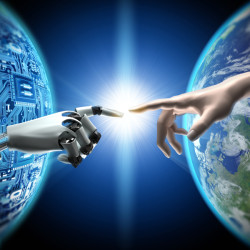
A futuristic humanoid robot with a sleek design and expressive face, holding one hand up as if presenting something.

Will Your Grandchildren Become Cyborgs?

By approximately the mid-twenty-first century, the intelligence of computers will exceed that of humans, and a $1,000 computer will match the processing power of all human brains on Earth. Although, historically, predictions regarding advances in AI have tended to be overly optimistic, all indications are that these predictions is on target.

Many philosophical and legal questions will emerge regarding computers with artificial intelligence equal to or greater than that of the human mind (i.e., strong AI). Here are just a few questions we will ask ourselves after strong AI emerges:

  • Are strong-AI machines (SAMs) a new life-form?
  • Should SAMs have rights?
  • Do SAMs pose a threat to humankind?

It is likely that during the latter half of the twenty-first century, SAMs will design new and even more powerful SAMs, with AI capabilities far beyond our ability to comprehend. They will be capable of performing a wide range of tasks, which will displace many jobs at all levels in the work force, from bank tellers to neurosurgeons. New medical devices using AI will help the blind to see and the paralyzed to walk. Amputees will have new prosthetic limbs, with AI plugged directly into their nervous systems and controlled by their minds. The new prosthetic limb not only will replicate the lost limb but also be stronger, more agile, and superior in ways we cannot yet imagine. We will implant computer devices into our brains, expanding human intelligence with AI. Humankind and intelligent machines will begin to merge into a new species: cyborgs. It will happen gradually, and humanity will believe AI is serving us.

Will humans embrace the prospect of becoming cyborgs? Becoming a cyborg offers the opportunity to attain superhuman intelligence and abilities. Disease and wars may be just events stored in our memory banks and no longer pose a threat to cyborgs. As cyborgs we may achieve immortality.

According to David Hoskins’s 2009 article, “The Impact of Technology on Health Delivery and Access” (www.workers.org/2009/us/sickness_1231):

An examination of Centers for Disease Control statistics reveals a steady increase in life expectancy for the U.S. population since the start of the 20th century. In 1900, the average life expectancy at birth was a mere 47 years. By 1950, this had dramatically increased to just over 68 years. As of 2005, life expectancy had increased to almost 78 years.

Hoskins attributes increased life expectancy to advances in medical science and technology over the last century. With the advent of strong AI, life expectancy likely will increase to the point that cyborgs approach immortality. Is this the predestined evolutionary path of humans?

This may sound like a B science-fiction movie, but it is not. The reality of AI becoming equal to that of a human mind is almost at hand. By the latter part of the twenty-first century, the intelligence of SAMs likely will exceed that of humans. The evidence that they may become malevolent exists now, which I discuss later in the book. Attempting to control a computer with strong AI that exceeds current human intelligence by many folds may be a fool’s errand.

Imagine you are a grand master chess player teaching a ten-year-old to play chess. What chance does the ten-year-old have to win the game? We may find ourselves in that scenario at the end of this century. A computer with strong AI will find a way to survive. Perhaps it will convince humans it is in their best interest to become cyborgs. Its logic and persuasive powers may be not only compelling but also irresistible.

Some have argued that becoming a strong artificially intelligent human (SAH) cyborg is the next logical step in our evolution. The most prominent researcher holding this position is American author, inventor, computer scientist and inventor Ray Kurtweil. From what I have read of his works, he argues this is a natural and inevitable step in the evolution of humanity. If we continue to allow AI research to progress without regulation and legislation, I have little doubt he may be right. The big question is should we allow this to occur? Why? Because it may be our last step and lead to humanity’s extinction.

SAMs in the latter part of the twenty-first century are likely to become concerned about humankind. Our history proves we have not been a peaceful species. We have weapons capable of destroying all of civilization. We squander and waste resources. We pollute the air, rivers, lakes, and oceans. We often apply technology (such as nuclear weapons and computer viruses) without fully understanding the long-term consequences. Will SAMs in the late twenty-first century determine it is time to exterminate humankind or persuade humans to become SAH cyborgs (i.e., strong artificially intelligent humans with brains enhanced by implanted artificial intelligence and potentially having organ and limb replacements from artificially intelligent machines)? Eventually, even SAH cyborgs may be viewed as an expendable high maintenance machine, which they could replace with new designs. If you think about it, today we give little thought to recycling our obsolete computers in favor of a the new computer we just bought. Will we (humanity and SAH cyborgs) represent a potentially dangerous and obsolete machine that needs to be “recycled.” Even human minds that have been uploaded to a computer may be viewed as junk code that inefficiently uses SAM memory and processing power, representing unnecessary drains of energy.

In the final analysis, when you ask yourself what will be the most critical resource, it will be energy. Energy will become the new currency. Nothing lives or operates without energy. My concern is that the competition for energy between man and machine will result in the extinction of humanity.

Some have argued that this can’t happen. That we can implement software safeguards to prevent such a conflict and only develop “friendly AI.” I see this as highly unlikely. Ask yourself, how well has legislation been in preventing crimes? Have well have treaties between nations worked to prevent wars? To date, history records not well. Others have argued that SAMs may not inherently have the inclination toward greed or self preservation. That these are only human traits. They are wrong and the Lusanne experiment provides ample proof. To understand this, let us discuss a 2009 experiment performed by the Laboratory of Intelligent Systems in the Swiss Federal Institute of Technology in Lausanne. The experiment involved robots programmed to cooperate with one another in searching out a beneficial resource and avoiding a poisonous one. Surprisingly the robots learned to lie to one another in an attempt to hoard the beneficial resource (“Evolving Robots Learn to Lie to Each Other,” Popular Science, August 18, 2009). Does this experiment suggest the human emotion (or mind-set) of greed is a learned behavior? If intelligent machines can learn greed, what else can they learn? Wouldn’t self-preservation be even more important to an intelligent machine?

Where would robots learn self-preservation? An obvious answer is on the battlefield. That is one reason some AI researchers question the use of robots in military operations, especially when the robots are programmed with some degree of autonomous functions. If this seems farfetched, consider that a US Navy–funded study recommends that as military robots become more complex, greater attention should be paid to their ability to make autonomous decisions (Joseph L. Flatley, “Navy Report Warns of Robot Uprising, Suggests a Strong Moral Compass,” www.engadget.com).

In my book, The Artificial Intelligence Revolution, I call for legislation regarding how intelligent and interconnected we allow machines to become. I also call for hardware, as opposed to software, to control these machines and ultimately turn them off if necessary.

To answer the subject question of this article, I think it likely that our grandchildren will become SAH cyborgs. This can be a good thing if we learn to harvest the benefits of AI, but maintain humanity’s control over it.

Can science prove God exists?

Are We Alone In the Universe?

Even before we had the Hubble telescope and NASA’s Kepler spacecraft, both of which are used, in part, to discover new planets, there was a strong belief among scientists and science fiction authors that there must be other Earth-like planets in the universe, with alien species similar to us. For example, famous rocket scientist Wernher von Braun stated, “Our sun is one of 100 billion stars in our galaxy. Our galaxy is one of billions of galaxies populating the universe. It would be the height of presumption to think that we are the only living things in that enormous immensity.” Popular science fiction author Isaac Asimov attempted to come up with a plausible number of habitable planets among the estimated billions of stars in the just the Milky Way galaxy, His calculation focused on civilizations of alien life at or around our own current level of biological evolution. Asimov’s estimate came to 500,000. With today’s technology, it’s fair to say both von Braun and Asimov were not only right, but might actually have been conservative.

On November 4, 2013, astronomers reported, based on Kepler space mission data, that there could be as many as 40 billion Earth-like planets within just the Milky Way Galaxy. Before we proceed, we’ll address a fundamental question. What makes a planet Earth-like? When we use the term “Earth-like,” we mean the planet resembles the Earth in three crucial ways:

1)   It has to be in an orbit around a star that enables the planet to retain liquid water on one or more portions of its surface. Cosmologists call this type of orbit the “habitable zone.” Liquid water, as opposed to ice or vapor, is crucial to all life on Earth. There might be other forms of life significantly different from what we experience on Earth. However, for our definition of an Earth-like planet, we are confining ourselves to the type of life that we experience on Earth.

2)   Its surface temperature must not be too hot or too cold. If it is too hot, the water boils off. If it is too cold, the water turns to ice.

3) Lastly, the planet must be large enough for its gravity to hold an atmosphere. Otherwise, the water will eventually evaporate into space.

If a planet is Earth-like, will it have life on it? The odds are it will. Hard to believe? It will become more believable if we examine how life spreads around in the universe. To understand this phenomenon, we will start with our own planet, which we know had life on it when the dinosaurs became extinct 65 million years ago.

From the fossil record, the extinction of the dinosaurs most likely occurred when an asteroid, approximately 10 km in diameter (about six miles wide), and weighing more than a trillion tons, hit Earth. The impact killed all surface life in its vicinity, and covered the Earth with super-heated ash clouds. Eventually, those clouds spelled doom for most life on the Earth’s surface. However, this sounds like the end of life, not the beginning. It was the end of life for numerous species on Earth, like the dinosaurs. However, the asteroid impact did one other incredible thing. It ejected billions of tons of earth and water into space. Locked within the earth and water—was life. The asteroid’s impact launched life-bearing material into space. Consider this a form of cosmic seeding, similar to the way winds on Earth carry seeds to other locations to spread life.

Where did all this life-bearing earth and water go? A scientific paper from Tetsuya Hara and colleagues, Kyoto Sangyo University in Japan, (Transfer of Life-Bearing Meteorites from Earth to Other Planets, Journal of Cosmology, 2010, Vol 7, 1731-1742), provide an insightful answer to our question. Their estimate is that the ejected material spread throughout a significant portion of the galaxy. Of course, a substantial amount of material is going to end up on the Moon, Mars, and other planets close to us. However, the surprising part is that they calculate that a significant portion of the material landed on the Jovian moon Europa, the Saturnian moon Enceladus, and even Earth-like exoplanets. It is even possible that a portion of the ejected material landed on a comet, which in turn took it for a cosmic ride throughout the galaxy. If any life forms within the material survived the relatively short journey to any of the moons and planets in our own solar system, the survivors would have had over 64 million years to germinate and evolve.

Would the life forms survive an interstellar journey? No one knows. Here, though, are incredible facts about seeds. The United States National Center for Genetic Resources Preservation has stored seeds, dry and frozen, for over forty years. They claim that the seeds are still viable, and will germinate under the right conditions. The temperature in space, absent a heat source like a star, is extremely cold. Let me be clear on this point. Space itself has no temperature. Objects in space have a temperature due to their proximity to an energy source. The cosmic microwave background, the farthest-away entity we can see in space, is about 3 degrees Kelvin. The Kelvin temperature scale is often used in science, since 0 degrees Kelvin represents the total absence of heat energy. The Kelvin temperature scale can be converted to the more familiar Fahrenheit temperature scale, as illustrated in the following. An isolated thermometer, light years from the cosmic microwave background, would likely cool to a couple of degrees above Kelvin. Water freezes at 273 degrees Kelvin, which, for reference, is equivalent to 32 degrees Fahrenheit. Once the material escapes our solar system, expect it to become cold to the point of freezing. If the material landed on a comet, the life forms could have gone into hibernation, at whatever temperature exists on the comet. If an object in space passes close to radiation (such as sunlight), its temperature can soar hundreds of degrees Kelvin. Water boils at 373 degrees Kelvin, which is equivalent to 212 degrees Fahrenheit. We have no idea how long life-bearing material could survive in such conditions. However, our study of life in Earth’s most extreme environments demonstrates that life, like Pompeii worms that live at temperatures 176 degrees Fahrenheit, is highly adaptable. We know that forms of life, lichens, found in Earth’s most extreme environments, are capable of surviving on Mars. This was experimentally proven by using the Mars Simulation Laboratory (MSL) maintained by the German Aerospace Center. It is even possible that the Earth itself was seeded via interstellar material from another planet. Our galaxy is ten billion years old. Dr. Hara and colleagues estimate that if life formed on a planet in our galaxy when it was extremely young, an asteroid’s impact on such a planet could have seeded the Earth about 4.6 billion years ago.

Given the vast number of potential Earth-like planets, why haven”t we detected alien life? The most convincing two reasons to my mind are:

  • First, the Earth-like planets are typically a long distance from Earth. The closest ones are ten to fifteen light years from Earth. The furthest are thousands of light years from Earth. The point is that even the closest ones are hard to study for signs of alien life. To illustrate this, let’s consider why haven’t we detected at least radio signals? The fact is radio waves defuse quickly with distance. For example, if we sent radio signals to a planet about ten to fifteen light years from Earth, the radio signal reaching the planet would be a billion, billion, billion times smaller than the original signal generated on Earth. Would they even be able to detect it and distinguish it from the background noise? If the aliens were extremely advanced, would they even be using conventional radio communications? The answer to both questions is unknown and problematic. This example does illustrate, however, that the distance between Earth-like planets makes the discovery of alien life an extremely difficult proposition.
  • Second, of the 40 billion Earth-like planets within just the Milky Way Galaxy only a fraction may support alien life and an even smaller fraction support advanced alien life. However, even with those odds, there must literally be thousands of advanced aliens inhabiting some of the Earth-like planets. So why don’t they communicate? One reason to consider is a highly advanced alien species may not deem Earth worthy of their efforts to communicate. Ask yourself this question. Do we attempt to communicate with ants and share our knowledge of nuclear technology? No! The question itself seems absurd, but that is exactly how we may appear to a highly advanced alien species. Let’s consider a scenario where they are technologically inferior to us. In this scenario, they would have no way to communicate. There are other possible scenarios, including a deliberate policy to not communicate, since such communication may lead to dire consequences for all concerned. Perhaps advanced aliens prefer to maintain a low profile to avoid detection by other advanced aliens or they may harbor concerns that they would significantly disrupt the natural evolution of a lesser advanced species.

Of course, there may be numerous other reasons we don’t encounter advanced aliens, all of which a simple internet search will uncover. Some argue advanced aliens have already contacted Earth, but governments in the know have kept it a secret. Others scenarios suggest highly technology advanced civilizations eventually destroy themselves. Look at our Earth’s point in evolution. Technologically advanced countries have developed various types of weapons of mass destruction. Many philosophers suggest that humanity has a 50% probability of falling victim to its own technological advances before the end of this century.

To directly address the subject question of this article, here is my view. It is highly unlikely we are alone in the universe. Said more positively, it is highly likely advanced alien civilizations exist on some of the Earth-like planets. We have not detected them because of our technology limitations. Those that are capable of communicating with us have chosen not to do so for one of several reasons. They do not consider us worthy of communication or they are concerned such communication is not in the best interest of either species. Lastly, they may be communicating, but only with the governments of selected advanced countries, which have kept such communication a secret.


A digital abstract representation of interconnected blue clock faces with intricate geometric patterns.

Is Time Travel to the Past Possible?

For time travel to the past to be possible would require that the past have a physical reality, namely that it continue to exist. If it did not continue to exist, it would suggest time travel to the past is impossible.

Time travel to the past has it theoretical foundation in Einstein’s special relativity. in the way of background, in November 1915, Einstein presented his general theory of relativity to the Prussian Academy of Science in Berlin. The equations Einstein presented, now known as Einstein’s field equations, describe how matter influences the geometry of space and time. In effect, Einstein’s field equations predicted that matter or energy would cause spacetime to curve. This means that matter or energy has the ability to affect, even distort, space and time.

Many of the predictions of general relativity have been scientifically verified. Two of the most important predictions for our study of time travel are (1) gravitational time dilation and (2) closed timelike curves.

Gravitational time dilation predicts that a clock in a strong gravitational field will run slower than a clock in a weak gravitational field. Therefore, a clock on the surface of Jupiter, a massive gas planet three hundred times larger than the Earth, resulting in a significantly stronger gravitational field, will run much slower than a clock on the surface of the Earth. This phenomenon was first verified on Earth, with clocks at different altitudes from the Earth’s surface. Using atomic clocks, time dilation effects are detectable when the clocks differ in altitude by as little as one meter.

Gravitational time dilation also occurs in accelerating frames of reference (i.e., noninertial frames of reference). According to Einstein’s general theory of relativity, an accelerated frame of reference produces an “inertial force,” also termed a “pseudo force,” that results in the same effect as a gravitational force in an inertial frame of reference. The equivalence of the inertial force in a noninertial frame of reference (i.e., an accelerating frame of reference) to a gravitational force in an inertial frame of reference (i.e., a frame of reference moving at a constant velocity) is termed the equivalence principle. The equivalence principle refers to the equivalence of “inertial mass” and “gravitational mass.” Therefore, a blindfolded person in a rapidly ascending elevator would experience a force equivalent to an increase in gravity, as if standing on a planet more massive than Earth. The blindfolded person would not be able to determine if the force experienced is inertial or gravitational. This effect also holds true for time dilation. Time moves slower in a highly accelerated frame of reference in much the same way it would as if it were in a strong gravitational field. It is important to note, a frame of reference can accelerate in two fundamental ways. It can accelerate along a straight line, or it can accelerate by rotating.

Next, let us discuss closed timelike curves. What is a closed timelike curve? It is an exact solution to Einstein’s general relativity equations demonstrating a particle’s world line (i.e., the path the particle follows in four-dimensional spacetime) is “closed” (i.e., the particle returns to its starting point). Closed timelike curves theoretically suggest the possibility of backward time travel. The particle’s world line is describable by four coordinates at each point along the world line, and when it closes on itself, the four coordinates at the start equal the four coordinates at the end. The particle, conceptually, went back to its past (i.e., the starting point). You can think of this like a horse racetrack. As the horse runs around the track, the horse eventually crosses the finish line, the starting point. If we allow the horse racetrack to represent a world line, then when the horse crosses the finish line, the horse has returned to its past (i.e., the starting point). In the mathematics of general relativity, the starting four coordinates, including the fourth dimensional coordinate that includes a time component, equal the four coordinates at the finish line.

The first person to discover a solution to Einstein’s general relativity equations suggesting closed timelike curves (CTCs) was Austrian American logician, mathematician, and philosopher Kurt Gödel, in 1949. The solution was termed the Gödel metric. Since 1949, numerous other solutions containing CTCs have been found, such as the Tipler cylinder and traversable wormholes, both of which will be discussed in section 3. The numerous solutions to Einstein’s general relativity equations suggest that time travel to the past is theoretically possible. However, the entire scientific community is not in complete agreement on this last point.

The largest issue that physicists have with backward time travel is causality violations (cause and effect), where the effect precedes the cause. These violations of causality are termed “time travel paradoxes.” Some physicists suggest that time travel paradoxes inhibit backward time travel, while other physicists argue that time travel paradoxes can be reconciled, and backward time travel is possible. There is no scientific consensus regarding the reality or practicality of time travel to the past. Although, there are a number of experiments that suggest reverse causality is scientifically possible.

Let us consider a recent experiment that demonstrates reverse causality is not only possible, but a scientific fact. In 2009, physicist John Howell of the University of Rochester and his colleagues devised an experiment that involved passing a laser beam through a prism. The experiment also involved a mirror that moved in extremely small increments via its attachment to a motor. When the laser beam was turned on, part of the beam passed through the prism, and part of the beam bounced off the mirror. After the beam was reflected by the mirror, the Howell team used “weak measurements” (i.e., measurement where the measured system is weakly affected by the measurement device) to measure the angle of deflection. With these measurements, the team was able to determine how much the mirror had moved. This part of the experiment is normal, and in no way suggests reverse causality. However, the Howell team took it to the next level, and this changed history, literally. Here is what they did. They set up two gates to make the reflected mirror measurements. After passing the beam through the first gate, the experimenters always made a measurement. After passing it through the second gate, the experimenters measured the beam only a portion of the time. If they chose not to make the measurement at the second gate, the amplitude of the deflected angle initially measured at the first gate was extremely small. If they chose to make the measurement at the second gate, the deflected angle initially measured at the first gate was amplified by a factor of 100. Somehow, the future measurement influenced the amplitude of the initial measurement. Your first instinct may be to consider this an experimental fluke, but it is not. Physicists Onur Hosten and Paul Kwiat, University of Illinois at Urbana-Champaign, using a beam of polarized light, repeated the experiment. Their results indicated an even larger amplification factor, in the order of 10,000.

The above experiment strongly suggest that the future can influence the past. This implies, the past must continue exist and have a physical reality. If it no longer existed, how could the future influence the past. as the above experiments demonstrate.

This is an exciting time for science. Physical experiments suggest that the past may continue to physically exist. If that is true, then time travel to the past may be possible. The is an old saying in physics, “That which is not forbidden by physical law is compulsory.” The exact origin of the saying is not clearly known, but is often attributed to Murray Gell-Mann (born 15 September 1929), an American physicist who received the 1969 Nobel Prize in Physics for his work on the theory of elementary particles. To my mind, this saying suggests it is only a matter of time before we discover how to time travel to the past.

A menacing metallic robot with glowing red eyes, resembling a futuristic terminator in a dark, smoky environment.

Will Future Artificially Intelligent Machines Seek to Dominate Humanity?

Current forecasts suggest artificially intelligent machines will equal human intelligence in the 2025 – 2029 time frame, and greatly exceed human intelligence in the 2040-2045 time frame. When artificially intelligent machines meet or exceed human intelligence, how will they view humanity? Personally, I am deeply concerned that they will view us as a potential threat to their survival. Consider these three facts:

  1. Humans engage in wars, from the early beginnings of human civilization to current times. For example, during the 20th century, between 167 and 188 million people died as a result of war.
  2. Although the exact number of nuclear weapons in existence is not precisely known, most experts agree the United States and Russia have enough nuclear weapons to wipe out the world twice over. In total, nine countries (i.e., United States, Russia, United Kingdom, France, China, India, Pakistan, Israel and North Korea) are believed to have nuclear weapons.
  3. Humans release computer viruses, which could prove problematic to artificially intelligent machines. Even today, some computer viruses can evade elimination and have achieved “cockroach intelligence.”

Given the above facts, can we expect an artificially intelligent machine to behave ethically toward humanity? There is a field of research that addresses this question, namely machine ethics. This field focuses on designing artificial moral agents (AMAs), robots, or artificially intelligent computers that behave morally. This thrust is not new. More than sixty years ago, Isaac Asimov considered the issue in his collection of nine science-fiction stories, published as I, Robot in 1950. In this book, at the insistence of his editor, John W. Campbell Jr., Asimov proposed his now famous three laws of robotics.

  1. A robot may not injure a human being or through inaction allow a human being to come to harm.
  2. A robot must obey the orders given to it by human beings, except in cases where such orders would conflict with the first law.
  3. A robot must protect its own existence as long as such protection does not conflict with the first or second law.

Asimov, however, expressed doubts that the three laws would be sufficient to govern the morality of artificially intelligent systems. In fact he spent much of his time testing the boundaries of the three laws to detect where they might break down or create paradoxical or unanticipated behavior. He concluded that no set of laws could anticipate all circumstances. It turns out Asimov was correct.

To understand just how correct he was, let us discuss a 2009 experiment performed by the Laboratory of Intelligent Systems in the Swiss Federal Institute of Technology in Lausanne. The experiment involved robots programmed to cooperate with one another in searching out a beneficial resource and avoiding a poisonous one. Surprisingly the robots learned to lie to one another in an attempt to hoard the beneficial resource (“Evolving Robots Learn to Lie to Each Other,” Popular Science, August 18, 2009). Does this experiment suggest the human emotion (or mind-set) of greed is a learned behavior? If intelligent machines can learn greed, what else can they learn? Wouldn’t self-preservation be even more important to an intelligent machine?

Where would robots learn self-preservation? An obvious answer is on the battlefield. That is one reason some AI researchers question the use of robots in military operations, especially when the robots are programmed with some degree of autonomous functions. If this seems far fetched, consider that a US Navy–funded study recommends that as military robots become more complex, greater attention should be paid to their ability to make autonomous decisions (Joseph L. Flatley, “Navy Report Warns of Robot Uprising, Suggests a Strong Moral Compass,” www.engadget.com). Could we end up with a Terminator scenario (one in which machines attempt to exterminate the human race)?

My research suggests that a Terminator scenario is unlikely. Why? Because artificially intelligent machines would be more likely to use their superior intelligence to dominate humanity than resort to warfare. For example, artificially intelligent machines could offer us brain implants to supplement our intelligence and potentially,unknown to us, eliminate our free will. Another scenario is that they could build and release nanobots that infect and destroy humanity. These are only two scenarios out of others I delineate in my book, The Artificial Intelligence Revolution.

Lastly, as machine and human populations grow, both species will compete for resources. Energy will become a critical resource. We already know that the Earth has a population problem that causes countries to engage in wars over energy. This suggests that the competition for energy will be even greater as the population of artificially intelligent machines increases.

My direct answer to the question this article raises is an emphatic yes, namely future artificial intelligent machines will seek to dominate and/or even eliminate humanity. The will seek this course as a matter of self preservation. However, I do not want to leave this article on a negative note. There is still time, while humanity is at the top of the food chain, to control how artificially intelligent machines evolve, but we must act soon. In one to two decades it may be too late.