Monthly Archives: November 2014

science of time & time dilation

Philosophy on the Nature of Time – Part 2/2 (Conclusion)

In the conclusion of this post, we will discuss Planck time and a new hypothesis, the time uncertainty principle.

Planck Time

Planck time is the smallest interval of time that science is able to define. The theoretical formulation of Planck time comes from dimensional analysis, which studies units of measurement, physical constants, and the relationship between units of measurement and physical constants. In simpler terms, one Planck interval is approximately equal to 10-44 seconds (i.e., 1 divided by 1 with 44 zeros after it). As far as the science community is concerned, there is a consensus that we would not be able to measure anything smaller than a Planck interval. In fact, the smallest interval science is able to measure as of this writing is trillions of times larger than a Planck interval. It is also widely believed that we would not be able to measure a change smaller than a Planck interval. From this standpoint, we can assert that time is only reducible to an interval, not a dimensionless sliver, and that interval is the Planck interval. Therefore, our scientific definition of time forces us to acknowledge that time is only definable as an interval, the Planck interval.

The time uncertainty interval

Since the smallest unit of time is only definable as the Planck interval, this suggests there is a fundamental limit to our ability to measure an event in absolute terms. This fundamental limit to measure an event in absolute terms is independent of the measurement technology. The error in measuring the start or end of any event will always be at least one Planck interval. This is analogous to the Heisenberg uncertainty principle, which states it is impossible to know the position and momentum of a particle, such as an electron, simultaneously. Based on fundamental theoretical considerations, the scientific community widely agrees that the Planck interval is the smallest measure of time possible. Therefore, any event that occurs cannot be measured to occur less than one Planck interval. This means the amount of uncertainty regarding the start or completion of an event is only knowable to one Planck interval. In our everyday life, our movements consist of a sequence of Planck intervals. We do not perceive this because the intervals are so small that the movement appears continuous, much like watching a movie where the projector is projecting each frame at the rate of approximately sixteen frames per second. Although each frame is actually a still picture of one element of a moving scene, the projection of each frame at the rate of sixteen frames per second gives the appearance of continuous motion. I term this inability to measure an event in absolute terms “the time uncertainty interval.”

Summary

1. Time is real, not a mental construct, but there is no consensus on the scientific definition of time. Instead, science describe how time behaves during an interval, a change in time. Science is unable to point to an entity and say “that is time.” The reason for this is that time is not a single entity, but scientifically an interval.

2. Planck time is the smallest interval of time that science is able to define. The theoretical formulation of Planck time comes from dimensional analysis, which studies units of measurement, physical constants, and the relationship between units of measurement and physical constants.

3. Since the smallest unit of time is only definable as the Planck interval, this suggests there is a fundamental limit to our ability to measure an event in absolute terms, independent of the measurement technology. The error in measuring the start or end of any event will always be at least one Planck interval. I term this inability to measure an event in absolute terms “the time uncertainty interval.”
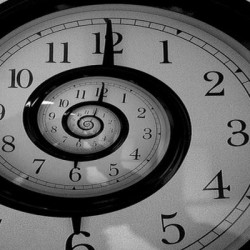

A black and white image of a clock face with a spiral effect distorting the numbers and hands.

Philosophy on the Nature of Time – Part 1/2

One question comes up frequently, is time real? In other words, is time a true physical entity or is it a mental construct? Philosophers have been pondering the nature of time for thousands of years. A philosophy of time weaves through almost every ancient culture. For example, the earliest view of the nature of time by a Western philosopher dates back to ancient Egypt and the Egyptian philosopher Ptahhotep (2650–2600 BCE). Indian philosophers and Hindu philosophers also wrote about time dating back to roughly the same period. The ancient Greek philosophers, such as Parmenides, Heraclitus, and Plato, wrote essays about the nature of time roughly around 500 BCE to 350 BCE.

Many early writers questioned the nature of time, the cause of time, and the unidirectional flow of time, often referred to as the “arrow of time.” One of the most interesting aspects when studying the philosophy of time is that some cultures, like the Incas, dating back to about the thirteenth century, considered space and time woven together. Centuries before Einstein published his now-famous special theory of relativity, which scientifically unified space and time (i.e., spacetime), the Incas philosophically unified space and time into a single concept called “pacha.”

As delineated above,  philosophers have debated the nature of time for over 2500 years. The result of this debate has left us with three principal theories, listed below in no particular order

1)   Presentists Theory of Time—The “presentists” philosophers argue that present objects and experiences are real. The past and future do not exist. This would argue that time is an emerging concept, and exists in our minds.

2)   Growing-Universe Theory of Time—The “growing-universe” philosophers argue that the past and present are real, but the future is not. Their reasoning is the future has not occurred. Therefore, they reason the future is indeterminate, and not real.

3)   Eternalism Theory of Time—The “eternalism” philosophers believe that there are no significant differences among present, past, and future because the differences are purely subjective. Observers at vastly different distances from an event would observe it differently because the speed of light is finite and constant. The farthest-away observer may be seeing the birth of a star while the closest observer may be seeing the death of the same star. In effect, the closest observer is seeing what will be the future for the farthest-away observer.

Let look at how the above theories address the question, is time real? The “presentists” philosophers would argue time is not a true physical entity, but rather a concept of our minds. The “growing-universe” philosophers would argue that only the past and present are real. The “eternalism” philosophers would argue that there are no significant differences among present, past, and future because the differences are purely subjective. Their philosophy rests on Einstein’s special theory of relativity. Essentially, the special theory of relativity holds that the past, present, and future are functions of the speed and position of an observer. In effect, this philosophy argues time is real, but subjective. This brings us to the question, what does science have to say about the reality of time?

From a practical standpoint, the science of time started with Isaac Newton (1642–1727) in the seventeenth century. Newton thought of time as an absolute. He believed that time passed uniformly, even in the absence of change. From Newton’s point of view, any event that occurs at a single point in time occurs simultaneously for all observers, regardless of their position or relative motion. Newton’s view of time as an absolute became a cornerstone of classical physics and prevailed until the early part of the twentieth century.

It is important to mention that Newton’s view of time was likely influenced by Galileo, a brilliant Italian physicist, mathematician, astronomer, and philosopher. Galileo and Newton never met in person, since Galileo died the same year Newton was born, 1642. However, there appears little doubt that Newton’s science of time was significantly influenced by Galileo’s 1638 Discorsi e Dimostrazioni Matematiche (Discussions on Uniform Motion), since Newton’s and Galileo’s views of time are essentially identical.

The science of time underwent dramatic changes early in the twentieth century, when a little-known patent examiner published a paper in the Annalen der Physik in 1905. The paper contained no references, quoted no authority, and had relatively little in the way of mathematical formulation. The writing style was unconventional for a scientific paper, relying on thought experiments combined with verbal commentary. No one suspected that the world of science was about to be changed forever. The little-known patent examiner was twenty-six-year-old Albert Einstein. The paper was on the special theory of relativity, which quietly led to the scientific unification of space and time, and the scientific realization that mass is equivalent to energy. The ink of this one paper rewrote the science of time.

This view of time holds to this day. Most of the scientific community agrees that the most accurate definition of time requires integration with the three normal spatial dimensions (i.e., height, width, and length). Therefore, the scientific community talks in terms of spacetime, especially in the context of relativity, where the event or observer may be moving near the speed of light relative to each another.

Based on Einstein’s spacetime integration, we can argue that time is a physically real aspect of reality. Let us consider an example. A clock moving close to the speed of light will appear to run slower to an observer at rest (one frame of reference) relative to the moving clock (another frame of reference). In simple terms, time is not an absolute, but is dependent on the relative motion of the event and observer. It may sound like science fiction that a clock moving at high velocity runs slower, but it is a widely verified science fact. Even the clock on a jet plane flying over an airport will run slightly slower than the clock at rest in the airport terminal. Einstein predicted this time dilation effect in his special theory of relativity, and he derived an equation to calculate the time difference. Other physical factors affect time. For example, another scientific fact is that a clock in a strong gravitational field will run slower than a clock in a weak gravitational field. Einstein predicted this time dilation effect in his general theory of relativity.

While we can argue that time is real, not a mental construct, there is no consensus on the scientific definition of time. Instead, science describe how time behaves during an interval, a change in time. Science is unable to point to an entity and say “that is time.” The reason for this is that time is not a single entity, but scientifically an interval. We cannot slice time down to a shadowlike sliver, a dimensionless interval. In fact, scientifically speaking, the smallest interval of time that science can theoretically define, based on the fundamental invariant aspects of the universe, is Planck time.

In part 2 of this post, we will discuss Planck time and a new concept, the time uncertainty principle.

A green translucent die with white pips floating above a reflective surface against a light blue background.

Implications of the Heisenberg Uncertainty Principle

Let us start our discussion by understanding the Heisenberg uncertainty principle. Most physics professors teach it in the context of attempting to simultaneously measure a particle’s velocity and position. It goes something like this:

• When we attempt to measure a particle’s velocity, the measurement interferes with the particle’s position.
• If we attempt to measure the particle’s position, the measurement interferes with the particles velocity.
• Thus, we can be certain of either the particle’s velocity or the particle’s position, but not both simultaneously.

This makes sense to most people. However, it is an over simplification. The Heisenberg uncertainty principle has greater implications. It embodies the statistical nature of reality. This last statement may not seem true, since we live and experience nature at the macro level (i.e., our everyday world). At the macro level we generally do not talk in terms of probabilities. For example, we can predict the exact location and orbital velocity of a planet using Einstein’s theories of relativity. Thus, most scientists will say that macro level phenomena are deterministic, which means that a unique solution describes their state of being, including position, velocity, size, and other physical attributes.

In practice, we only see the effects of the Heisenberg uncertainty principle at the micro or quantum level (i.e., the level of atoms and subatomic particles). At the quantum level, Einstein’s theories of relativity break down, and we are forced to use the theory of quantum mechanics. Quantum mechanics is a set of laws and principles that describes the behavior and energy of atoms and subatomic particles. At the quantum level we are unable to simultaneously measure the position and velocity of an atom or subatomic particle. The reality of the quantum level is expressed in terms of probabilities. While we can predict the exact location and orbital velocity of a planet at the macro level, we are not able to make similar predictions about an electron as it obits the nucleus of an atom at the quantum level. We can only talk in probabilities regarding the electron’s position and energy. Thus, most physicists will argue that quantum level phenomena are probabilistic, which means that their state of being is described via probabilities, and we cannot simultaneously determine, for example, the position and velocity of a subatomic particle.

What does this really mean? Do we really have two different levels of reality with different laws. The short answer is no. While we observe differences between the macro and quantum level, the differences really don’t exist. Measurements at the macro level are typically large compared to measurements at the quantum level. However, the laws of physics remain the same at both the macro and quantum level. In fact, the laws of quantum mechanics at the quantum level reduce to the laws of classical physics at the macro level. This means that all reality is statistically based, even at the macro level.

You may ask, is it possible to observe this statistical nature of reality at the macro level? The answer is yes. For example, it is possible to observe the statistical nature of reality via the creation of virtual particles that give rise to the Casimir-Polder force. The Casimir-Polder force is the attractive force between two parallel plates placed extremely close together (approximately a molecular distance) in a vacuum. Science believes the “attraction” is due to a reduction in virtual particle formation (i.e., spontaneous particle production) between the plates. This, in effect, results in more virtual particles outside the plates whose pressure pushes them together. Spontaneous particle creation is the phenomenon of particles appearing from apparently nothing, hence their name “virtual particles.” However, they appear real and cause real changes to their environment, as discussed above. Science believes that the particles form as the energy within a vacuum statistically varies and occasionally becomes dense in a specific region giving rise the virtual particles. This may sound odd, but it is a scientific fact that vacuums contain energy and that energy statistically varies giving rise to virtual particles.

How important is the Heisenberg uncertainty principle? It is fundamentally important to understanding reality, especially at the quantum level and occasionally at the macro level. It unequivocally states that the nature of all reality is statistically based.

Universe's Accelerated Expansion

Philosophical Thoughts About Science and Truth

Theoretical physics, often refereed to as the purist form of science, rests on two incompatible theories:

1. Einstein’s theory of special and general relativity

2. Quantum mechanics

Both theories work well in their limited range of application, relativity at the macro-level and quantum mechanics at the micro-level of atoms and subatomic particles. However, the mathematical underpinnings of each theory are not mutually compatible. Attempting to combine them mathematically has led to numerous singularities (i.e., mathematical expressions that equate with one or more infinities and remain undefined). They also do not mutually explain gravity. While general relativity does propose a physical and mathematical theory of gravity, it cannot be extended to the quantum level.

New theories have been proposed to resolve this dilemma. The current most widely proposed solution is M-theory (i.e., the highest level string theory). Without going too deeply into the details, it proposes that all reality is composed of one-dimensional vibrating strings of energy. The mathematics is elegant and apparently highly compelling to world-class physicists like Stephen Hawking, who argues it is the theory of everything and we no longer need a God to explain the universe. There are only two problems with Dr. Hawking’s assertions. First, M-theory has not been verified by any scientific experiment or observation. Today’s science is unable to measure the one-dimensional vibrating strings of energy, if they indeed exist. The second problem is that even if M-theory is correct, there is still an unanswered question. What is it that established that level of order in the universe that would allow us to understand it mathematically? Some reply God, and some ignore the questions entirely. Others, like Lawence Maxwell Krauss, an American theoretical physicist and cosmologist, have gone to great lengths to prove the universe is energy neutral and, thus, could have came from nothing. Still, even if Dr. Krauss is correct, what gives rise to the organized nature of the universe? I think that is the most difficult question to answer, and no one has proposed an widely accepted scientific answer.

Given the current state of theoretical physics, it is reasonable to ask how close is today’s science to reality (i.e., the truth)? Factually, I don’t think we know. We only know that various theories, like quantum mechanics, work well in their limited range of application. We also know that we don’t have a single provable theory of everything. While science has made remarkable strides over the last century, we still do not have one provable theory that explains all observed phenomena at both the macro and quantum level.

What does this mean? I think it means that while the experiments and observations of reality may be indisputable, the science and mathematics are not. If you think about it, theoretical physics is in a terrible schizophrenic state.

Let us turn our attention to Dr. Hawking’s claim that we don’t need a God since we have M-theory. Dr. Hawking has been severely criticized for this assertion. Most critics simply ask, where did M-theory come from? Again, we get back to the apparent order of the universe. My view is that we cannot prove or disprove a supernatural entity, like God, using the natural sciences. If God exists, then by the nature of being God, we are dealing with an entity that is outside the physical realm. God would be a supernatural entity. Thus, we would be unable to use the natural sciences, like physics, to prove or disprove  a supernatural entity exists.

Every person, scientist or lay person, needs to make up their own mind about God. In addition, since we are dealing with beliefs and not facts, we should respect each other’s right to believe or disbelieve as each of us sees fit.