You may never have heard of nanoweapons. Recent polls indicate that most people in the United States do not know about nanotechnology, let alone nanoweapons. Therefore, let us start at the beginning.
According to the United States National Nanotechnology Initiative’s website, nano.gov, “Nanotechnology is science, engineering, and technology conducted at the nanoscale, which is about 1 to 100 nanometers.” The diameter of a typical human hair is about 100,000 nanometers. This means we are dealing with technology that is invisible to the naked eye or even under an optical microscope. This may suggest that nanotechnology products are rare. Nothing could be further from the truth. Numerous companies are producing commercial nanotechnology products, from cosmetics to integrated circuit microprocessors. Nanomedicine (i.e., medical nanotechnology) is using T-cell nanobots, tiny robots at the nanoscale, in medical trials to cure over eighty percent of terminally ill cancer patients. Factually, you may not have heard about nanotechnology, but you are likely using a product that incorporates it. Some estimates place the worldwide market for nanotechnology products at over $1 trillion in 2015 and estimated to grow to $3 trillion by 2020.
Nanoweapons are any military technology that exploits the power of nanotechnology. Let me provide an example. In 2007, the Russian military successfully tested the world’s most powerful non-nuclear air-delivered bomb, nicknamed the “father of all bombs.” Even though it only carries about 7 tons of explosives compared with more than 8 tons of explosives carried by the United States Massive Ordnance Air Blast bomb, the Russian bomb is four times more powerful. The Russians do not explain how they achieve the more destructive bomb. However, most likely they are using nanometals, such as nanoaluminum, as a catalyst to create explosives more powerful than conventional explosives. As powerful as the Russian bomb is, it still pales in comparison to nuclear weapons. Given the title of this article, you may wonder if I am being an alarmist. Let me share some information with you.
Let us start with some facts. The typical events most people consider probable to cause humanity’s extinction, such as a large asteroid or a super-volcanic eruption, have a low probability of occurrence, about 1 in 50,000. Ironically, one of the most probable events likely to cause human extinction is seldom in the media or addressed by world governments, namely molecular nanotechnology weapons (i.e., nanoweapons). In 2008, experts surveyed at the Global Catastrophic Risk Conference at the University of Oxford predicted that nanoweapons have a 1 in 20 (i.e., 5%) probability of causing human extinction by the year 2100.
Are these experts right? Unfortunately, all the evidence to date suggests they are. For example, consider the simplest of all nanoweapons, toxic nanoparticles. The United States, Russia, and China know how to make toxic nanoparticles in quantities sufficient to cripple an adversary’s populace. A populace exposed to toxic nanoparticles may experience serious illnesses, including death. In sufficient quantity, toxic nanoparticles could wipe out New York City, Beijing, or Moscow, which qualifies them as nanoweapons of mass destruction (NMD). Delivery to the target populace could be as simple as introducing it into the city’s reservoirs. Even a single individual may become the target. A recent 2016 headline in Pravda, Russia’s state run newspaper, reads, “US nano weapon killed Venezuela’s Hugo Chavez, scientists say.” The Venezuelan scientists mentioned in the article attributed Hugo Chavez’s death to toxic nanoparticles that cause cancer, but no data in the public domain substantiates their claim. However, the assertion itself indicates an awareness of toxic nanoparticles and their potential lethality.
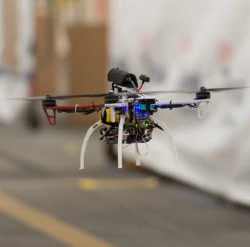
What makes nanoweapons more problematic than nuclear weapons is our potential to lose control over them. For example, consider a nanobot that mimics an innocuous fly. It could be a surveillance or lethal nanoweapon. This may sound like science fiction, but it is not. On Dec. 16, 2014, the United States Army Research Laboratory announced development of a fly drone weighing only a small fraction of a gram. Using DARPA’s Fast Lightweight Autonomy (FLA) program, which allows small drones to enter buildings and avoid crashing into objects, the fly drone could spy on an adversary from within the adversary’s operations center. This gives a completely new meaning to “fly on the wall.” Alternately, it could deposit a small, but lethal amount of toxin in the adversary’s food or water. The most lethal toxin known is botulism H. As little as 100 nanograms of botulism H is lethal to humans, who would be unable to smell, taste, or see that amount of toxin. Imagine 50 million fly drones, each able to deliver a lethal toxin. In that quantity, the fly drones become nanoweapons of mass destruction. However, a quantity of that size raises a question, How do we control these nanoweapons of mass destruction? If we lost control, the fly drones could spread beyond the adversary’s boarder and begin killing indiscriminately. It becomes the technological equivalent of a bioweapon, but does not fall under the Geneva Protocol.
It may be hard to believe, but nanoweapons of mass destruction are moving from science fiction to science fact. This brings us back to the title of the post, Will Nanoweapons of Mass Destruction (NMD) Be Our Final Invention?