
Tag Archives: time

Close-up of an ornate clock face with Roman numerals illuminated by a warm golden light.

The Science of Time – Part 2/3

The Science of Time: This is taken from appendix 5 of my new book, How to Time Travel, which will be available on Amazon in early September 2013.

What happens as the frames of reference move at velocities close to the speed of light? To address this question, we need to discuss the Lorenz transformation.

Time is relative (Lorenz transformation)

To transfer the time coordinates between frames moving close to the speed of light, an entirely new transformation methodology needed to be developed. Einstein became painfully aware of this during the development of his famous special theory of relativity. As a result, he utilized the Lorenz transformation. Some authors give Einstein credit as having developed the Lorenz transformation. This is not historically correct. The Lorenz transformation was in existence prior to Einstein’s publication of the special theory of relativity in 1905. In fact, numerous physicists, including Voigt (1887), Lorentz (1895), Larmor (1897), and Poincaré (1905), contributed to its formulation. It was Poincaré, in 1905, who brought it into its final modern form and named it the Lorenz transformation. It is fair, though, to say that Einstein rederived the Lorenz transformation in the context of special relativity.

Just what is the Lorenz transformation, and how does it treat the time coordinate between frames moving at a constant rate close to the speed of light? It takes into account that light travels at a finite speed (approximately 186,000 miles/second), and that speed is a constant in any frame of reference moving at a constant velocity, typically referred to as an inertial frame of reference. As a result, according to the Lorenz transformation, different observers moving at different velocities or at rest will not measure time in the same way. Indeed, they may measure different elapsed times, and even a different orderings of events.

Time as a coordinate

At this point, it may appear obvious that time is a coordinate. Both the Galilean and Lorenz transformations view time as a coordinate, and they only differ in how they translate the time coordinate between initial frames of reference. Intuitively, when you think of time as a coordinate, it makes sense. For example, when you set a meeting, you not only set the place (i.e., the spatial coordinates), but the time (i.e., the temporal coordinate). In this context, time is a coordinate (i.e., also known as “coordinate time”). This terminology distinguishes it from “proper time,” which is not a coordinate, but rather a process. In Einstein’s special theory of relativity, “proper time” (also known as “clock time”) is a measure of change, such as the number of rotations of a simple mechanical clock’s hands. It is arbitrary. For example, proper time may refer to the time it takes a candle to burn down to a specific point. Before we go further, let us be perfectly clear on the distinction of time as a coordinate (“coordinate time”) and proper time (“clock time”). If you specify that you will meet someone at a specific time, you are using “coordinate time.” If you say it takes the second hand of your watch one minute to make a compete revolution, you are talking about proper time (“clock time”). You may wonder if coordinate time and proper time are related. It turns out they are. Einstein’s special theory of relativity relates coordinate time, proper time, and space to each other via spacetime, which we will discuss next. Stay tuned for The Science of Time – Part 3/3
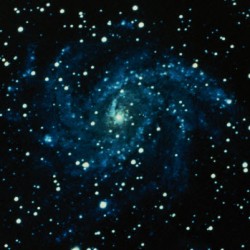
A vibrant spiral galaxy surrounded by numerous bright stars in deep space.

The Reality of Time

Philosophers have been pondering the nature of time for at least the last 2500 years. The key question boil down to: is time real or is it a mental construct?

We often equate time with change, such as sand flowing through an hourglass. However, imagine if there were no change. Would time still exist? To address this question, let us take an example from Unraveling the Universe’s Mysteries (2012), by Louis A. Del Monte (available at Amazon.com). The example will be a thought experiment. We do not currently have technology that permits us to perform this example in a lab, but performing it in our minds will illustrate the point.

Consider an atom frozen at absolute zero. All motion in the atom would stop. I am aware that this thought experiment violates the laws of thermodynamics and quantum mechanics. However, please remember it is a thought experiment to illustrate point. The purpose of this thought experiment is to allow us, conceptually, to separate existence from change. From the standpoint of the atom, there is no change. All motion has stopped. Yet, the atom continues to exist.

This raises the question: what does it mean to exist? One possible scenario is to equate existence to movement in the fourth dimension. If the atom were to move in any of the typical three-dimensional spatial coordinates, the atom would have kinetic energy associated with that movement. Similarly, one could argue that an atom moving in the fourth dimension would also have kinetic energy.

In Einstein’s special theory of relativity, the typical three-dimensional spatial coordinates are what we experience in everyday life, namely height, width, and length. The fourth dimension is also a spatial coordinate, but is equal to ict, where i = , c is the speed of light in empty space, and t is time, representing the numerical order of physical events measured with clocks.

If we want to express movement in the fourth dimension, we would need to use the mathematical discipline of calculus. If we want to calculate the kinetic energy associated with that movement, we would use the relativistic equation for kinetic energy. These calculations have been performed and are documented in aforementioned book, Unraveling the Universe’s Mysteries. For the sake of brevity, I will only present the result here. The kinetic energy associated with moving in the fourth dimension is:

KEX4 = -.3mc2

Where KEX4is the energy associated with an object’s movement in in the fourth dimension X4, m is the rest mass of an object, and c is the speed of light in a vacuum. I have termed this equation the Existence Equation Conjecture.

What does it mean? My interpretation is that existence requires negative energy. In fact, even for a small object like a cupcake, the negative energy would be enormous, typically about equal to an atomic bomb, only negative.

In my book, Unraveling the Universe’s Mysteries, I used the equation to explain the physics behind time dilation. I will just briefly describe here that I compare the kinetic energy required to extend the life of a muon (a negatively charged fundamental particle about 200 times heavier than an electron) to the energy required to satisfy the Existence Equation Conjecture for that extended life. Correlation of the experimental results of accelerating a muon (i.e. adding kinetic energy to the muon) to increase its existence (known as time dilation) are within 2% predicted by the Existence Equation Conjecture.

Many of you may wonder why I added the word “Conjecture.” I have only one solid data point and feel the scientific community should weigh in on the validity of the equation. Therefore, I consider it a conjecture at this point.

If the equation continues to hold up under scientific scrutiny, then we have a new insight into the nature of existence.

It is hard to believe or even imagine that the simple state of being (existence) requires negative energy. Welcome to the edge of science, where physics and metaphysics blur.