Tag Archives: nanoweapons

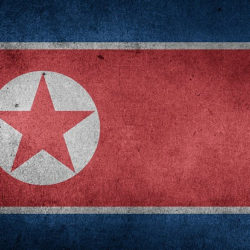
North Korean flag with a red star inside a white circle on a red background, bordered by blue and white stripes.

North Korea’s Chemical Weapons, Biological Weapons, and Nanoweapons

It may appear unbelievable that a country unable to feed its people or reliably provide basic utilities, like electricity, is able to develop and deploy chemical weapons, biological weapons, and nanoweapons. However, that is the reality.

The US, UN, and world media attention currently focuses on North Korea’s missile and nuclear tests, mainly because they are visible elements of military capability. However, the world’s most secretive nation is not placing all its bets on missiles and nuclear weapons. Let us examine their asymmetrical capabilities in chemical weapons, biological weapons, and nanoweapons.

  • North Korea possesses thousands of tons of chemical weapons, including nerve, blister, blood, and vomiting agents, as well as some biological weapons, including anthrax, smallpox, and cholera.
  • The State Academy of Sciences (SAS) runs 40 research institutes, 200 smaller research centers, a scientific equipment factory, and six publishing houses. The SAS focuses on, among other STEM (science, technology, engineering, mathematics) disciples, nanotechnology and its application to weapons (i.e., nanoweapons).

You may wonder, How does a nation that is unable to feed its populace or reliably provide a basic utility, like electricity, have the capability to focus on chemical weapons, biological weapons, and nanoweapons? The answer in a single word is Songun.

On August 25, 1960, Kim Jong-il, the then supreme leader of the Democratic People’s Republic of Korea (DPRK), commonly referred to as North Korea, instituted Songun, a “military first” policy. From that time forward, Songun became North Korea’s guiding policy in all matters domestic and foreign.

While the North Korean people may starve or sit in darkness, Songun assures their domestic defense industry, approximately 1,800 underground defense industry plants scattered throughout the country, and the State Academy of Sciences gets priority over all other needs.

Western analysts assess that North Korea’s military capabilities are rudimentary versus those of the United States, and the United States and its allies would prevail in a conflict with North Korea. However, the conflict may take months to conclude. In those months, North Korea’s military could cause the death of millions of people in South Korea and Japan, as well as many of the US forces within the region. In addition, we should assume North Korea would use all weapons at its disposal, including nuclear, conventional, and asymmetrical.

This begs a question, How potent are North Korea’s chemical weapons, biological weapons, and nanoweapons? Unlike conventional weapons, ballistic missiles, and nuclear weapons, it is extremely difficult to analyze asymmetrical weapons capabilities. However, this is what we know.

  • North Korea began its own chemical industry in 1954 and started making chemical weapons from its beginning. In 2014, the South Korean Defense Ministry estimated that North had stockpiled 2,500 to 5,000 tons of chemical weapons and had a capacity to produce a variety of biological weapons.
  • In my book, Nanoweapons: A Growing Threat To Humanity (Potomac Books 2017), I made the observation that China’s offensive nanoweapons capabilities may benefit from their alliances with North Korea and vice versa. Although, China’s nanoweapons capabilities are inferior to those of the United States, they are still formidable.

North Korea is a signatory to the Geneva Protocol, which prohibits the use of chemical weapons in warfare, and to the Biological and Toxins Weapons Convention (BTWC), which prohibits the development, production and stockpiling of bacteriological (biological) and toxin weapons. However, evidence suggests North Korea is responsible for the assassination of Kim Jong-un’s half-brother Kim Jong-nam, who was critical of Kim Jong-un’s regime. Authorities allege that North Korean agents sprayed VX nerve agent in Kim Jong-nam’s face, causing his death. If true, this suggests North Korea is unlikely to abide by the Geneva Protocol or the BTWC.

Unfortunately, the Geneva Conventions, which establish the standards of international law for humanitarian treatment in war, does not cover nanoweapons. Therefore, North Korea could deploy the simplest of nanoweapons, such as toxic nanoparticles, which mimic chemical weapons, and still be within the standards of international law.

UN sanctions have isolated North Korea to the point that over 90% of their trade is with China, which is critical to maintaining Kim Jong-un’s regime. However, China is becoming friendlier with the US, which North Korea sees as an enemy. Recently, the US and China voted for more UN sanctions against North Korea, and China curtailed its trade with them. Given the beefed-up US military presence in the region and China’s friendlier posture toward the US, North Korean leadership likely feels threatened. If North Korea’s leadership believes they will lose their position of power, they will strike perceived enemies with all capabilities at their disposal. If conflict erupts, expect North Korea to attempt to use its nuclear weapons, its conventional weapons, and its asymmetrical capabilities in chemical weapons, biological weapons, and nanoweapons.
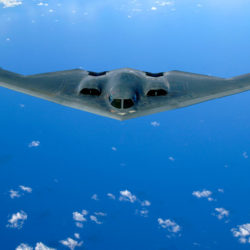
 

A B-2 Spirit stealth bomber flying over a blue sky with scattered clouds below.

North Korea’s “Super-mighty pre-emptive strike” – More Likely to Come from US after Pence Leaves Region

It would be unwise for the United States to preemptively attack North Korea while Vice President Pence is in the Asian region. It would also be suicidal for North Korea to attack any target that would potentially harm Pence. But, when Pence completes his 10 day Asian trip, all elements of a US preemptive strike against North Korea will be in place, namely:

  • Pence will have met with all major stakeholders in the region, including South Korea, Japan, and China, and likely appraised them of US intentions, in an effort to avoid miscommunications if hostilities start
  • Coupled with Pence’s Asian trip, the US will have sent a clear message that it will use its military force when it deems necessary, namely
    • The US Cruise missile attack on Syria’s Shayrat air base, suspected of being the launch site of Syria’s chemical weapons attack
    • The US’s use of the GBU-43/B Massive Ordnance Air Blast (MOAB)  against ISIS’s system of tunnels and caves in Afghanistan’s eastern Nangarhar Province
  • The US antiballistic defense system, Terminal High Altitude Area Defense system (Thaad), deployed in South Korea, will be fully operational
  • The US will have two aircraft carrier strike groups in the region, the USS Ronald Reagan, currently at the Yokosuka Naval Base in Japan, and the Carl Vinson, considered to be the US’s top supercarrier
  • A squadron of Whiteman Air Force Base (in Missouri) B-2 stealth bombers, each loaded with two of the US’s largest bunker buster bombs, the 15-ton GBU-57A/B Massive Ordnance Penetrator (MOP), will be ready to strike North Korea’s most hardened bunkers

While the news media has given significant coverage of Pence’s Asian trip, the US’s recent use of military force, the deployment of the Thaad missile defense system, and the aircraft striker groups, little has been discussed about B-2 bombers, each able to accommodate a payload of two MOPs. The B-2s have a range of slightly over 6,000 miles. With refueling in flight, the B-2s would be capable of striking North Korea in a round trip from Whiteman Air Force Base.

While recent news coverage of the US MOAB has correctly labeled it the “largest non-nuclear bomb” in the US arsenal, most did not emphasize the MOAB is not a bunker buster. So let’s understand the difference between the MOAB and the MOP.

The Pentagon developed the MOAB for use as an anti-personnel weapon, not as a bunker buster. In fact, the MOAB has a light 2,900 pound aluminum casing surrounding its 9 ton payload and is primarily an air burst munition. As mentioned in my previous Huff Post April 17, 2017 article, “United States ‘Mother Of All Bombs’ And Other Nanoweapons,” the MOAB likely achieves its 11 ton equivalent TNT blast via the use of nanoaluminum. As defined in my book, Nanoweapons: A Growing Threat to Humanity (Potomac 2017), “Nanoweapons are any military technology that exploits the power of nanotechnology.” This means even the largest munition, such as the MOAB, is a nanoweapon if it uses nanotechnology.

In sharp contrast, the MOP is a 15-ton earth/concrete-penetrating weapon, with a classified payload specially developed by the Defense Threat Reduction Agency to destroy weapons of mass destruction. I judge the MOP payload also uses a nano-enhanced explosive payload. This is speculation, but considering the military’s decade long experimentation with nano-accelerants to boost conventional explosives, the dots appear to connect.

With the above understanding, it is clear that the first elements of US preemptive strike against North Korea would involve B-2 bombers hammering hardened bunkers thought to be housing nuclear tipped ballistic missiles. Concurringly, the US would also use:

  • Ticonderoga-class guided-missile cruisers, like the USS Lake Champlain in the Carl Vinson supercarrier group, to launch Tomahawk cruise missiles to strike strategic or tactical targets, especially anti-aircraft missile launch sites
  • Carrier launched fighter aircraft to attack North Korean artillery and rocket launchers, once anti-aircraft missile sites have been destroyed
  • Thadd to counter any North Korean attempt to launch its ballistic missiles hidden in its vast mountainous forests
  • US attack submarines to destroy North Korean submarines and warships

The US goal of a preemptive strike would be to prevent North Korea from launching attacks, using artillery and missiles tipped with nuclear, chemical, or conventional warheads, against South Korea, Japan, other targets in the Pacific, including potentially Hawaii and US warships.

Will a US preemptive strike prevent North Korea from launching a counter attack? The answer is probably not completely, considering North Korea has up to 15,000 cannons and missile launchers in hardened bunkers.

A US preemptive strike is almost certain to result in some allied civilian, military, and US casualties. The question is how much, but US intelligence agencies are not providing estimates.

No matter how you view the North Korean problem, it is a nightmare. Even with a relatively successful US preemptive strike, What is the next move? China has about 150,000 troops stationed on the China Korean border. Will they invade North Korea? Will the US invade North Korea? Again, US intelligence agencies are not providing answers.

We know that we cannot allow North Korea to obtain strategic nuclear weapons capable of hitting targets in the US. It is possible that Pence’s visit to the region is to set the stage for a US preemptive strike, by via strategic understandings with South Korea, China and Japan. The US would likely see China as more stable occupying force in North Korea than Kim Jong-un’s regime. President Trump has made it clear to Chinese President Xi Jinping that China’s help in resolving the North Korean problem would lead to a more favorable trade deal with the United States.

When Pence returns to the United States, what he reports to the president is likely to determine the next US move.

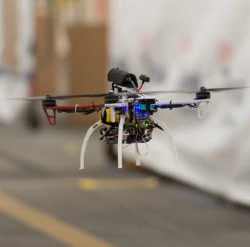
A close-up of a small quadcopter drone hovering indoors with visible wiring and components.

Will Nanoweapons of Mass Destruction (NMD) Be Our Final Invention?

You may never have heard of nanoweapons. Recent polls indicate that most people in the United States do not know about nanotechnology, let alone nanoweapons. Therefore, let us start at the beginning.

According to the United States National Nanotechnology Initiative’s website, nano.gov, “Nanotechnology is science, engineering, and technology conducted at the nanoscale, which is about 1 to 100 nanometers.” The diameter of a typical human hair is about 100,000 nanometers. This means we are dealing with technology that is invisible to the naked eye or even under an optical microscope. This may suggest that nanotechnology products are rare. Nothing could be further from the truth. Numerous companies are producing commercial nanotechnology products, from cosmetics to integrated circuit microprocessors. Nanomedicine (i.e., medical nanotechnology) is using T-cell nanobots, tiny robots at the nanoscale, in medical trials to cure over eighty percent of terminally ill cancer patients. Factually, you may not have heard about nanotechnology, but you are likely using a product that incorporates it. Some estimates place the worldwide market for nanotechnology products at over $1 trillion in 2015 and estimated to grow to $3 trillion by 2020.

Nanoweapons are any military technology that exploits the power of nanotechnology. Let me provide an example. In 2007, the Russian military successfully tested the world’s most powerful non-nuclear air-delivered bomb, nicknamed the “father of all bombs.” Even though it only carries about 7 tons of explosives compared with more than 8 tons of explosives carried by the United States Massive Ordnance Air Blast bomb, the Russian bomb is four times more powerful. The Russians do not explain how they achieve the more destructive bomb. However, most likely they are using nanometals, such as nanoaluminum, as a catalyst to create explosives more powerful than conventional explosives. As powerful as the Russian bomb is, it still pales in comparison to nuclear weapons. Given the title of this article, you may wonder if I am being an alarmist. Let me share some information with you.

Let us start with some facts. The typical events most people consider probable to cause humanity’s extinction, such as a large asteroid or a super-volcanic eruption, have a low probability of occurrence, about 1 in 50,000. Ironically, one of the most probable events likely to cause human extinction is seldom in the media or addressed by world governments, namely molecular nanotechnology weapons (i.e., nanoweapons). In 2008, experts surveyed at the Global Catastrophic Risk Conference at the University of Oxford predicted that nanoweapons have a 1 in 20 (i.e., 5%) probability of causing human extinction by the year 2100.

Are these experts right? Unfortunately, all the evidence to date suggests they are. For example, consider the simplest of all nanoweapons, toxic nanoparticles. The United States, Russia, and China know how to make toxic nanoparticles in quantities sufficient to cripple an adversary’s populace. A populace exposed to toxic nanoparticles may experience serious illnesses, including death. In sufficient quantity, toxic nanoparticles could wipe out New York City, Beijing, or Moscow, which qualifies them as nanoweapons of mass destruction (NMD). Delivery to the target populace could be as simple as introducing it into the city’s reservoirs. Even a single individual may become the target. A recent 2016 headline in Pravda, Russia’s state run newspaper, reads, “US nano weapon killed Venezuela’s Hugo Chavez, scientists say.” The Venezuelan scientists mentioned in the article attributed Hugo Chavez’s death to toxic nanoparticles that cause cancer, but no data in the public domain substantiates their claim. However, the assertion itself indicates an awareness of toxic nanoparticles and their potential lethality.

What makes nanoweapons more problematic than nuclear weapons is our potential to lose control over them. For example, consider a nanobot that mimics an innocuous fly. It could be a surveillance or lethal nanoweapon. This may sound like science fiction, but it is not. On Dec. 16, 2014, the United States Army Research Laboratory announced development of a fly drone weighing only a small fraction of a gram. Using DARPA’s Fast Lightweight Autonomy (FLA) program, which allows small drones to enter buildings and avoid crashing into objects, the fly drone could spy on an adversary from within the adversary’s operations center. This gives a completely new meaning to “fly on the wall.” Alternately, it could deposit a small, but lethal amount of toxin in the adversary’s food or water. The most lethal toxin known is botulism H. As little as 100 nanograms of botulism H is lethal to humans, who would be unable to smell, taste, or see that amount of toxin. Imagine 50 million fly drones, each able to deliver a lethal toxin. In that quantity, the fly drones become nanoweapons of mass destruction. However, a quantity of that size raises a question, How do we control these nanoweapons of mass destruction? If we lost control, the fly drones could spread beyond the adversary’s boarder and begin killing indiscriminately. It becomes the technological equivalent of a bioweapon, but does not fall under the Geneva Protocol.

It may be hard to believe, but nanoweapons of mass destruction are moving from science fiction to science fact. This brings us back to the title of the post, Will Nanoweapons of Mass Destruction (NMD) Be Our Final Invention?


Detailed sketch of a mechanical rabbit with intricate robotic limbs and wings in a dynamic pose.

The Rise of the Nanobots

Let’s start with a simple definition. Nanobots are nanoscale robots. Once, strictly confined to speculation and science fiction, the military and medical industry is making them a reality.

In the medical industry, specifically the area of nanomedicine, nanobots are being developed and used in human trials to cure a number of diseases, including cancer. For example, on May 15, 2015 Next Big Future reported, “Bachelet (i.e., Dr. Ido Bachelet, manager of Bar-Ilan University’s robot laboratory) has developed a method of producing innovative DNA molecules with characteristics that can be used to ‘program’ them to reach specific locations in the body and carry out pre-programmed operations there in response to stimulation from the body.” In this case, the pre-programming involves detecting cancer cells and delivering an existing cancer drug treatment directly to a cancerous cell, bypassing healthy cells. As of this writing, Dr. Bachelet and Pfizer announced “partnering” to perform human trials, using the DNA nanobots. However, there have been no reports on the human trials to date.

Other medical researchers are taking a similar approach, as reported in Science Translational Medicine, Renier J. Brentjens et. al., 20 Mar 2013. In essence, they remove some of the patient’s T-cells, which are cells produced by the patient’s thymus gland. T-cells work as part of the human immune system. After removing the T-cells, researchers alter them in the laboratory with a gene therapy to make them recognize a protein on the cancer cells. Then they inject the altered T-cells into the patient’s bloodstream. There the T-cells order the cancerous cell to return to their normal configuration. If the cell has mutated too far to return to its original configuration, it orders the cell to self-destruct. Their results, reported in 2013, have been astounding, causing the cancer of 14 out of 16 terminally ill patients to go into remission. I think it would be correct to consider the altered T-cells nanobots.

The military has been relatively quiet about their work with nanobots. However, the use of United States military robots dates back to World War I, with its use of torpedoes. As is clear from recent conflicts, military robotics are now an indispensable technology the United States, and other countries, use to make war. A new thrust in military robotics is emerging, namely shrinking them.  For example, on December 16, 2014, the Army Research Laboratory announced creation of a “fly drone” weighing a small fraction of a gram. The fly drone’s capabilities are secret, but it is plausible the fly drone will offer the United States military the ability to enter buildings, perform surveillance, and potentially offensive operations. This gives a completely new meaning to “fly on the wall.” Although the Army did not comment on the construction of the fly drone, I judge it incorporates nanotechnology. If the Army is willing to announce development on a fly size drone, it is likely that they have even smaller more advanced drones in development.

You might wonder how does a fly drone provide offensive capabilities. Similar to the way biological flies spread diseases, the fly drone could deposit a toxic substance on an adversary’s food. For example, it may be used to deposit botulinum toxin H, the most lethal toxin in existence. The lethal dose is 100 nanograms. That amount of toxin would be impossible to see, smell, or taste.

I wrote this post to make an important point. Nanobots have move from sci-fi to science fact. Millions of nanobots can cure diseases like cancer or, as nanoweapons, become nanoweapons of mass destruction (NMD). Technology is ethically neutral. It is up to humanity to use the technology ethically.


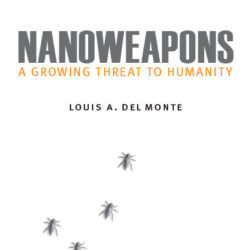
Book cover titled 'Nanoweapons: A Growing Threat to Humanity' by Louis A. Del Monte with small insect-like figures.

Nanoweapons: A Growing Threat to Humanity (Book)

My new book and the first in its genre, Nanoweapons: A Growing Threat to Humanity, is now available at a special introductory price of 30% off from all popular booksellers.

From the Publisher, Potomac Books

Nearly Invisible Weapons of Mass Destruction 

 
Nanoweapons just might render humanity extinct in the near future—a notion that is frightening and shocking but potentially true. In Nanoweapons Louis A. Del Monte describes the most deadly generation of military weapons the world has ever encountered. With dimensions one-thousandth the diameter of a single strand of human hair, this technology threatens to eradicate humanity as it incites world governments to compete in the deadliest arms race ever.

In his insightful and prescient account of this risky and radical technology, Del Monte predicts that nanoweapons will dominate the battlefield of the future and will help determine the superpowers of the twenty-first century. He traces the emergence of nanotechnology, discusses the current development of nanoweapons—such as the “mini-nuke,” which weighs five pounds and carries the power of one hundred tons of TNT—and offers concrete recommendations, founded in historical precedent, for controlling their proliferation and avoiding human annihilation. Most critically, Nanoweapons addresses the question: Will it be possible to develop, deploy, and use nanoweapons in warfare without rendering humanity extinct?

Louis A. Del Monte is an award-winning physicist, featured speaker, and is the chief executive officer of Del Monte and Associates, Inc. During his thirty-year career as a physicist and business executive at IBM and Honeywell, he led the development of microelectronics and sensors and developed patents fundamental to the fabrication of integrated circuits. He is the author of The Artificial Intelligence Revolution: Will Artificial Intelligence Serve Us or Replace Us? and How to Time Travel: Explore the Science, Paradoxes, and Evidence.

Praise

Louis Del Monte provides a futurist clarion call for people to start thinking and talking about this emerging technology—a technology fraught with the potential for great good and great harm.”—Col. Thomas R. Lujan, U.S. Army (Ret.), attorney at law

Nanoweapons opens the cloak of secrecy on the developing area of nanotechnologies and how societies may use them in the future for good and evil. A very captivating topic.”—Tamara Bratland, engineer for a Fortune 500 medical device company

“A very informative read. Nanotechnology can enhance our lives or eradicate humankind. This book can help preserve our future.”—Richard Spielberger, former Honeywell Engineer Fellow

Get Your Copy Now At 30% Off


Download Publisher PDF Information and Order Form

At Your Favorite Local Bookstore