Tag Archives: louis del monte

end of the universe

What Made the Big Bang Go Bang?

This is a little play on words. The Big Bang theory holds that the evolution of the universe started with an infinitesimal packet of near infinite energy (termed a “singularity”) that suddenly expanded and continues to expand. If this is true, was it big? No, it was infinitesimally small. Did it go bang? No, it expanded. Space is a vacuum, and it is unable to transmit sound waves. Therefore, there were no sound waves to make a bang noise. Granted, I was not there since it took place 13.8 billion years ago, and you are certainly entitled to your own opinion. I am only jesting, but the description above of the Big Bang theory is what the scientific community holds to be responsible for the evolution of the universe.

What initiated the Big Bang’s expansion?

Throughout the theories of science, there appears to be a common thread based on well-observed physical phenomena regarding the behavior of energy. That common thread states that differences in temperature, pressure, and chemical potential always seek equilibrium if they are in an isolated physical system. For example, with time, a hot cup of coffee will cool to room temperature. This means it reaches equilibrium (balance, stability and sameness) with the temperature of the room, which is the isolated physical system in this example. Readers familiar with thermodynamics will instantly attribute this behavior of energy as following the second law of thermodynamics. However, the same law, worded differently, exists in numerous scientific contexts. In the interest of clarity, I am going to restate this law, describing the behavior of energy, in a way that makes it independent of scientific contexts. In a sense, it abstracts the essence of the contextual statements, and views applications of the law in various scientific contexts as specific cases. I am not the first physicist to undertake generalizing the second law of thermodynamics to make it independent of scientific contexts. However, I believe my proposed restatement provides a simple and comprehensive description of the laws that energy follows. For the sake of reference, I have termed my restatement the Minimum Energy Principle.

Energy in any form seeks stability at the lowest energy state possible, and will not transition to a new state unless acted on by another energy source.

Consider these two examples to illustrate the Minimum Energy Principle.

1)   Radioactive substances. Radioactive substances emit radiation until they are no longer radioactive (they become stable). However, by introducing other radioactive substances under the right conditions, they can transition to a new state. Indeed, if the proper radioactive elements combine under the right circumstances, the result can be an atomic explosion.

2)   A thermodynamic example. Consider a branding iron fresh from the fire. It emits thermal radiation until it reaches equilibrium with its surroundings. In other words, once a branding iron leaves the fire, it will start to cool by transferring energy to its surrounding. Eventually, it will be at the same temperature as its surroundings. (This illustrates the first part of the Minimum Energy Principle: Energy in any form seeks stability at the lowest energy state possible.) However, if we increase the temperature of the branding iron by placing it back in the fire, the branding iron will absorb energy until it again reaches equilibrium with the temperature of the fire. (This illustrates the second part of the Minimum Energy Principle: It transitions to this new state by being acted on by the fire. The fire acts as an energy source.)

The Minimum Energy Principle is consistent with the law of entropy. To understand this, we will need to discuss entropy. In classical thermodynamics, entropy is the energy unavailable for work in a thermodynamic process. For example, no machine is one hundred percent efficient in converting energy to work. A portion of the energy is always lost in the form of waste heat. An example is the miles per gallon achievable via your car engine, ignoring other factors such as the weight of the vehicle, its aerodynamic design, and other similar factors. Several car manufacturers are able to build highly efficient engines. However, no car manufacturer can build an engine that is one hundred percent efficient. As a result, a fraction of total energy is always lost, typically in the form of waste heat.

Entropy proceeds in one direction, and is a measure of the system’s disorder. Any increase in entropy implies an increase in disorder and an increase in stability. For example, the heat lost in a car engine is lost to the atmosphere, and is no longer usable to do work. The heat lost is adding to the disorder of the universe, and is a measure of entropy. Oddly, though, the lost heat is completely stable.

In a given system, entropy is either constant or increasing, depending on the flow of energy. If the system is isolated, and has no energy flow, the entropy remains constant. If the system is undergoing an energy change, such as ice melting in a glass of water, the entropy is increasing. When the ice completely melts, and the system reaches equilibrium with its surrounding, it is stable. This has a significant implication. Entropy is constantly increasing in the universe since everything in the universe is undergoing energy change. In theory, the entropy of the universe will eventually maximize, and all reality will be lost to heat. The universe will be completely stable and static. I have termed this the “entropy apocalypse.” (Some physicists term this “heat death.”) I know I am being a little dramatic here, but most of the scientific community believes the entropy (disorder) of the universe is increasing. Eventually, all energy in the universe will be stable and unusable, all change will cease to occur, and the universe will have reached the entropy apocalypse.

Based on the above discussion of entropy, we can argue that entropy seeks to maximize and, therefore, reduce energy to the lowest state possible. This is why I stated that the Minimum Energy Principle, which asserts that energy seeks the lowest state possible, is consistent with law of entropy.

How does this help us understand what made the Big Bang go bang? The Minimum Energy Principle, along with our understanding of the behavior of entropy, makes answering this question relatively easy. The scientific community agrees that the Big Bang started with a point of infinite energy, at the instant prior to the expansion. From the Minimum Energy Principle, we know “Energy in any form seeks stability at the lowest energy state possible and will not transition to a new state unless acted on by another energy source.” Since we know it went “bang,” we can make three deductions regarding the infinitely dense-energy point. First, it was not stable. Second, it was not in the lowest energy state possible. Third, the entropy of the infinitely dense-energy point was at its lowest state possible, which science terms the “ground-state entropy.” These three conditions set the stage for the Minimum Energy Principle and the laws of entropy to initiate the Big Bang.

By the very nature of “playing the tape” of the expanding universe back to discover its origin, namely the Big Bang, we can conclude a highly dense energy state. It will be a highly dense energy state because we are going to take all the energy that expanded from the Big Bang, and cause it to contract. As it contracts, the universe grows smaller and more energy-dense. At the end of this process, we have a highly dense energy state. I think of it as a point, potentially without dimensions, but with near-infinite energy. This view is widely held by the scientific community. If it is true, all logic causes us to conclude it was an infinitely excited energy state, and we would have every reason to question its stability—and to believe it was at the “ground-state” entropy (the lowest entropy state possible).

Our observations of unstable energy systems in the laboratory suggest that as soon as the point of infinite energy came to exist, it had to seek stability at a lower energy level. The Big Bang was a form of energy dilution. In the process of lowering the energy, it increased the entropy of the universe. Once again, we see the Minimum Energy Principle and the law of entropy acting in concert.

How long did the infinitely dense-energy point exist? No one really knows. However, we can approach an answer by understanding more about time.

Discussing the Big Bang in terms of time, as we typically understand time, is difficult. It will not do any good to look at your watch or think in small fractions of a second. Stop-motion photography will not work this time. Those times are infinitely large compared to Planck time (~ 10-43 seconds, which is a one divided by a one with forty-three zero after it). Theoretically, Planck time is the smallest time-frame we will ever be able to measure. So far, we have not even come close to measuring Planck time. The best measurement of time to date is of the order 10-18 seconds.

What is so significant about Planck time? The fundamental constants of the universe formulate Planck time, not arbitrary units. According to the laws of physics, we would be unable to measure “change” if the time interval were shorter that Planck time. In other words, Planck time is the shortest interval we humans are able to measure, or even comprehend change to occur. Scientifically, it can be argued that no time interval is shorter that Planck time. Thus, the most rapid change can only occur in concert with Planck time, and no faster. Therefore, when we discuss the initiation of the Big Bang, the smallest time interval we can consider is Planck time.

The whole notion of Planck time, and its relationship to the Big Bang, begs another question. Did time always exist? Most physicists say NO. Time requires energy changes, and that did not occur until the instant of the Big Bang. Stephen Hawking, one of the world’s most prominent physicists and cosmologists, is on record that he believes time started with the Big Bang. Dr. Hawking asserts that if there was a time before the Big Bang, we have no way to access the information. From this standpoint, it is reasonable to believe time for our universe started with the Big Bang. This is our reality. This is consistent with Occam’s razor, which states the simplest explanation is the most plausible one (until new data to the contrary is available). For our universe, the Big Bang started the clock ticking, with the smallest tick being Planck time.

We are finally in a position to answer the crucial question: What made the big bang go bang?

The Big Bang followed the Minimum Energy Principle, “Energy in any form seeks stability at the lowest energy state possible, and will not transition to a new state unless acted on by another energy source.” The infinitely dense energy point, which science terms a “singularity,” sought stability at the lowest energy state possible. Being infinitely energy-dense, implies instability and minimum entropy (ground-state entropy). Thus, it required dilution to become stable, which caused entropy to increase. The dilution came in the form of the “Big Bang.” Since we were dealing with an unstable infinitely energy-dense point, it is reasonable to assert the Big Bang went bang at the instant of existence. The instant of existence would correlate to the smallest time interval science can conceive, the Planck time. This process is continuing today as space continues its accelerated expansion. 

Source: Unraveling the Universe’s Mysteries (2012), Louis A. Del Monte, available on Amazon.com
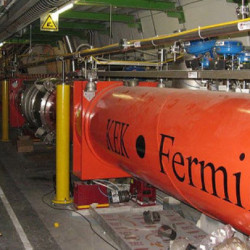
Interior view of the Fermi particle accelerator with its large orange beamline and surrounding machinery.

Evidence of time travel to the future (time dilation)

When we talk about time travel to the future, in scientific terms we are talking about time dilation. What is time dilation? It is a scientific fact that time moves slower for any mass accelerated near the speed of light. If that mass were a clock, for example, the hands of the clock would appear to be moving slower than a clock in the hand of an observer at rest. That phenomenon is termed time dilation. Below are the classic experiments that have demonstrated time travel to the future (time dilation) is real.

Velocity time dilation experimental evidence:

Rossi and Hall (1941) compared the population of cosmic-ray-produced muons at the top of a six-thousand-foot-high mountain to muons observed at sea level. A muon is a subatomic particle with a negative charge and about two hundred times more massive than an electron. Muons occur naturally when cosmic rays (energetic-charged subatomic particles, like protons, originating in outer space) interact with the atmosphere. Muons, at rest, disintegrate in about 2 x 10⁻⁶ seconds. The mountain chosen by Rossi and Hall was high. The muons should have mostly disintegrated before they reached the ground. Therefore, extremely few muons should have been detected at ground level, versus the top of the mountain. However, their experimental results indicated the muon sample at the base experienced only a moderate reduction. The muons were decaying approximately ten times slower than if they were at rest. They made use of Einstein’s time dilation effect to explain this discrepancy. They attributed the muon’s high speed, with its associated high kinetic energy, to be dilating time.

In 1963, Frisch and Smith once again confirmed the Rossi and Hall experiment, proving beyond doubt that extremely high kinetic energy prolongs a particle’s life.

With the advent of particle accelerators that are capable of moving particles at near light speed, the confirmation of time dilation has become routine. A particle accelerator is a scientific apparatus for accelerating subatomic particles to high velocities by using electric or electromagnetic fields. The largest particle accelerator is the Large Hadron Collider, completed in 2008.

In 1977, J. Bailey and CERN (European Organization for Nuclear Research) colleagues accelerated muons to within 0.9994% of the speed of light and found their lifetime had been extended by 29.3 times their corresponding rest mass lifetime. (Reference: Bailey, J., et al., Nature 268, 301 [1977] on muon lifetimes and time dilation.) This experiment confirmed the “twin paradox,” whereby a twin makes a journey into space in a near-speed-of-light spaceship and returns home to find he has aged less than his identical twin who stayed on Earth. This means that clocks sent away at near the speed of light and returned near the speed of light to their initial position demonstrate retardation (record less time) with respect to a resting clock.

Gravitational time dilation experimental evidence:

In 1959, Pound and Rebka measured a slight redshift in the frequency of light emitted close to the Earth’s surface (where Earth’s gravitational field is higher), versus the frequency of light emitted at a distance farther from the Earth’s surface. The results they measured were within 10% of those predicted by the gravitational time dilation of general relativity.

In 1964, Pound and Snider performed a similar experiment, and their measurements were within 1% predicted by general relativity.

In 1980, the team of Vessot, Levine, Mattison, Blomberg, Hoffman, Nystrom, Farrel, Decher, Eby, Baugher, Watts, Teuber, and Wills published “Test of Relativistic Gravitation with a Space-Borne Hydrogen Maser,” and increased the accuracy of measurement to about 0.01%. In 2010, Chou, Hume, Rosenband, and Wineland published “Optical Clocks and Relativity.” This experiment confirmed gravitational time dilation at a height difference of one meter using optical atomic clocks, which are considered the most accurate types of clocks.

This information is from my new book, How to Time Travel, available in both a Kindle and paperback edition on Amazon. To browse the book free and read the reviews click here: How to Time Travel.

Black and white photo of a large crowd of people gathered outdoors, many wearing hats and coats.

Is This Photographic Evidence of a Time Traveler?

Is This Photographic Evidence of a Time Traveler? This post is based on material from chapter 2 of my new book, How to Time Travel.

If you do an Internet search with Google using the keyword phase “time travel evidence” (without the quotes), you will get about 258,000,000 search returns. Most of the “evidence” is not scientific evidence. It is anecdotal. However, the sheer volume of time travel anecdotal evidence on the internet makes it hard to ignore.

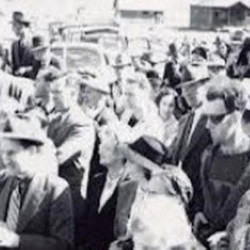
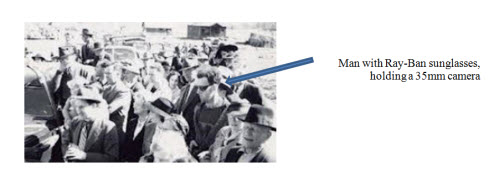
One category of evidence is old photographs. Many sites include old photographs that show people out of context, for example, wearing clothing that does not fit the time, such as modern sunglasses, or using devices, such as a 35mm camera, that did not exist at the time the photograph was taken. To see these results do a Google search using the phrase “time travel photo evidence” (without the quotes). You can find several websites that have a number of good examples such as the 1941 photograph of a person with Ray-Ban sunglasses,  a screen-print T-shirt and a 35mm camera (below).

10-18-2013 11-25-53 AM photo evidence

Let us  examine some of the photographic evidence. I have made two observations:

  1. Many of the old photographs are fuzzy. This is typical of old photographs, since cameras in the early part of the twentieth century were crude.
  2. The claims that something or someone is “out of context” are a bit of a stretch. For example, consider the man in the 1941 photograph. Some suggest he is wearing Ray-Ban sunglasses and a screen-print T-shirt, and holding a modern 35mm camera. I think the photograph is too fuzzy to make a solid case for these assertions, but that is just my opinion. I suggest you view the photograph and draw your own conclusion.

In addition, with today’s computer technology and state-of-the-art photograph-editing programs, such as Photoshop, it is possible to manipulate a photograph and have Elvis shaking hands with Albert Einstein. Only a highly trained computer photographic expert would be able to determine that the photograph is a computer-generated manipulation of pixels—in other words, a fake. The technology is that good. This makes me suspicious of all photographic evidence that has not been analyzed by a highly trained expert.

Although the photograph is intriguing, it is not conclusive. Therefore, you will have to be the judge. Is this photograph evidence of a time traveler?


Black and white aerial view of a military patrol boat sailing on the ocean.

Did the Philadelphia Experiment (Time Travel) Really Happen? – Part 2/2 (Conclusion)

Did the Philadelphia Experiment (Time Travel) Really Happen? In part 1, we noted the Philadelphia Experiment is as good as urban legends get, supposedly incorporating the science of Einstein, a government secret experiment, unexplainable phenomena, and brainwashed survivors. It is only natural to ask: How did the Philadelphia Experiment urban legend get started?

The origin of the Philadelphia Experiment urban legend is itself another urban legend. We have one urban legend underpinning another. To quote Winston Churchill, we have “a riddle, wrapped in a mystery, inside an enigma.” Again, there are numerous accounts of the origin of the Philadelphia Experiment. We will use the 2002 book by James Moseley and Karl Pflock, Shockingly Close to the Truth!: Confessions of a Grave-Robbing Ufologist, as a reference on the origin of the Philadelphia Experiment urban legend.

According to Moseley and Pflock’s 2002 book, in 1957, the Office of Naval Research (ONR) in Washington, DC, contacted Morris K. Jessup, an astronomer and author of the 1955 book The Case for the UFO. He was asked to study the contents of a parcel that the ONR had received in a manila envelope marked “Happy Easter.” It was a paperback copy of Jessup’s UFO book that had been extensively annotated in its margins. Moseley and Pflock claim that annotations were written with three different shades of pink ink. The annotations detail correspondences among three individuals: “Jemi,” and two others the ONR labeled “Mr. A.” and “Mr. B.” The annotators refer to themselves as “Gypsies,” discuss people living in outer space, and comment on the merits of Jessup’s assumptions in the book. The annotations also contain a reference to the Philadelphia Experiment.

The ONR asked Jessup if he knew anything about the annotations, including knowledge of those involved. Jessup identified “Mr. A” as Carlos Allende. Supposedly, Allende had sent Jessup a letter in 1955 claiming to have served on the SS Andrew Furuseth and claiming to have direct knowledge of the Philadelphia Experiment. Allende claimed he witnessed the Eldridge appear and disappear. When Jessup requested that Allende provide evidence and corroboration, Jessup received another correspondence. This new correspondence came from a man identifying himself as Carl M. Allen. Allen said that he could not provide the evidence and corroboration Jessup sought. However, Allen implied that he might be able to recall some details via hypnosis. This all seemed highly suspicious to Jessup, and he discontinued the correspondence. (Apparently, Jessup’s suspicions were well founded. The ONR determined the return address on Allende’s letter to Jessup was an abandoned farmhouse.)

Now, the story becomes even stranger. According to Moseley and Pflock’s 2002 book, the ONR decided to fund a small printing, about a hundred copies, of the annotated volume, complete with both letters Jessup had received from Allende/Allen. The Texas-based Varo Manufacturing Company did the printing. Supposedly, the ONR gave Jessup three copies and circulated the rest within the navy. For those interested, I found a copy of the Varo edition online at this website: https://obscurantist.com/files/case-for-ufos-annotated.pdf.

Jessup began to write extensively on the topic in an attempt to make a living, but his follow-up book did not sell well, and the publisher rejected his other manuscripts. Jessup became depressed, and his life took a turn for the worse when he was involved in a car accident. This further added to his depression, and Jessup committed suicide on April 20, 1959.

What gives this urban legend legs are three published books. These are not the only books on the Philadelphia Experiment. However, according to historian Mike Dash, numerous authors appear to take their information from one of the three sources below:

  1. Jessup’s 1955 book, The Case for the UFO
  2. Moseley and Pflock’s 2002 book, Shockingly Close to the Truth!: Confessions of a Grave-Robbing Ufologist
  3. The ONR’s Varo edition of Jessup’s book, complete with annotations and letters Jessup had received from Allende/Allen

However, is any of it true? Do the facts support any portion of the Philadelphia Experiment?

In 1980, Robert Goerman wrote in Fate magazine that Carlos Allende/Carl Allen was Carl Meredith Allen of New Kensington, Pennsylvania. Carl Meredith Allen had a history of psychiatric illness. Goerman speculates that Allen may have fabricated the Philadelphia Experiment as a result of his mental illness. Later Goerman characterized Allen as “a creative and imaginative loner…sending bizarre writings and claims.”

Berlitz and Moore’s book The Philadelphia Experiment: Project Invisibility, published in 1979, claims to include factual information, such as an interview with a scientist involved in the experiment. This book is considered a definitive source for information on the Philadelphia Experiment. However, some critics accuse Berlitz and Moore of plagiarizing story elements from the novel Thin Air, by George E. Simpson and Neal R. Burger, which was published a year earlier. However, this criticism may not be fair. Earlier works on the subject likely inspired Thin Air, including Berlitz’s chapter on the experiment in his 1977 book, Without a Trace: New Information from the Triangle. This suggests the criticism of plagiarism is unwarranted. Berlitz and Moore’s book may be the real deal.

Now, let us discuss the science and other facts surrounding the Philadelphia Experiment. From the standpoint of science, light bends, in accordance with Einstein’s general theory of relativity, when it is near the surface of an extremely massive object, such as a sun or a black hole. No known or published scientific apparatus exists that enables us to bend light around an object the size of a navy ship. Could the navy have secretly developed such an apparatus by 1943? I do not think it is likely, but I will not rule it out altogether. The science claimed to be used in the Philadelphia Experiment was unified field theory. Factually, even today, there is no accepted unified field theory, but it is an area of ongoing research. Einstein was working on unified field theory, attempting to unify electromagnetism with general relativity, his theory of gravity. Some accounts of the Philadelphia Experiment suggest that Einstein was successful, but chose not to publish it.

The USS Eldridge was commissioned on August 27, 1943. This is one month after the first experiment was reported to occur. According to official records, it remained in port in New York City until September 1943. Also according to official records, the Eldridge was on its first shakedown cruise in the Bahamas during the time the October experiment was reported to occur. Proponents of the Philadelphia Experiment argue that the ship’s logs have been falsified and the real logs are classified.

In 1996, the Office of Naval Research (ONR) stated, “ONR has never conducted investigations on radar invisibility, either in 1943 or at any other time.” In addition, they pointed out that the ONR was not established until 1946, three years after the Philadelphia Experiment. The implication is the ONR did not exist or conduct the Philadelphia Experiment. Further, the ONR denounced the Philadelphia Experiment as “science fiction.” This appears to be corroborated by the navy veterans who served aboard the USS Eldridge. During a 1999 reunion, the Eldridge veterans told a Philadelphia newspaper that their ship had never made port in Philadelphia.

Some critics debunk the Philadelphia Experiment by arguing it was just a case of misinterpretation. They argue the Eldridge was “degaussed” (the process of making a steel ship’s hull nonmagnetic) while in port, and this procedure started the urban legend. It is a fact that the Eldridge was degaussed. This was a common procedure to render a ship undetectable to magnetically fused undersea mines and torpedoes. It required the generation of a strong electromagnetic field onboard the ship. Charles F. Goodeve invented this procedure when he was a commander in the Royal Canadian Naval Volunteer Reserve. The Royal Navy and United States Navy used it widely during World War II.

Is the Philadelphia Experiment fact or fiction? Is it possible the United States Navy has been able to orchestrate a consistent set of lies over a period of what is now about seventy years? You will have to be the judge. I have provided the story points proponents and opponents of the Philadelphia Experiment cite. Which side do you favor? Regardless of which way you lean, one thing is certain. The accounts of the Philadelphia Experiment are intriguing, and they are still making the rounds over seventy years since the alleged first experiment. It is, in my opinion, representative of the category of urban legends related to time travel.

The entire case study of the Philadelphia Experiment is also in my new book, How to Time Travel, available on Amazon.com in both a paperback and Kindle version https://amzn.to/1922in4.

Black and white aerial view of a military patrol boat sailing on the ocean.

Did the Philadelphia Experiment (Time Travel) Really Happen? – Part 1/2

Did the Philadelphia Experiment (Time Travel) Really Happen?

The Philadelphia Experiment is one of the most popular urban legends regarding time travel. For this reason, I have compiled a complete case study of it and included it my new book, How to Time Travel. In my judgment, it is a good representation of the urban legend category. Word of mouth, books, the Internet, motion pictures, and documentaries have popularized it, and it is still making the rounds alive and well today.

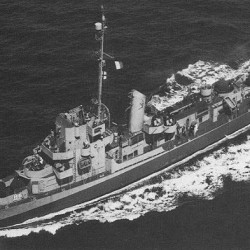
The Philadelphia Experiment, also known as Project Rainbow, allegedly had the objective of “cloaking” (i.e., rendering invisible) the United States Navy destroyer escort Eldridge, shown in a 1943-era photograph with this article.

Purportedly, in the process of cloaking the Eldridge, strange phenomena occurred, including time travel. The experiment supposedly took place at the Philadelphia Naval Shipyard, on or around October 28, 1943.

Like many urban legends, there are numerous accounts of the Philadelphia Experiment. What follows are key story points common to most accounts. Allegedly, the experiment had full navy backing and was based on unified field theory (a term coined by Albert Einstein), which seeks to unite the fields of electromagnetism (in this case, light) and gravity into a single field. The theory was to bend light around the ship using large electrical generators, consequently bending spacetime and rendering the ship an invisible time machine.

There are no reliable attributable accounts, but supposedly, the Eldridge was fitted with the electrical generators in the summer of 1943 by “researchers,” whose identity remains unknown. After being properly equipped, testing began, reportedly with some success. Here are the salient test accounts:

  • July 22, 1943—The Eldridge was rendered invisible, some witnesses reporting a “greenish fog” in its place.
  • October 28, 1943—The Eldridge vanished in a flash of blue light and teleported to Norfolk, Virginia, about two hundred miles away. The Eldridge sat in full view of men aboard the SS Andrew Furuseth, a nearby merchant ship, for an unspecified period of time, whereupon the Eldridge vanished and reappeared at the original Philadelphia site, traveling approximately ten seconds (in some accounts longer) back in time.

According to many accounts, the experiments caused the crew to experience serious side effects. A number of accounts claim some members of the crew were fused physically to the metal structures of the ship, the atoms of their bodies intermixed with the atoms of the ship. For example, one sailor supposedly had his hand embedded in the steel hull of the ship one level below where he was originally standing. Others crew members were said to suffer nausea and mental disorders, and even to vanish completely. To make the story complete, the navy is said to have “brainwashed” any Eldridge survivors to prevent them from revealing the incidents.

The Philadelphia Experiment is as good as urban legends get, supposedly incorporating the science of Einstein, a government secret experiment, unexplainable phenomena, and brainwashed survivors. It is only natural to ask: How did the Philadelphia Experiment urban legend get started?

Stay tuned for part 2. The entire case study is also in my new book, How to Time Travel, available on Amazon.com in both paperback and Kindle version https://amzn.to/1922in4.

Image: United States Navy destroyer escort Eldridge