Tag Archives: louis del monte

Extraterrestrial Intelligence

Searching for Potential Alien Artifacts to Establish Proof of their Existence

Similar to the way archaeologists uncover lost civilizations on Earth by analyzing the artifacts left behind, various researchers believe the past presence of advanced aliens could be detected in a similar manner. This is a reasonable approach. It has historically provided evidence of civilizations that appear to have simply vanished. For example, the Mayan calendar is supposedly predicting the end of the world on December 21, 2012. Unfortunately, this is a poor example of a lost civilization, since it never disappeared. In fact, the Maya and their decedents still populate the Maya area, and continue to honor traditions that date back centuries. Millions of Mayans still speak the Mayan language. As for the Maya calendar, most scholars do not interpret it to predict the end of the world.

A real example of a lost civilization can be found in our own North American backyard. The Anasazi lived in the bordering parts of Utah, Arizona, New Mexico, and Colorado. The Anasazi civilization emerged about 1100 BC, and appeared to vanish about 1100 AD. However, did they really vanish? Most archeologist think not. They did abandon their traditional homeland. In a number of cases, the “lost” civilizations are not lost. They move to a different location for reasons that generally relate to survival, like water and food availability. However, the point is that we know about the Anasazi civilization by studying the artifacts lefts behind, including their dwellings, pottery, tools, and the like.

Proponents of ancient alien visits to Earth point to the numerous alien-like artifacts. These include:

  • References in religious texts, such as the Book of Ezekiel (Biblical Old Testament)
  • Physical evidence such as Nazca Lines, which depict drawings that can only be fully seen from the air (Peru)
  • Ancient aircraft-type models, like the Saqqara Bird (1898 excavation of the Pa-di-Imen tomb in Saqqara, Egypt), and small gold model “planes” (Central America and coastal areas of South America)
  • Unusual ancient monuments and ruins such as the Giza pyramids in Egypt, Machu Picchu in Peru, Baalbek in Lebanon, the Moai on Easter Island, and Stonehenge in England. Proponents of ancient alien visits argue these structures could not have been built without alien help. They argue that the ability to build them was beyond the capability of humankind at the time they were built.

This is a sampling that proponents of ancient aliens provide as evidence that the Earth has been visited since ancient times by advanced aliens. Numerous books forward this theory. The most famous was written by Erich von Däniken, and published in 1968 (Chariots of the Gods?).

Obviously, this is a speculative theory, and not everyone agrees. In fact, there is considerable disagreement. Several disagree on religious grounds, like the Christian creationist community. Other critics simply say the evidence is subject to various interpretations. In reality, we have not found irrefutable evidence—the “smoking gun.” For example, if we found an electromagnetic transmitter (a radio) of unknown origin inside a newly discovered 3,000-year-old pyramid, that would be a smoking gun.

Source: Unraveling the Universe’s Mysteries (2012), Louis A. Del Monte

Image: iStockPhoto

A black and white image of a clock face with a spiral effect distorting the numbers and hands.

Twisting the Arrow of Time

The flow of time, sometimes referred to as the “arrow of time,” is a source of debate, especially among physicists. Most physicists argue that time can only move in one direction based on “causality” (i.e., the relationship between cause and effect). The causality argument goes something like this: every event in the future is the result of some cause, another event, in the past. This appears to make perfect sense, and it squares with our everyday experience. However, experiments within the last several years appear to argue reverse causality is possible. Reverse causality means the future can and does influence the past. For example, in reverse causality, the outcome of an experiment is determined by something that occurs after the experiment is done. The future is somehow able to reach into the past and affect it. Are you skeptical? Skepticism is healthy, especially in science. Let us discuss this reverse causality experiment.

In 2009, physicist John Howell of the University of Rochester and his colleagues devised an experiment that involved passing a laser beam through a prism. The experiment also involved a mirror that moved in extremely small increments via its attachment to a motor. When the laser beam was turned on, part of the beam passed through the prism, and part of the beam bounced off the mirror. After the beam was reflected by the mirror, the Howell team used “weak measurements” (i.e., measurement where the measured system is weakly affected by the measurement device) to measure the angle of deflection. With these measurements, the team was able to determine how much the mirror had moved. This part of the experiment is normal, and in no way suggests reverse causality. However, the Howell team took it to the next level, and this changed history, literally. Here is what they did. They set up two gates to make the reflected mirror measurements. After passing the beam through the first gate, the experimenters always made a measurement. After passing it through the second gate, the experimenters measured the beam only a portion of the time. If they chose not to make the measurement at the second gate, the amplitude of the deflected angle initially measured at the first gate was extremely small. If they chose to make the measurement at the second gate, the deflected angle initially measured at the first gate was amplified by a factor of 100. Somehow, the future measurement influenced the amplitude of the initial measurement. Your first instinct may be to consider this an experimental fluke, but it is not. Physicists Onur Hosten and Paul Kwiat, University of Illinois at Urbana-Champaign, using a beam of polarized light, repeated the experiment. Their results indicated an even larger amplification factor, in the order of 10,000.

The above experimental results raise questions about the “arrow of time.” It appears that under certain circumstances, the arrow of time can point in either direction, and time can flow in either direction, forward or backward. This is a scientific result, and I am not going to speculate about religious connotations, free will, and the like. Obviously, there are numerous religious connotations possible and a plethora of associated questions.

Source: How to Time Travel (2013), Louis A. Del Monte

M-theory

Using Wormholes as a Time Machine

Scientists have proposed using “wormholes” as a time machine. A wormhole is a theoretical entity in which space-time curvature connects two distant locations (or times). Although we do not have any concrete evidence that wormholes exist, we can infer their existence from Einstein’s general theory of relativity. However, we need more than a wormhole. We need a traversable wormhole. A traversable wormhole is exactly what the name implies. We can move through or send information through it.

If you would like to visualize what a wormhole does, imagine having a piece of paper whose two-dimensional surface represents four-dimensional space-time. Imagine folding the paper so that two points on the surface are connected. I understand that this is a highly simplified representation. In reality, we cannot visualize an actual wormhole. It might even exist in more than four dimensions.

How do we create a traversable wormhole? No one knows, but most scientists believe it would require enormous negative energy. This is interesting, since the Existence Equation Conjecture, discussed in previous posts, implies moving in time requires negative energy. A number of scientists believe the creation of negative energy is possible, based on the study of virtual particles and the Casimir effect.

Assuming we learn how to create a traversable wormhole, how would we use it to travel in time? The traversable wormhole theoretically connects two points in space-time, which implies we could use it to travel in time, as well as space. However, according to the theory of general relativity, it would not be possible to go back in time prior to the creation of the traversable wormhole. This is how physicists like Stephen Hawking explain why we do not see visitors from the future. The reason: the traversable wormhole does not exist yet.

Stephen Hawking did a fascinating time-traveler experiment in his popular TV series, “Into the Universe with Stephen Hawking.” He held a reception for time travelers from the future. He sent the invitations out after the reception had already occurred. His hope was that someone in the far-distant future would come across the invitation, and travel back in time to attend the reception. In the TV series, you see the reception room and Stephen Hawking, but no time travelers. He was disappointed.

However, we have four possible explanations why no time travelers attended:

1.    The invitation did not survive into the far-distant future, a future whose science enabled time travel to the past.

2.    Time travel into the past is not possible in the future, regardless of how far into the future the invitations survive.

3.    The human race does not exist in the distant future, destroyed by our own hand, or a cosmic calamity.

4.    Time travelers showed up at the party, but it was in another universe (an alternate reality suggested by the “Many-Worlds of Quantum Mechanics” theory). Perhaps in that reality, the TV series broadcasts a reception room filled with time travelers.

Although, we are discussing time travel, it is essential to note that wormholes imply connections between different points in space. This means that they may provide a faster-than-light connection between two planets, for example. Although faster-than-light travel is not possible, the wormhole may represent a shortcut. Travel inside the wormhole may remain below the speed of light, but be faster than the time it would take light to traverse the same two points outside the wormhole. Think of this simple picture.

You are on one side of the mountain. If you want to travel to the other side of the mountain by traversing its circumference, the journey will take longer than using a tunnel that connects to the other side of the mountain. The speed you travel is the same, but the tunnel allows a shortcut, and it appears that you traveled faster.

Will we ever be able to create traversable wormholes? Theoretically, it appears possible. Experiments are being conducted, as I write, using the Large Hadron Collider to create small wormholes, small black holes, and dark matter. The next decade holds considerable promise to address these questions.

Source: Unraveling the Universe’s Mysteries (2013), Louis A. Del Monte

Image: iStockPhoto (licensed)

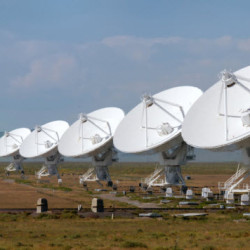
A row of large white satellite dishes under a partly cloudy sky in an open field.

Searching for Radio Emissions from Advanced Aliens

Since our discovery of the radio in 1895, we have been beaming radio transmissions into space. Most scientists believe the invention of the radio and radio telescopes would be a natural technological evolution by any intelligent life. Therefore, it would be reasonable to conclude that advanced aliens may have transmitted proof of their existence. The timeframe of their transmissions would depend on when they evolved. If their evolution were concurrent with ours, their transmissions would have started about a century ago. However, if they evolved millions of years ahead of us, their transmissions could have started millions of years ago.

In fact, the whole notion of listening for radio transmissions from aliens dates back to 1896, when Nikola Tesla promoted the idea that the radio could be used to contact advanced extraterrestrial life. In the early 1900s, Guglielmo Marconi, the inventor of the radio, claimed to have picked up Martian radio signals. Other iconic scientists, like Lord Kelvin, credited with inventing the telegraph, added fuel to the radio search for advanced aliens by publicly stating that the radio represented a possible way to detect and even contact them.

When scientists of the stature of Tesla, Marconi, and Kelvin speak, the world listens. In 1924, Mars was closer to Earth than any time in the last 100 years before or since. Obviously, this would be an excellent time to listen for radio transmissions from Mars. To avoid cluttering the Martian signals with our own, a “National Radio Silence Day” was promoted by the United States. For a 36-hour period, during August 21-23, 1924, all radios were silent for five minutes at the beginning of each hour. Concurrently, a dirigible was used to lift a radio up in order to receive signals 3 kilometers above the United States Naval Observatory. A select few listened, including the chief cryptographer of the U.S. Army, William F. Friedman. No radio transmissions from Mars were reported.

The most famous human enterprise listening for alien radio transmissions is SETI, which is not a single organization, but rather a group of organizations that employ radio technology to search for advanced extraterrestrial life. This includes Harvard University, the University of California, Berkeley, and the SETI Institute. Astronomer Frank Drake, using a small radio telescope, undertook the first SETI experiment in 1960. In 1961, the first SETI conference was held at Green Bank, West Virginia. From this humble beginning, SETI was launched. It is still highly active in its search for extraterrestrial radio transmissions as of this writing.

SETI technology has improved vastly. They are searching more frequencies than ever before. However, to date we have no confirmable evidence. SETI researchers have intercepted signals twice, once in 1977 and once in 2003, that may have been alien in nature, but they were not able to confirm the results. In fact, after more than five decades of searching, no confirmable radio transmission evidence of advanced aliens exists. However, to be fair to SETI, we need to examine their two greatest obstacles.

1.    Scale Problems—The universe is enormous, and SETI has had to confine its search to sun-like solar systems within about 200 light years of Earth. Our galaxy is about 100,000 light years across. This may appear as if they have examined about 20% of our galaxy, but that would be incorrect. They focus on high-probability solar systems (ones similar to our own), and thinly slice space looking for the radio transmission. Therefore, the real number is much less than 20%. If it is viewed in terms of the volume, SETI has covered one-fifteen millionth of our own Milky Way galaxy. This, however, is likely to improve. If we add the recent upgrades that SETI made in 2007, namely the Allen Telescope Array, located in northern California, SETI is able to extend its search radius to 25,000 light years. This enables SETI to examine the 40 billion solar systems closer to the center of our galaxy. Still though, we are looking for a needle in a very large galactic haystack.

2.    Technical Hurdles—Our transmitted radio and television signals disperse relatively rapidly in space. They would require extremely sensitive radio telescopes to detect. To understand this, imagine someone holding a candle at night a few feet from you. You are able to see it clearly. This is because numerous photons from the candle are reaching your eyes. Next, imagine that person moves farther away from you. The farther away the person moves, the dimmer the candle becomes. After a while, you will not be able to see the candle at all. The photons of the candle spread out over distance. Initially, when you were close to the candle, numerous photons reached your eyes. As the candle moved farther away, the photons spread out over a larger area, and fewer of them reach your eyes. This is why the candle became dimmer. Eventually, the candle was so far away, too few photons were reaching your eyes for your eyes to sense them.

SETI estimates that even with a sensitive radio telescope, as the extremely large Arecibo Observatory radio telescope in Puerto Rico, the Earth’s radio and televisions transmissions would only be detectable at a distance within 0.3 light years. Therefore, unless the advanced aliens used highly directed transmissions, we would likely not detect them. In addition, if the advanced aliens compressed their data, similar to data downloads from the Internet, the compressed data would appear as noise to us. In addition, advanced aliens may be using frequencies we are not monitoring or do not penetrate our atmosphere. The list of technical hurdles is numerous. Their sheer number and complexity has cast doubt on the entire SETI methodology. Critics believe the SETI efforts are futile, since the technical hurdles regarding the interception of advanced alien radio transmissions are enormous.

Image: iStockphoto (licensed)

Abstract fractal pattern resembling a cosmic or underwater scene with glowing blue and white textures.

How Negative Energy and Time Travel to the Past Are Connected

Today’s science knows precious little about negative energy. The best example we have of creating negative energy in the laboratory is the Casimir effect, which we briefly discussed previously, but will now discuss in detail. Let us start by discussing the energy associated with a vacuum. Vacuums contain energy. One simple experiment to prove this is to take two electrically neutral metal plates and space them closely together in a vacuum. They will be attracted to each other (i.e., the Casimir effect). At approximately 10 nm (i.e., 1/100,000 meters) separation, the plates experience an attraction force of about one atmosphere (i.e., typically, the pressure we feel at sea level on Earth). What is causing this force?

The energy in a vacuum is termed “vacuum energy.” Surprisingly, it appears to obey the laws of quantum mechanics. For example, the energy will statistically vary within the vacuum. When the vacuum energy statistically concentrates, it gives rise to virtual particles, which is termed a “quantum fluctuation.” When the metal plates are spaced closely, relatively few virtual particles can form between the plates. A much larger population of virtual particles can form around the plates. This larger population of particles exerts a force on the outside of the plates. This force is the Casimir-Polder force, and it pushes the plates together. However, another strange physical phenomenon is also occurring between the closely spaced plates. In quantum mechanics, every particle has a “zero-point energy.” Even a vacuum is said to have a zero-point energy. The zero-point energy, or the “ground state,” is the lowest energy level that a particle or a vacuum may have. By reducing the space between the plates, some physicists believe we are reducing the normal zero point energy of the vacuum between the plates. When this occurs, those physicists argue the vacuum energy between the plates is negative energy (i.e., below the zero-point energy).

The scientific community is not in complete consensus regarding the properties or even the existence of negative energy. Physicists are able to mathematically model negative energy and use those models to make predictions regarding the theoretical behavior of negative energy. While the mathematical models do not prove the existence of negative energy, it is instructive to consider their predictions, and their implications to time travel. Here are the salient features of negative energy based on the mathematical modeling:

• Negative energy implies the existence of negative mass. This, of course, begs a question. What is negative mass? Negative mass is a hypothetical concept in theoretical physics. Anglo-Austrian mathematician and cosmologist Hermann Bondi suggested its existence in 1957. If it exists, it is the negative counterpart of normal (i.e., positive) mass and exhibits unusual properties. For example, normal masses exhibit attractive forces, known as gravitational attraction. Negative masses would exhibit repulsive forces. However, be careful not to equate negative mass with antimatter. The vast majority of the scientific community holds that antimatter is still positive mass. Based on this consensus, they predict antimatter would exhibit the same properties as positive mass. For example, two antimatter particles would exert an attractive force on each other, not a repulsive force. The implications of negative mass on time travel are ambiguous, since the existence of negative mass itself is ambiguous.

• Several in the scientific community suggest that a negative energy vacuum would allow light to travel faster than a normal positive energy vacuum. If this theory proves to be correct, it could have major implications for time travel. For example, there is speculation that this property may allow people to travel faster than the speed of light in a negative-energy vacuum bubble. Previously, we have discussed that as a mass approaches the speed of light, time dilates (i.e., time slows down for the mass). If the mass exceeds the speed of light, the implication is that it can travel into the past. We will discuss this further in the next chapter.

• Stephen Hawking and other physicists suggest that negative energy is required to stabilize a “traversable wormhole,” an entity that would allow a person, object, or information to travel between two points in time or space. Wormholes are a hypothetical shortcut between two points in time or two points in space. There are solutions to Einstein’s general equations of relativity suggesting the theoretical existence of wormholes. However, we have no observational evidence that they exist in reality.

Until we can find a way to produce negative energy and apply it experimentally to determine its effect on time, we can only speculate.

Source: How to Time Travel (2013), Louis A. Del Monte