Tag Archives: louis del monte

Nature of Light

Do We Live In A Quantum Universe? – Part 1/3

The notion that all reality (mass, space, time, and energy) consists of discrete energy quantums is counterintuitive. For example, an electric current consists of individual electrons flowing in a wire. However, you do not notice your television flickering as the electrons move through the circuits. The light you read by consists of individual photons. Yet, your eyes do not sense individual photons reflected from the page. The point is that our senses perceive reality as a continuum, but this perception is an illusion. In the following, we will examine each element of reality one by one to understand its true nature. In this post, “Do We Live In A Quantum Universe? – Part 1/3,” we will start by exploring the qunatized nature of mass.

Mass—the sum of all its atoms.

We will start with mass. Any mass is nothing more than the sum of all its atoms. The atoms themselves consist of subatomic particles like electrons, protons, and neutrons, which consist of even more elementary particles, like quarks. (Quarks are considered the most elementary particles. I will not describe the six different types of quarks in detail, since it will unnecessary complicate this discussion.) The point is any mass reduces to atoms, which further reduces to subatomic particles. The atom is a symphony of these particles, embodying the fundamental forces (strong nuclear, weak nuclear, electromagnet, and gravity). Does all this consist of energy quantums? In the final analysis, it appears it does, including the fundamental forces themselves. How can this be true?

In the early part of the Twentieth Century, the theory of quantum mechanics was developed. It is able to predict and explain phenomena at the atomic and subatomic level, and generally views matter and energy as quantized (discrete particles or packets of energy). Quantum mechanics is one of modern science’s most successful theories. At the macro level, which is our everyday world, any mass is conceivably reducible to atoms, subatomic particles, and fundamental forces.

Science holds that the fundamental forces (strong nuclear, weak nuclear, electromagnet, and gravity) mediate (interact) via particles. For example, the electromagnetic force mediates via photons. We have verified the particle for all the fundamental forces, except gravity. A number of theoretical physicists believe a particle is associated with gravity, namely the graviton. The graviton is a hypothetical elementary massless particle that theoretical physicists believe is responsible for the effects of gravity. The problem is that all efforts to find the graviton have failed. This is an active area of research, and work continues to find the graviton, and to develop a quantum gravity theory. If we assume gravity mediates through a particle, the case is easily made via Einstein’s mass-energy equivalence equations (E = mc2) that all mass, as well as the fundamental forces, reduces to energy quantums.

Although, we are unable to prove conclusively that all masses, including the fundamental forces, consists of discrete energy packets, numerous scientists believe they are. This realization caused Albert Einstein great distress. He wrote in 1954, one year prior to his death, “I consider it quite possible that physics cannot be based on the field concept, i.e., on continuous structures. In that case, nothing remains of my entire castle in the air, gravitation theory included, [and of] the rest of modern physics.” Einstein, who grew up in the world of classical physics, was a product of his time. Classical physics utilizes the concept of fields to explain physical behavior. The fields of classical physics are a type of invisible force that influences physical behavior. For example, classical physics explains the repulsion of two positively charged particles due to an invisible repulsive field between them. Modern physics explains this repulsion due to the mediation of photons, which act as force carriers. The main point is that mass and the fundamental forces are ultimately reducible to discrete elements, which equate to discrete packets of energy (quantums).

In the next post, “Do We Live In A Quantum Universe? – Part 2/3,” we will explore the nature of space. We will address the question: Is space quantized?

Source: Unraveling the Universe’s Mysteries (2013), Louis A. Del Monte

Image: iStockPhoto (licensed)

Abstract digital art featuring a radiant white light at the center surrounded by intricate geometric patterns and electric green lines.

The Mysterious Nature of Energy

We scientists talk about energy, and derive equations with energy mathematically expressed in the equation as though we understand energy. The fact is: we do not. It is an indirectly observed quantity. We infer its existence. For example, in physics, we define energy as the ability of a physical system to do work on another physical system. Physics is one context that uses and defines the word energy. However, the word energy has different meanings in different contexts. Even the average person throws the term energy around in phrases like, “I don’t have any energy today,” generally inferring a lack of vigor, force, potency, zeal, push, and the like. The word energy finds its way into both the scientific community and our everyday communications, but the true essence of energy remains an enigma.

The concept of energy is an old concept. It comes from the ancient Greek word, “enérgeia,” which translates “activity or operation.” As previously stated, we do not know the exact essence of energy, but we know a great deal about the effects of energy. To approach a better understanding, consider these four fundamental properties of energy:

1. Energy is transferable from one system to another.

Transferring mass between systems results in a transfer of energy between systems. Mass and energy have been inseparably equated, since 1905, via Einstein’s famous mass–energy equivalence equation, E = mc2, where E is energy, m is mass, and c is the speed of light in a vacuum. This equation is widely held as a scientific fact. Experimental results over the last century strongly validate it. Typically, mass transfers between systems occur at the atomic level as atoms capture subatomic particles or bond to form products of different masses.

Non-matter transfer of energy is possible. For example, a system can transfer energy to another by thermal radiation (heat). The system that absorbs the thermal radiation experiences an increase in energy, typically measured by its temperature. This is how the radiators in a house raise the room temperature. Here is another example: If an object in motion strikes another object, a transfer of kinetic energy results. Consider billiard balls. When one ball strikes another, it imparts kinetic energy to the ball it strikes, causing it to move.

2.  Energy may be stored in systems.

If you pick up a rock from the ground and hold it at shoulder height, you have stored energy between the rock and ground via the gravitation attraction created between the Earth and rock. You may consider this potential energy. When you open your hand, the rock will fall back to the ground. Why? The answer is straightforward. It required your energy to hold the rock in its new position at shoulder height. As soon as you, by opening your hand, released the energy that you were providing, it reduced to a lower energy state when the gravitational field pulled the rock back to the ground.

Any type of energy that is stored is “potential energy,” and all types of potential energy appear as system mass. For example, a compressed metal spring will be slightly more massive than before it was compressed. When you compress the spring, you do work on the system. The work on the system is energy, and that energy is stored in the compressed spring as potential energy. Because of this stored potential energy, the spring becomes more massive.

3. Energy is not only transferable–it is transformable from one form to another.

Our example regarding the rock falling back to the ground is an example of energy transformation. The potential energy was transformed to kinetic energy when you opened your hand and released the rock. This is what caused the rock to fall back to the ground. Here is an industrial example. Hydroelectric plants generate electricity by using water that flows over a falls due to gravity. In effect, they are transforming the falling water (gravitational energy) into another form of energy (electricity).

4. Energy is conserved.

This is arguably the most sacred law in physics. Simply stated: Energy cannot be created or destroyed in an isolated system. The word “isolated” implies the system does not allow other systems to interact with it. A thermos bottle is an example of an isolated system. It is preventing the ambient temperature from changing the temperature inside the thermos. For example, it keeps your coffee hot for a long time. Obviously, it is not a perfectly isolated system since eventually it will lose heat to the atmosphere, and your coffee will cool to the ambient temperature that surrounds the thermos bottle. For example, in your house, the coffee in a cup will cool to room temperature.

In summary, energy may be transferred, stored, and transformed, but it cannot be created or destroyed in an isolated system. This means the total energy of an isolated system does not change.

Next, we will consider energy in different contexts. Unfortunately, since we do not know the true essence of energy, we need to describe it via the effects we observe in the context that we observe them. Here are two contexts:

1)   Cosmology and Astronomy

Stars, nova, supernova, quasar, and gamma-ray bursts are the highest-output mass into energy transformations in the universe. For example, a star is typically a large and massive celestial body, primarily composed of hydrogen. Due to its size, gravity at the star’s core is immense. The immense gravity causes the hydrogen atoms to fuse together to form helium, which causes a nuclear reaction to occur. The nuclear reaction, in effect, transforms mass into energy. In the cosmos, mass-to-energy transformations are due to gravity, and follow Einstein famous equation, E = mc2 (discussed previously). The gravity can result in nuclear fusion, as described in the above example. It can cause a dying star to collapse and form a black hole.

2) Chemistry

Energy is an attribute of the atomic or molecular structure of a substance. For example, an atom or molecule has mass. From Einstein’s mass-energy equivalence equation, (E = mc2), we know the mass equates to energy. In chemistry, an energy transformation is a chemical reaction. The chemical reaction typically results in a structural change of the substance, accompanied by a change in energy. For example, when two hydrogen atoms bond with one oxygen atom, to form a water molecule, energy emits in the form of light.

Other scientific contexts give meaning to the word energy. Two examples are biology and geology. Numerous forms of energy are accepted by the scientific community. The various forms include thermal energy, chemical energy, electric energy, radiant energy, nuclear energy, magnetic energy, elastic energy, sound energy, mechanical energy, luminous energy, and mass. I will not go into each form and context for the sake of brevity. My intent is to illustrate that the word energy in science must be understood within a specific context and form.

As mentioned above, we truly do not know the essence of energy; we infer its existence by its effects. The effects we measure often involve utilizing fundamental concepts of science, such as mass, distance, radiation, temperature, time, and electric charge. Adding to ambiguity, energy is often confused with power. Although we often equate “power” and “energy” in our everyday conversation, scientifically they are not the same. Strictly speaking, in science, power is the rate at which energy is transferred, used, or transformed. For example, a 100-watt light bulb transforms more electricity into light than a 60-watt light bulb. In this example, the electricity is the energy source. Its rate of use in the light bulbs is power. It takes more power to run a 100-watt bulb than a 60-watt bulb. Your electric bill will verify this is true.

What is it about energy that makes it mysterious? Science does not understand the nature of energy. We have learned a great deal about energy in the last century. The word energy has found its way into numerous scientific contexts as well as into our everyday vernacular, but we do not know the fundamental essence of energy. We can infer it exists. Its existence and definition is context sensitive. We do not have any instrument to measure energy directly, independent of the context. Yet, in the last century, we have learned to harness energy in various forms. We use electrical energy to power numerous everyday items, such as computers and televisions. We have learned to unleash the energy of the atom in nuclear reactors to power, for example, cities and submarines. We have come a long way, but the fundamental essence of energy remains an enigma.

In the next post, we will discuss another aspect of energy that haunts the scientific community. Does all reality consist of discrete packets (quantums) of energy? Are mass, space, time, and energy composed of quantized energy? We can make a reasonably strong case that they are. It is counterintuitive because we do not experience reality that way. For example, when you pick up a rock, you do not directly experience the atoms that make up the rock. However, the rock is nothing more than the sum of all its atoms. If all reality is made of quantized energy, we live in a Quantum Universe. What exactly is a Quantum Universe? Stay tuned, and we will explore what a Quantum Universe is in the next post.

Source: Unraveling the Universe’s Mysteries (20120, Louis A. Del Monte

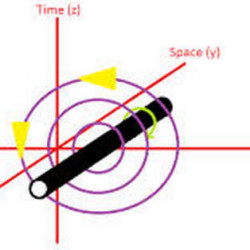
A diagram showing a black rod in space with concentric circles and arrows, labeled with time (x) and space (y) axes.

Tipler cylinder time travel – Is It Possible?

The Tipler cylinder is a cylinder of dense matter and infinite length. Historically, Dutch mathematician Willem Jacob van Stockum (1910–1944) found Tipler cylinder solutions to Einstein’s equations of general relativity in 1924. Hungarian mathematician/physicist Cornel Lanczos (1893–1974) found similar Tipler cylinder solutions in 1936. Unfortunately, neither Stockum nor Lanczos made any observations that their solutions implied closed timelike curves (i.e., time travel to the past).

In 1974, American mathematical physicist/cosmologist Frank Tipler’s analysis of the above solutions uncovered that a massive cylinder of infinite length spinning at high speed around its long axis could enable time travel. Essentially, if you walk around the cylinder in a spiral path in one direction, you can move back in time, and if you walk in the opposite direction, you can move forward in time. This solution to Einstein’s equations of general relativity is known as the Tipler cylinder. The Tipler cylinder is not a practical time machine, since it needs to be infinitely long. Tipler suggests that a finite cylinder may accomplish the same effect if its speed of rotation increases significantly. However, the practicality of building a Tipler cylinder was discredited by Stephen Hawking, who provided a mathematical proof that according to general relativity it is impossible to build a time machine in any finite region that contains no exotic matter with negative energy. The Tipler cylinder does not involve any negative energy. Tipler’s original solution involved a cylinder of infinite length, which is easier to analyze mathematically, and although Tipler suggested that a finite cylinder might produce closed timelike curves if the rotation rate were fast enough, Hawking’s proof appears to rule this out. According to  Hawking, “it can’t be done with positive energy density everywhere! I can prove that to build a finite time machine, you need negative energy.”

One caveat, Hawking’s proof appears in his 1992 paper on the “chronology protection conjecture,” which has come under serious criticism by numerous physicists. Their main objection to the Hawking’s conjecture is that he did not employ quantum gravity to make his case. On the other hand, Hawking and others have not been able to develop a widely accepted theory of quantum gravity. Hawking did just about the only thing he could do under the circumstances. He used Einstein’s formulation of gravity as found in the general theory of relativity. Another fact, Hawking’s proof regarding the Tipler cylinder is somewhat divorced from the main aspects of his paper and could be viewed to stand on its own. However, in science we are always judged by the weakest link in our theory. Thus, with a broad brush, the chronology protection conjecture has been discredited, and even Hawking has acknowledged some of its short comings.

Where does that leave us with a finite Tipler cylinder time machine? In limbo! There is no widely accepted proof that a finite Tipler cylinder spinning at any rate would be capable of time travel. There is also another problem. We lack any experimental evidence of a spinning Tipler cylinder influencing time.

Source: How to Time Travel (2013), Louis A. Del Monte

Abstract fractal pattern resembling a cosmic or underwater scene with glowing blue and white textures.

Do We Need M-Theory? Maybe!

Most high school science classes teach the classical view of the atom, incorporating subatomic particles like protons, electrons, and neutrons. This is the particle theory of the atom dating to the early Twentieth Century. In about the 1960s, scientists discovered more subatomic particles. By the 1970s, scientists discovered that protons and neutrons consist of subatomic particles called quarks (an elementary particle not known to have a substructure). In the 1980s, a mathematical model called string theory, was developed. It is a branch of theoretical physics. String theory sought to explain how to construct all particles and energy in the universe via hypothetical one-dimensional “strings.” Subatomic particles are no longer extremely small masses. Instead, they are oscillating lines of energy, hence the name “strings.” In addition, the latest string theory (M-theory) asserts that the universe is eleven dimensions, not the four-spacetime dimensions we currently experience in our daily lives. String theory was one of science’s first attempts at a theory of everything (a complete mathematical model that describes all fundamental forces and matter).

In about the mid-1990s, scientists considered the equivalences of the various string theories, and the five leading string theories were combined into a one comprehensive theory, M-theory. M-theory postulates eleven dimensions of space filled with membranes, existing in the Bulk (super-universe). The Bulk contains an infinite number of membranes, or “branes” for short.

According to M-theory, when two branes collide, they form a universe. The collision is what we observed as the Big Bang when our universe formed. From that standpoint, universes continually form via other Big Bangs (collisions of branes).

Does this explain the true origin of the energy? No! It still begs the question: where does the energy come from to create the membranes? The even-bigger question: is there any scientific proof of the multiverse? Recently, several scientists claim unusual ring patterns on the cosmic microwave background might be the result of other universes colliding with ours. However, even the scientists forwarding this theory suggest caution. It is speculative. At this point, we must admit no conclusive evidence of a multiverse exists. In fact, numerous problems with the multiverse theories are known. This does not mean there are no multiverses. Currently, though, we have no conclusive experimental proof, but do have numerous unanswered questions.

All multiverse theories share three significant problems.

1) None of the multiverse theories explains the origin of the initial energy to form the universe. They, in effect, sidestep the question entirely.

2) No conclusive experimental evidence proves that multiverses exist. This is not to say that they do not exist. It just means we cannot prove they exist.

3) Critics argue it is poor science. We are postulating universes we cannot see or measure in order to explain the universe we can see and measure.

However, in the last hundred years, we have made discoveries, and experimentally verified phenomena that in prior centuries would have been considered science fiction, metaphysics, magic, and unbelievable. We discovered numerous secrets of the universe, once believed to be only the Milky Way galaxy—to now being an uncountable number of galaxies in a space that is expanding exponentially. We also unlocked the secrets of the atom, once believed to be the fundamental building block of matter (from the Greek atomos “uncut”). Currently, we understand the atom consists of electrons, protons, and neutrons, which themselves consist of subatomic particles like quarks. The list of discoveries that have transformed our understanding of reality over the last century is endless. From my perspective, skepticism can be healthy. However, one cannot be entirely closed-minded when it comes to exploring the boundaries of science.

This brings us to the crucial question: Do we need M-Theory? My answer is: Maybe! Right now, it’s the only “mainstream” game in town. It has numerous respected proponents, including world-renowned cosmologist/physicist Stephen Hawking. However, the “mainstream” has been wrong before, and we are in uncharted waters. It may be right, and the mathematics is elegant. The only thing missing is experimental evidence (i.e., proof). On this one, you’ll have to weigh the facts and draw your own conclusion.

Source: Unraveling the Universe’s Mysteries (2012), Louis A. Del Monte

Image: iStockPhoto (licensed)


Aliens and UFOs

Are UFOs Time Travelers from the Future?

Internet searches for the keyword acronym “UFO” (unidentified flying object) are among the most popular on the Internet. According to Google, there are five million global searches per month for the keyword acronym “UFO” (without the quotes).

Let us start with a little background. Surprisingly, the United States Air Force (USAF) officially created the acronym “UFO” in 1953. Their intent was to replace the more popular phrases such as “flying saucers” and “flying discs” because of the variety of shapes reported. In their official statement, the United States Air Force defined the term UFO as “any airborne object which, by performance, aerodynamic characteristics, or unusual features, does not conform to any presently known aircraft or missile type, or which cannot be positively identified as a familiar object.”

The phenomena, namely UFO sightings, are worldwide. Various governments and civilian committees have studied them. The conclusions reached by the various organizations that have studied them vary significantly. Some conclude UFOs do not represent a threat and are of no scientific value (see, e.g., 1953 CIA Robertson Panel, USAF Project Blue Book, Condon Committee). Others conclude the exact opposite (see, e.g., 1999 French COMETA study, 1948 USAF Estimate of the Situation, Sturrock Panel).

Given the sheer volume of unexplained sightings by credible witnesses, including military, police, and civilian witnesses, there is little doubt that the UFO phenomenon is real and worldwide, and for the most part, there is no widely accepted public or scientific explanation of what they are or what their intentions might be.

Three popular speculations regarding UFOs are:

  1. They are future generations of humans who have mastered the science of time travel, and they are coming back either to observe us or to carry out other intentions.
  2. They are technologically advanced aliens from another planet who have mastered the science of time travel, and they are coming here either to observe us or to carry out other intentions.
  3. They are secret government (United States or any government) experimental spacecraft, and by some accounts they are reverse engineered from advanced alien spacecraft in the government’s possession.

In my estimation, the ninety-page 1999 French COMETA study (the English translation stands for “Committee for In-Depth Studies”) is the most authoritative source of UFO information and provides a thoughtful, balanced view. Here are the facts that led me to this position:

  • The COMETA membership consisted of an independent group of mostly former “auditors” (i.e., defense and intelligence analysts) at the Institute of Advanced Studies for National Defense, or IHEDN, a high-level French military think tank, and by various other highly qualified experts. The independence of the group lends credence that the findings and conclusions would not be censored.
  • The French government did not sponsor it. This lends credence that the COMETA members were objective and not politically guided.
  • The COMETA study was carried out over several years. This lends credence that the COMETA study is a thorough account of UFO phenomena, not a hastily put out government press release.

The 1999 COMETA study concluded:

  1. About 5% of the UFO cases studied were inexplicable.
  2. The best hypothesis to explain them was the extraterrestrial hypothesis (ETH), but they acknowledged this is not the only possible hypothesis.
  3. The authors accused the US government of engaging in a massive cover-up of UFO evidence.

According to the 1999 COMETA study, a small but significant percentage of UFOs are likely of extraterrestrial origin. Does this rule out that they are future generations of humans, visiting the past? In my opinion, it does not. Even the conclusions of the 1999 COMETA study did not rule out this possibility. However, there is no conclusive evidence either way.

You will find an English translation of the 1999 COMETA study at this website address: https://www.ufoevidence.org/newsite/files/COMETA_part2.pdf.

The main questions regarding time travel and UFOs are:

  • Are the UFOs future generations of humans, time traveling back to our past and present?
  • Are the UFOs alien spacecraft, or secret government experimental spacecraft, able to traverse great distances using technologies essential to time travel, like a matter-antimatter propulsion system?

I suggest you read the complete 1999 COMETA study and draw your own conclusions.

Source: How to Time Travel (2013), Louis A. Del Monte