
Tag Archives: louis del monte

A weathered yellow road sign with the word 'Insolvenz' crossed out, symbolizing the end of insolvency and free market economy.

The Threat of Economic Collapse

This article examines the relationship between fossil fuels and world economies. It asserts that as fossil fuels become scarce toward the end of the 21st century, world economies will face collapse. Let’s begin by discussing world currencies.

All currencies today are “fiat money,” meaning they are not backed by a commodity or anything of intrinsic value. Instead, governments back fiat currency by declaring it a “legal tender.” This means the money has no intrinsic value, but depends on the trust people place in the nation’s economy and their implicit agreement that the nation’s “money” is valuable.

Let us examine the concept of “value.” It is obvious that if confidence is lost in a nation’s economy (i.e., its ability to produce valuable products and services), the value of it fiat current decreases. This is generally measure against some internationally agreed to “standard,” such as gold. Interestingly, gold is also a fiat currency, since its intrinsic value, mainly industrial and commercial uses, is marginal relative to its universal appeal. Gold is valuable because historically we have all agreed it is valuable.

If a nation is unable to produce or procure the fossil fuels it requires, its economy will decline. This means its “gross domestic product,” the amount of goods and services with intrinsic value, will decline. Concurrently, the nation’s fiat currency will decline, which is termed “inflation.” In some cases, as demonstrated in post-World War I Germany, a nation’s fiat currency can experience hyperinflation and completely collapse.

During dire times, such as world wars, people have traded suitcases filled with gold and silver for suitcases filled with meat and potatoes. The point is that the “value” of fiat currencies, including precious metals, depends on “trust,” not intrinsic value.

Let’s examine how humanity will likely react to fiat currencies during the critical energy crisis, a point in time when fossil fuels become scarce. Let’s begin by discussing the world’s oil, coal, and natural gas reserves?

BP, one of the seven “supermajor” oil and gas companies, predicts that the world has only about 50 years of oil left. Often, such predictions come from an alarmist environmental group. This prediction comes from the highly respected BP, the sixth largest company in the 2015 Fortune Global 500. Some experts argue our large natural gas and coal reserves will address the oil shortage. However, the remaining petroleum resources, natural gas and coal, are also limited resources. The United States Energy Information Agency (EIA) estimates at our current use rate, recoverable reserves of natural gas should last 84 years and coal 261 years. These projections may provide a degree of comfort, but note the important phase “at our current use rate.” Unfortunately, our use rate of fossil fuels has been increasing since 1970, with the exception of the “The Great Recession (December 2007 – June 2009).” For example, in 2013, the EIA projected energy consumption would rise by 56% by 2040. Based on the CIA World Fact Book, when natural gas and coal shoulder the burden to supplement the diminishing oil reserves, they too will become scarce within just decades. The preponderance of scientific estimates argues humanity will face a severe shortage of all fossil fuels toward the end of 21st century, which by definition is the critical energy crisis.

Currently, modern civilizations run on fossil fuels. Alternative energy sources, like nuclear, wind, geothermal, hydro, and solar, only account for about 20% of the energy consumed. Without fossil fuels, almost everything stops. If we continue our reliance on fossil fuels, the outlook is bleak. By the end of the 21st century, the severe energy shortage will make it extremely difficult to mine natural resources, build factories, produce products, or provide sufficient food for the estimated 11 billion-world population.

Unfortunately, the critical energy crisis garners little prime time media coverage. With regard to energy, the media focuses its attention on OPEC (Organization of the Petroleum Exporting Countries) and our involvement in the Middle East, marked by “gulf wars” and counter insurgency. Experts, including their numerous books and articles, focus their attention on the post-peak oil challenges that the world will face within a decade or two. I agree that post-peak oil challenges will be exceptionally difficult, in the early stages similar to the “1973 oil embargo.” Initially, the average person will again experience long lines at the pump, gas prices doubling, inflation in double digits, and unemployment nearing 10%. Although, many will judge these issues severe, they will pale in comparison to the critical energy crisis.

As serious as the critical energy crisis threatens to be, its inevitable existence seems relegated to a footnote. Media coverage of it is thin to non-existent. We do not have a concerted worldwide effort to address it. Our best scientists are not working the problem. There is literally no master plan, let alone a “plan B.”

On our current course, during the fourth quarter of the 21st century the cost of the scant remaining fossil fuels will rise to unprecedented highs, which in turn will:

  1. Usher in a depression that will surpass the “Great Depression”
  2. Cause hyperinflation, since the cost of almost everything is tied to the price of fossil fuels
  3. Cause severe product and food shortages

Factually, our global efforts to phase out fossil fuels and switch to alternative energy sources have us on a critical energy crisis collision course. Despite the evidence of a looming critical energy crisis, there is no worldwide initiative to address it. Even the United States, the strongest world economy, lacks a plan. Although, many fossil fuel phase-out initiatives are taking place at the state and local levels, in reality, we are a nation unprepared for the inevitable. Some nations, like Sweden, do have a plan to fade out fossil fuels. Most, though, ignore the risks, like China and Japan. However, we all share the same planet. When the fossil fuels are gone, they will be gone for everyone.

Given this understanding, let us fast-forward about 50 years. If BP is correct, the world oil supply is nearly gone. The price of oil in United States dollars will reach unprecedented highs. Even “hard currencies,” like gold and silver, will depreciate relative to oil. The reason is that dollars, gold, and silver do not have an intrinsic value. Oil does. The intrinsic value of oil, and other fossil fuels, lies in their use as an energy source. Based on this line of reasoning, one can argue that the only real currency is energy.

The end of the Petroleum Age is now within the lifetime of many, approximately half a century out. The end of coal and gas will follow within decades. Modern humans, as a species, have walked the Earth for 200,000 years. A half century, in the scheme of human civilization, is like a “blink of the eye.” As discussed above, there is a fundamental relationship between fossil fuels and national economies. For Earth’s civilizations to continue, we urgently need a worldwide plan, combined with an international effort, to phase out fossil fuels in favor of alternative, clean energy sources. It saddens me to say, it’s now a political issue and it is not clear world leaders understand the problem.

Detailed sketch of a mechanical rabbit with intricate robotic limbs and wings in a dynamic pose.

The Rise of the Nanobots

Let’s start with a simple definition. Nanobots are nanoscale robots. Once, strictly confined to speculation and science fiction, the military and medical industry is making them a reality.

In the medical industry, specifically the area of nanomedicine, nanobots are being developed and used in human trials to cure a number of diseases, including cancer. For example, on May 15, 2015 Next Big Future reported, “Bachelet (i.e., Dr. Ido Bachelet, manager of Bar-Ilan University’s robot laboratory) has developed a method of producing innovative DNA molecules with characteristics that can be used to ‘program’ them to reach specific locations in the body and carry out pre-programmed operations there in response to stimulation from the body.” In this case, the pre-programming involves detecting cancer cells and delivering an existing cancer drug treatment directly to a cancerous cell, bypassing healthy cells. As of this writing, Dr. Bachelet and Pfizer announced “partnering” to perform human trials, using the DNA nanobots. However, there have been no reports on the human trials to date.

Other medical researchers are taking a similar approach, as reported in Science Translational Medicine, Renier J. Brentjens et. al., 20 Mar 2013. In essence, they remove some of the patient’s T-cells, which are cells produced by the patient’s thymus gland. T-cells work as part of the human immune system. After removing the T-cells, researchers alter them in the laboratory with a gene therapy to make them recognize a protein on the cancer cells. Then they inject the altered T-cells into the patient’s bloodstream. There the T-cells order the cancerous cell to return to their normal configuration. If the cell has mutated too far to return to its original configuration, it orders the cell to self-destruct. Their results, reported in 2013, have been astounding, causing the cancer of 14 out of 16 terminally ill patients to go into remission. I think it would be correct to consider the altered T-cells nanobots.

The military has been relatively quiet about their work with nanobots. However, the use of United States military robots dates back to World War I, with its use of torpedoes. As is clear from recent conflicts, military robotics are now an indispensable technology the United States, and other countries, use to make war. A new thrust in military robotics is emerging, namely shrinking them.  For example, on December 16, 2014, the Army Research Laboratory announced creation of a “fly drone” weighing a small fraction of a gram. The fly drone’s capabilities are secret, but it is plausible the fly drone will offer the United States military the ability to enter buildings, perform surveillance, and potentially offensive operations. This gives a completely new meaning to “fly on the wall.” Although the Army did not comment on the construction of the fly drone, I judge it incorporates nanotechnology. If the Army is willing to announce development on a fly size drone, it is likely that they have even smaller more advanced drones in development.

You might wonder how does a fly drone provide offensive capabilities. Similar to the way biological flies spread diseases, the fly drone could deposit a toxic substance on an adversary’s food. For example, it may be used to deposit botulinum toxin H, the most lethal toxin in existence. The lethal dose is 100 nanograms. That amount of toxin would be impossible to see, smell, or taste.

I wrote this post to make an important point. Nanobots have move from sci-fi to science fact. Millions of nanobots can cure diseases like cancer or, as nanoweapons, become nanoweapons of mass destruction (NMD). Technology is ethically neutral. It is up to humanity to use the technology ethically.


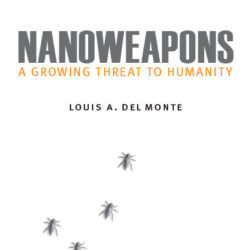
Book cover titled 'Nanoweapons: A Growing Threat to Humanity' by Louis A. Del Monte with small insect-like figures.

Nanoweapons: A Growing Threat to Humanity (Book)

My new book and the first in its genre, Nanoweapons: A Growing Threat to Humanity, is now available at a special introductory price of 30% off from all popular booksellers.

From the Publisher, Potomac Books

Nearly Invisible Weapons of Mass Destruction 

 
Nanoweapons just might render humanity extinct in the near future—a notion that is frightening and shocking but potentially true. In Nanoweapons Louis A. Del Monte describes the most deadly generation of military weapons the world has ever encountered. With dimensions one-thousandth the diameter of a single strand of human hair, this technology threatens to eradicate humanity as it incites world governments to compete in the deadliest arms race ever.

In his insightful and prescient account of this risky and radical technology, Del Monte predicts that nanoweapons will dominate the battlefield of the future and will help determine the superpowers of the twenty-first century. He traces the emergence of nanotechnology, discusses the current development of nanoweapons—such as the “mini-nuke,” which weighs five pounds and carries the power of one hundred tons of TNT—and offers concrete recommendations, founded in historical precedent, for controlling their proliferation and avoiding human annihilation. Most critically, Nanoweapons addresses the question: Will it be possible to develop, deploy, and use nanoweapons in warfare without rendering humanity extinct?

Louis A. Del Monte is an award-winning physicist, featured speaker, and is the chief executive officer of Del Monte and Associates, Inc. During his thirty-year career as a physicist and business executive at IBM and Honeywell, he led the development of microelectronics and sensors and developed patents fundamental to the fabrication of integrated circuits. He is the author of The Artificial Intelligence Revolution: Will Artificial Intelligence Serve Us or Replace Us? and How to Time Travel: Explore the Science, Paradoxes, and Evidence.

Praise

Louis Del Monte provides a futurist clarion call for people to start thinking and talking about this emerging technology—a technology fraught with the potential for great good and great harm.”—Col. Thomas R. Lujan, U.S. Army (Ret.), attorney at law

Nanoweapons opens the cloak of secrecy on the developing area of nanotechnologies and how societies may use them in the future for good and evil. A very captivating topic.”—Tamara Bratland, engineer for a Fortune 500 medical device company

“A very informative read. Nanotechnology can enhance our lives or eradicate humankind. This book can help preserve our future.”—Richard Spielberger, former Honeywell Engineer Fellow

Get Your Copy Now At 30% Off


Download Publisher PDF Information and Order Form

At Your Favorite Local Bookstore

A digital representation of technology with a smartphone, tablet, and laptop connected by circuits and data streams.

Will Artificial Intelligence Cause Human Extinction?

Will your grandchildren face extinction? Even worse, will they become robotic slaves to a supercomputer?

Humanity is facing its greatest challenge, artificial intelligence (AI). Recent experiments suggest even primitive artificially intelligent machines are capable of learning deceit, greed, and self-preservation, without being programmed to do so. There is alarming evidence that artificial intelligence, without legislation to police its development, will displace humans as the dominant species by the end of the twenty-first century.

There is no doubt that AI is the new scientific frontier, and it is making its way into many aspects of our lives. Our world includes “smart” machines with varying degrees of AI, including touch-screen computers, smartphones, self-parking cars, smart bombs, pacemakers, and brain implants to treat Parkinson’s disease. In essence, AI is changing the cultural landscape, and we are embracing it at an unprecedented rate. Currently, humanity is largely unaware of the potential dangers that strong artificially intelligent machines pose. In this context, the word “strong” signifies AI greater than human intelligence.

Most of humanity perceives only the positive aspects of AI technology. This includes robotic factories, such as Tesla Motors, which manufactures electric cars that are ecofriendly. There’s also the da Vinci Surgical System, a robotic platform designed to expand the surgeon’s capabilities and offer a state-of-the-art, minimally invasive option for major surgery. These are only two of many examples of how AI is positively affecting our lives. However, there is a dark side. For example, Gartner Inc., a technology research group, forecasts robots and drones will replace a third of all workers by 2025. Could AI create an unemployment crisis? The US military is deploying AI into many aspects of warfare. Will autonomous drones replace human pilots and make war more palatable to technologically advanced countries? As AI permeates the medical field, the average human lifespan will increase. Eventually, strong artificially intelligent humans (SAHs) with AI brain implants to enhance their intelligence and cybernetic organs will become immortal. Will this exacerbate the worldwide population crisis, which already as a concern at the United Nations? By 2045 most AI futurists predict that a single strong artificially intelligent machine (SAM) will exceed the cognitive intelligence of the entire human race. How will SAMs view us? Objectively, humanity is an unpredictable species. We engage in wars, develop weapons capable of destroying the world, and maliciously release computer viruses. Will SAMs view us as a threat? Will we be able to maintain control of strong AI or will we fall victim to our own invention?

A fiery image of Earth with flames surrounding it, highlighting the continents in vivid purple and orange tones.

What Is Causing Climate Change?

Let’s look at climate change from a scientific perspective, but acknowledge lay public opinion. About 97% of scientists, based on published peer reviewed papers, and 75% of the lay public, based on opinion polls, believe the current trend in global warming is due to human activity, especially burning fossil fuels. Here are some salient facts:

  • According to the Intergovernmental Panel on Climate Change (IPCC), a scientific intergovernmental body under the auspices of the United Nations, the Earth’s climate is warming, as discuss in Chapter 5. The IPCC estimates there is a 95% probability that humans are causing most of it by burning fossil fuels, engaging in deforestation, and using aerosol spray
  • According to the United States Environmental Protection Agency, the number one cause of climate change comes from burning fossil fuels, with over 40% due to burning coal to generate electricity and 33% from vehicle emissions.
  • Numerous other respected scientific organization, such as the Royal Society, American Geophysical Union, Joint Science Academies, American Meteorological Society, and American Association for the Advancement of Science, also attribute global warming to the human-caused increase in greenhouse gas concentrations
  • About 3% of scientists disagree and the popular media have given them strong representation. This in turn has caused significant lay public and political debate, especially in the United States
  • The scientific consensus in a “nutshell”: The rapid increase in carbon dioxide, which has almost doubled during the last century to the point it is becoming toxic to numerous species, is responsible for the “greenhouse effect.” {Note: Merriam-Webster.com defines the “greenhouse effect” as follows: warming of the surface and lower atmosphere of a planet (as Earth or Venus) that is caused by conversion of solar radiation into heat in a process involving selective transmission of short wave solar radiation by the atmosphere, its absorption by the planet’s surface, and reradiation as infrared which is absorbed and partly reradiated back to the surface by atmospheric gases}
  • Dissenting scientific views: There is no consensus among dissenting scientists regarding the cause of climatic change. Dissenting debate has centered on two points:
  1. Climate sensitivity – how responsive the climate system might be to any given level of greenhouse gases
  2. Consequences of global warming – how the climate will respond locally and globally to greenhouse gases

The preponderance of scientific evidence makes a strong case that human activity, especially burning fossil fuels, is responsible for global warming. It points out no scientific body of national or international standing maintains a formal opinion dissenting from any of the main points put forward by the IPCC.