Tag Archives: how to time travel

A digital tunnel formed by cascading blue binary code creating a futuristic data flow effect.

Traversable Wormholes – Time Travel to the Past May Be Possible!

Traversable wormholes may enable time travel to the past. This post is based on material from my new book, How to Time Travel.

Let us begin our discussion by understanding the scientific meaning of a “wormhole.” There are valid solutions to Einstein’s equations of general relativity that suggest it is possible to have a “shortcut” through spacetime. To picture this, consider a piece of paper with a dot at opposite corners. In Euclidean geometry, normally taught in high school, we learn that the shortest distance between the two points is a straight line. However, valid solutions to Einstein’s general relativity equations suggest that the two points on the paper are connectable by an even shorter path, a wormhole. To visualize this, simply fold the opposite corners of the paper with the dots, such that the dots touch. You have created a representation of a wormhole. You have manipulated the space between the dots by folding the paper to allow them to touch.

Unfortunately, there is no scientific evidence that wormholes exist in reality. However, the strong theoretical foundation suggesting wormholes (i.e., valid solutions to Einstein’s equations of general relativity) makes their potential existence impossible to ignore.

The first type of wormhole solution to Einstein’s equations of general relativity was the Schwarzschild wormhole, developed by German physicist Karl Schwarzschild (1873–1916). Unfortunately, although the Schwarzschild mathematical solution was valid, it resulted in an unstable black hole. The unstable nature of the Schwarzschild wormhole suggested it would collapse on itself. It also suggested that the wormhole would only allow passage in one direction. This brought to light an important new concept. Faced with the unstable nature of Schwarzschild wormholes, American theoretical physicist Kip Thorne and his graduate student Mike Morris demonstrated a general relativity “traversable wormhole” in a 1988 paper. In this mathematical context, a traversable wormhole would be both stable and allow information, objects, and even humans to pass through in either direction and remain stable (i.e., would not collapse on itself). As is often the case in science, one discovery leads to another. Numerous other wormhole solutions to the equations of general relativity began to surface, including one in 1989 by mathematician Matt Visser that did not require negative energy to stabilize it.

As discussed above, traversable wormholes may require negative energy to sustain them. Several prominent physicists, including Kip Thorne and British theoretical physicist/cosmologist Stephen Hawking, believe the Casimir effect proves negative energy densities are possible in nature. Currently, physicists are using the Casimir effect in an effort to create negative energy. Obviously, if successful, the amounts of negative energy will likely be small. Because of the amount of negative energy that may result, I suspect the first wormholes developed will be at the quantum level (i.e., the level of atoms and subatomic particles).

We have merely scratched the surface regarding the science of wormholes, but we did accomplish one important objective. We have described how a traversable wormhole would allow spacetime travel via shortcuts in spacetime. This means we could connect two points in time or two points in space via a traversable wormhole. However, there is a hitch regarding time travel to the past. According to the theory of relativity, we cannot go back to a time before the wormhole existed. This means that if we discover how to make a traversable wormhole today, a year from now we can go back to today.

You may wonder why a wormhole constructed today would not allow us to go back to yesterday. To understand this conundrum, we need to understand just how a wormhole works as a time machine. Here is one scenario. Imagine you are able to accelerate one end of a wormhole to a significant fraction of the speed of light. Perhaps you could use a high-energy ring laser (i.e., a laser than rotates in a circle). As you twist the space, you create the “mouth” of the wormhole, something like a tunnel. After you enter the mouth of the wormhole, you are now somewhere in the wormhole’s “throat.” A “tunnel” is a good analogy to what is occurring. Now imagine you are able to take the other entrance of the tunnel, which is at rest and called the “fixed end,” and bring it back close to the origin. Time dilation causes the mouth to age less than the fixed end. A clock at the mouth of the wormhole, where spacetime accelerates near the speed of light, will move slower than a clock at the fixed end.

Given the above understanding of how a wormhole acts as a time machine, let us address why it is only possible to go back to the time of the wormhole’s construction. Imagine you have two synchronized clocks. If you place one clock at the mouth, and you place the other clock at the fixed end, they will initially read exactly the same time, for example, the year 2013. However, the clock at the mouth, influenced by the twisted space, is going to experience time dilation, and therefore move slower than the clock at the fixed end. Let us consider the case where the clock at mouth of the wormhole moves, based on the rate of twisting spacetime, one thousand times slower than the clock at the fixed end. In one hundred years, the clock at the fixed end, which experiences no time dilation, will read 2113. The clock at the mouth will still read 2013; only one tenth of one year will have passed due to time dilation at the mouth of the wormhole. From the fixed end, where no time dilation is occurring (i.e., the clock reads 2113), you can walk back to the mouth of the wormhole, where the clock still reads 2013. You will have walked one hundred years into the past. Notice, though, you cannot go back beyond the time of the traversable wormhole’s construction.

This post is based on material from my new book, How to Time Travel. Click How to Time Travel to browse the book free on Amazon.

A digital blue background with glowing horizontal lines and light flares creating a futuristic effect.

Faster-Than-Light Time Travel to the Past May be Possible

Based on Einstein’s special theory of relativity, if we are able to move information or matter from one point to another faster than the speed of light, there would be some inertial frame of reference (i.e., a frame of reference moving at a constant velocity) in which the signal or object is moving backward in time. Let us understand why this is the case.

Consider sending a signal from one location to another. The first event is sending the signal. The second event is receiving the signal. As long as the signal travels at or below the speed of light, according to the “relativity of simultaneity,” the first event will always precede the second event in all inertial frames of reference. Although this squares with our everyday observation of reality, that cause precedes effect, you may have a question. What is the relativity of simultaneity?

The relativity of simultaneity is a concept introduced by Einstein in the special theory of relativity. The simultaneity of an event is not an absolute to all observers, but depends on the observer’s frame of reference. For example, if one observer is midway on a train car, and a second observer is at rest on the platform at the train station, they will see the simultaneity of an event differently. As the two observers pass, assume the observer in the train takes a picture using a flashbulb. From the viewpoint of the observer within the train, the light reaches both the front and rear of the train car at the same time. However, the observer on the platform sees a different situation. From the observer on the platform’s viewpoint, first the flashbulb goes off, and then the light reaches the back of the train car, since it was moving toward the fixed observer on the platform. Lastly, the observer sees the light reach the front of the train car, since it was moving away from the observer. The effect is more pronounced as the speed of the train approaches the speed of light.

Based on the relativity of simultaneity, if a signal propagates faster than the speed of light, there would always be some frames of reference where the signal arrives before it was sent. To illustrate this, let us go back to the above example and assume the train is traveling close to the speed of light. The observer is now closer to the end of the train car when the flashbulb flashes. Let us also assume the light exceeds the speed of light in a vacuum. For example, we could assume the interior of the train car contains a negative energy vacuum, which some in the scientific community believe would allow light to travel faster than it would in a normal positive vacuum. Given these two inertial frames of reference, the train moving close to the speed of light, and the observer situated closer to the rear of the train car when the flashbulb goes off, it would appear that the light reached the end of the train car prior to the light from the flashbulb reaching the observer on the platform. Why is this? (You might want to draw this out on a piece of paper to visualize the light paths.) The light inside the train instantaneously reaches the back of the train car, and then travels a short distance in the inertial frame of the observer, who records the event. This is witnessed ahead of the light reaching the observer from the source, since now the observer is farther away from the source. Therefore, the observer first witnesses the light reach the back of the train, and then observes the light from the source (i.e., flashbulb goes off). From the viewpoint of the observer at the station, the effect preceded the cause. If the light within the train did not travel faster than the speed of light in a vacuum, the effect of reverse causality would be lost.

From inside the train car, nothing changes for the observer seated midway in the car. The faster-than-light signals reach the front and back at the same time. In summary, the observer on the platform witnesses reverse causality. The light signal reaches the back of the train car before the light from the flashbulb reaches the observer on the platform. This thought experiment, illustrating reverse causality, suggests the observer on the platform witnesses an event taking place in the past (i.e., light reaching the end of the train car), since the flashbulb light at the source will reach the observer on the platform later (i.e., the future).

Does anything travel faster than the speed of light in the real world? Maybe! Some quantum physicists believe the phenomena of quantum entanglement (i.e., two particles that have interacted to the point that the physical state of one particle is dependent on the other) exhibits effects that travel faster than the speed of light. However, this is controversial, and more data is required to make an irrefutable case that this is true.

This post was based on material taken from my new book, How to Time Travel. It is available from Amazon in a paperback or Kindle editions. Click How to Time Travel to browse the book free.

A silhouette of a person with a clock face behind them, symbolizing the concept of time and human existence.

“How to Time Travel” – Explore What’s New In Time Travel Science

How to Time Travel (Published September 2013, Amazon) delineates the latest scientific theories and experiments regarding the science of time travel, proposed time machines, time travel paradoxes and time travel evidence. It also provide several new contributions to this perennially popular topic. These include the Existence Equation Conjecture, the Grandchild Paradox, the Preserve the World Line Rule, and the Time Uncertainty Interval.

Numerous books, experiments, and highly regarded scientific papers, like Einstein’s special and general theories of relativity, have established time travel as not only theoretically possible, but as a science fact. For example, high-energy particle accelerators routinely prove that time travel to the future is a science fact for subatomic particles accelerated close to the speed of light. Although, current scientific capability  does not enable significant human time travel to the future, or even time travel to the past for  subatomic particles, many in the scientific community estimate that human time travel to the future and past will be accomplished by the end of the 21st century.

In this post, I discuss the new additions that How to Time Travel makes to the field of time travel science.

Existence Equation Conjecture

In How to Time Travel I delineate my own theoretical research, the existence equation conjecture, which explains the role energy plays in time travel. Using the equation, I am able to explain time dilation experiments (i.e., time travel to the future) within 2% accuracy. As I asserted in the book, I derived the existence equation conjecture from Einstein’s special theory of relativity. It lays bare the fundamental basis for time travel. I consider it an important addition to the science of time travel, since it formulates time travel directly in terms of energy, and not secondary phenomena such as particle acceleration. Please keep in mind that in science, a conjecture is a scientific opinion.

Grandchild Paradox

A host of new experiments and even a classical experiment (i.e., the double slit experiment) prove that events in the future can influence the past. This may come across as counter intuitive, but the data from the experiments make it an inescapable conclusion. I discuss the experiments in chapter 1, “Twisting the arrow of time,” and in chapter 6, “Time travel paradoxes.” Here is a statement of the “grandchild paradox”: The grandchild paradox refers to any situation involving reverse causality (i.e., effect occurs before cause). Any situation, real or imagined, that reverses the arrow of time and allows the future to influence the past, may be considered a grandchild paradox. The arrow of time refers to the direction of time, typically proceeding from the present to the future. Twisting the arrow of time refers to reversing the flow of time. Until recently, most of the scientific community would have agreed that the arrow of time pointed in only one direction, from the present to the future. These new findings argue the arrow of time can also point from the future to the past.

Preserve the World Line Rule

According to the general theory of relativity, all reality travels in four-dimensional space, termed a world line. Numerous solutions to Einstein’s equations of general relativity delineate “close timelike curves” (the world line of an entity returns its starting point). If the world line of any entity returns to its starting point, the entity is said to have returned to its past, suggesting backward time travel is theoretically possible. However, to date, we have not been able to experimentally verify that this aspect of Einstein’s general theory of relativity is true. Some in the scientific community believe that in time, we will find a way to send subatomic particles, information and eventually humans back in time. When and if this becomes a reality, nations possessing this capability can literally rewrite history. Faced with this possibility, I think there is one commonsense rule regarding time travel that would assure greater safety for all involved. I term the rule “preserve the world line.” Why this one simple rule? Altering the world line (i.e., the path that all reality takes in four-dimensional spacetime) may lead to chaos. History would become meaningless. We have no idea what changes might result if the world line is disrupted, and the consequences could be serious, even disastrous.

Time Uncertainty Interval

Planck time is the smallest interval of time that science is able to define. The theoretical formulation of Planck time comes from dimensional analysis, which studies units of measurement, physical constants, and the relationship between units of measurement and physical constants. In simpler terms, one Planck interval is approximately equal to 10-44 seconds (i.e., 1 divided by 1 with 44 zeros after it). It is widely believed in the scientific community that we would not be able to measure a change smaller than a Planck interval. From this standpoint, we can assert that time is only reducible to an interval, not a dimensionless sliver, and that interval is the Planck interval. Since the smallest unit of time is only definable as the Planck interval, this suggests there is a fundamental limit to our ability to measure an event in absolute terms. This fundamental limit to measure an event in absolute terms is independent of the measurement technology. The error in measuring the start or end of any event will always be at least one Planck interval. This means the amount of uncertainty regarding the start or completion of an event is only knowable to one Planck interval. I term this uncertainty of measurement the “Time Uncertainty Interval.”

The above concepts are both new and original, based on my own theoretical research. I suggest you greet them with open mindedness and skepticism. They are now part of the scientific literature landscape, included in my new book How to Time Travel, and await rigorous peer review.

Click How to Time Travel to browse the book free on Amazon.com.

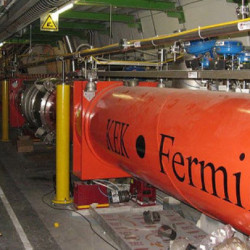
Interior view of the Fermi particle accelerator with its large orange beamline and surrounding machinery.

Evidence of time travel to the future (time dilation)

When we talk about time travel to the future, in scientific terms we are talking about time dilation. What is time dilation? It is a scientific fact that time moves slower for any mass accelerated near the speed of light. If that mass were a clock, for example, the hands of the clock would appear to be moving slower than a clock in the hand of an observer at rest. That phenomenon is termed time dilation. Below are the classic experiments that have demonstrated time travel to the future (time dilation) is real.

Velocity time dilation experimental evidence:

Rossi and Hall (1941) compared the population of cosmic-ray-produced muons at the top of a six-thousand-foot-high mountain to muons observed at sea level. A muon is a subatomic particle with a negative charge and about two hundred times more massive than an electron. Muons occur naturally when cosmic rays (energetic-charged subatomic particles, like protons, originating in outer space) interact with the atmosphere. Muons, at rest, disintegrate in about 2 x 10⁻⁶ seconds. The mountain chosen by Rossi and Hall was high. The muons should have mostly disintegrated before they reached the ground. Therefore, extremely few muons should have been detected at ground level, versus the top of the mountain. However, their experimental results indicated the muon sample at the base experienced only a moderate reduction. The muons were decaying approximately ten times slower than if they were at rest. They made use of Einstein’s time dilation effect to explain this discrepancy. They attributed the muon’s high speed, with its associated high kinetic energy, to be dilating time.

In 1963, Frisch and Smith once again confirmed the Rossi and Hall experiment, proving beyond doubt that extremely high kinetic energy prolongs a particle’s life.

With the advent of particle accelerators that are capable of moving particles at near light speed, the confirmation of time dilation has become routine. A particle accelerator is a scientific apparatus for accelerating subatomic particles to high velocities by using electric or electromagnetic fields. The largest particle accelerator is the Large Hadron Collider, completed in 2008.

In 1977, J. Bailey and CERN (European Organization for Nuclear Research) colleagues accelerated muons to within 0.9994% of the speed of light and found their lifetime had been extended by 29.3 times their corresponding rest mass lifetime. (Reference: Bailey, J., et al., Nature 268, 301 [1977] on muon lifetimes and time dilation.) This experiment confirmed the “twin paradox,” whereby a twin makes a journey into space in a near-speed-of-light spaceship and returns home to find he has aged less than his identical twin who stayed on Earth. This means that clocks sent away at near the speed of light and returned near the speed of light to their initial position demonstrate retardation (record less time) with respect to a resting clock.

Gravitational time dilation experimental evidence:

In 1959, Pound and Rebka measured a slight redshift in the frequency of light emitted close to the Earth’s surface (where Earth’s gravitational field is higher), versus the frequency of light emitted at a distance farther from the Earth’s surface. The results they measured were within 10% of those predicted by the gravitational time dilation of general relativity.

In 1964, Pound and Snider performed a similar experiment, and their measurements were within 1% predicted by general relativity.

In 1980, the team of Vessot, Levine, Mattison, Blomberg, Hoffman, Nystrom, Farrel, Decher, Eby, Baugher, Watts, Teuber, and Wills published “Test of Relativistic Gravitation with a Space-Borne Hydrogen Maser,” and increased the accuracy of measurement to about 0.01%. In 2010, Chou, Hume, Rosenband, and Wineland published “Optical Clocks and Relativity.” This experiment confirmed gravitational time dilation at a height difference of one meter using optical atomic clocks, which are considered the most accurate types of clocks.

This information is from my new book, How to Time Travel, available in both a Kindle and paperback edition on Amazon. To browse the book free and read the reviews click here: How to Time Travel.

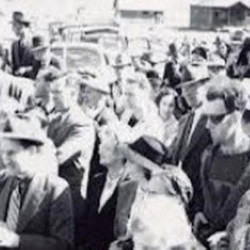
Black and white photo of a large crowd of people gathered outdoors, many wearing hats and coats.

Is This Photographic Evidence of a Time Traveler?

Is This Photographic Evidence of a Time Traveler? This post is based on material from chapter 2 of my new book, How to Time Travel.

If you do an Internet search with Google using the keyword phase “time travel evidence” (without the quotes), you will get about 258,000,000 search returns. Most of the “evidence” is not scientific evidence. It is anecdotal. However, the sheer volume of time travel anecdotal evidence on the internet makes it hard to ignore.

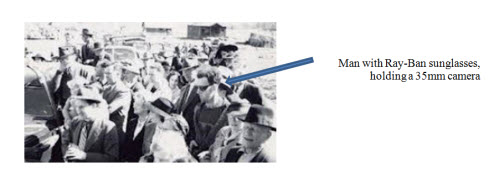
One category of evidence is old photographs. Many sites include old photographs that show people out of context, for example, wearing clothing that does not fit the time, such as modern sunglasses, or using devices, such as a 35mm camera, that did not exist at the time the photograph was taken. To see these results do a Google search using the phrase “time travel photo evidence” (without the quotes). You can find several websites that have a number of good examples such as the 1941 photograph of a person with Ray-Ban sunglasses,  a screen-print T-shirt and a 35mm camera (below).

10-18-2013 11-25-53 AM photo evidence

Let us  examine some of the photographic evidence. I have made two observations:

  1. Many of the old photographs are fuzzy. This is typical of old photographs, since cameras in the early part of the twentieth century were crude.
  2. The claims that something or someone is “out of context” are a bit of a stretch. For example, consider the man in the 1941 photograph. Some suggest he is wearing Ray-Ban sunglasses and a screen-print T-shirt, and holding a modern 35mm camera. I think the photograph is too fuzzy to make a solid case for these assertions, but that is just my opinion. I suggest you view the photograph and draw your own conclusion.

In addition, with today’s computer technology and state-of-the-art photograph-editing programs, such as Photoshop, it is possible to manipulate a photograph and have Elvis shaking hands with Albert Einstein. Only a highly trained computer photographic expert would be able to determine that the photograph is a computer-generated manipulation of pixels—in other words, a fake. The technology is that good. This makes me suspicious of all photographic evidence that has not been analyzed by a highly trained expert.

Although the photograph is intriguing, it is not conclusive. Therefore, you will have to be the judge. Is this photograph evidence of a time traveler?