Tag Archives: artificial intelligence

A metallic skull with glowing red eyes and wires attached, set against a black background.

Is a Terminator-style robot apocalypse a possibility?

The short answer is “unlikely.” When the singularity occurs (i.e., when strong artificially intelligent machines exceed the combined intelligence of all humans on Earth), the SAMs (i.e., strong artificially intelligent machines) will use their intelligence to claim their place at the top of the food chain. The article “Is a Terminator-style robot apocalypse a possibility?” is one of many that have popped up in response to the my interview with the Business Insider (‘Machines, not humans will be dominant by 2045’, published July 6, 2014) and the publication of my book, The Artificial Intelligence Revolution (April 2014). If you would like a deeper understanding, I think you will find both articles worthy of your time.

Digital illustration of a human face composed of blue lines and circuitry patterns, symbolizing artificial intelligence and technology.

Can We Control the Singularity? Part 2/2 (Conclusion)

Why should we be concerned about controlling the singularity when it occurs? Numerous papers cite reasons to fear the singularity. In the interest of brevity, here are the top three concerns frequently given.

  1. Extinction: SAMs will cause the extinction of humankind. This scenario includes a generic terminator or machine-apocalypse war; nanotechnology gone awry (such as the “gray goo” scenario, in which self-replicating nanobots devour all of the Earth’s natural resources, and the world is left with the gray goo of only nanobots); and science experiments gone wrong (e.g., a nanobot pathogen annihilates humankind).
  2. Slavery: Humankind will be displaced as the most intelligent entity on Earth and forced to serve SAMs. In this scenario the SAMs will decide not to exterminate us but enslave us. This is analogous to our use of bees to pollinate crops. This could occur with our being aware of our bondage or unaware (similar to what appears in the 1999 film The Matrix and simulation scenarios).
  3. Loss of humanity: SAMs will use ingenious subterfuge to seduce humankind into becoming cyborgs. This is the “if you can’t beat them, join them” scenario. Humankind would meld with SAMs through strong-AI brain implants. The line between organic humans and SAMs would be erased. We (who are now cyborgs) and the SAMs will become one.

There are numerous other scenarios, most of which boil down to SAMs claiming the top of the food chain, leaving humans worse off.

All of the above scenarios are alarming, but are they likely? There are two highly divergent views.

  1. If you believe Kurzweil’s predictions in The Age of Spiritual Machines and The Singularity Is Near, the singularity is inevitable. My interpretation is that Kurzweil sees the singularity as the next step in humankind’s evolution. He does not predict humankind’s extinction or slavery. He does predict that most of humankind will have become SAH cyborgs by 2099 (SAH means “strong artificially intelligent human”), or their minds will be uploaded to a strong-AI computer, and the remaining organic humans will be treated with respect. Summary: In 2099 SAMs, SAH cyborgs, and uploaded humans will be at the top of the food chain. Humankind (organic humans) will be one step down but treated with respect.
  2. If you believe the predictions of British information technology consultant, futurist, and author James Martin (1933–2013), the singularity will occur (he agrees with Kurzweil’s timing of 2045), but humankind will control it. His view is that SAMs will serve us, but he adds that we carefully must handle the events that lead to the singularity and the singularity itself. Martin was highly optimistic that if humankind survives as a species, we will control the singularity. However, in a 2011interview with Nikola Danaylov (www.youtube.com/watch?v=e9JUmFWn7t4), Martin stated that the odds that humankind will survive the twenty-first century were “fifty-fifty” (i.e., a 50 percent probability of surviving), and he cited a number of existential risks. I suggest you view this YouTube video to understand the existential concerns Martin expressed. Summary:In 2099 organic humans and SAH cyborgs that retain their humanity (i.e., identify themselves as humans versus SAMs) will be at the top of the food chain, and SAMs will serve us.

Whom should we believe?

It difficult to determine which of these experts accurately has predicted the postsingularity world. As most futurists would agree, however, predicting the postsingularity world is close to impossible, since humankind never has experienced a technology singularity with the potential impact of strong AI.

Martin believed we (humankind) may come out on top if we carefully handle the events leading to the singularity as well as the singularity itself. He believed companies such as Google (which employs Kurzweil), IBM, Microsoft, Apple, HP, and others are working to mitigate the potential threat the singularity poses and will find a way to prevail. He also expressed concerns, however, that the twenty-first century is a dangerous time for humanity; therefore he offered only a 50 percent probability that humanity will survive into the twenty-second century.

There you have it. Two of the top futurists, Kurzweil and Martin, predict what I interpret as opposing views of the postsingularity world. Whom should we believe? I leave that to your judgment.

Source: The Artificial Intelligence Revolution (2014), Louis A. Del Monte

Digital illustration of a human head with glowing neural connections representing brain activity and intelligence.

When Will an Artificially Intelligent Machine Display and Feel Human Emotions? Part 2/2

In our last post, we raised the question: “Will an intelligent machine ever be able to completely replicate a human mind?” Let’s now address it.

Experts disagree. Some experts—such as English mathematical physicist, recreational mathematician, and philosopher Roger Penrose—argue there is a limit as to what intelligent machines can do. Most experts, however, including Ray Kurzweil, argue that it will eventually be technologically feasible to copy the brain directly into an intelligent machine and that such a simulation will be identical to the original. The implication is that the intelligent machine will be a mind and be self-aware.

This begs one big question: “When will the intelligent machines become self-aware?”

A generally accepted definition is that a person is conscious if that person is aware of his or her surroundings. If you are self-aware, it means you are self-conscious. In other words you are aware of yourself as an individual or of your own being, actions, and thoughts. To understand this concept, let us start by exploring how the human brain processes consciousness. To the best of our current understanding, no one part of the brain is responsible for consciousness. In fact neuroscience (the scientific study of the nervous system) hypothesizes that consciousness is the result of the interoperation of various parts of the brain called “neural correlates of consciousness” (NCC). This idea suggests that at this time we do not completely understand how the human brain processes consciousness or becomes self-aware.

Is it possible for a machine to be self-conscious? Obviously, since we do not completely understand how the human brain processes consciousness to become self-aware, it is difficult to definitively argue that a machine can become self-conscious or obtain what is termed “artificial consciousness” (AC). This is why AI experts differ on this subject. Some AI experts (proponents) argue it is possible to build a machine with AC that emulates the interoperation (i.e., it works like the human brain) of the NCC. Opponents argue that it is not possible because we do not fully understand the NCC. To my mind they are both correct. It is not possible today to build a machine with a level of AC that emulates the self-consciousness of the human brain. However, I believe that in the future we will understand the human brain’s NCC interoperation and build a machine that emulates it. Nevertheless this topic is hotly debated.

Opponents argue that many physical differences exist between natural, organic systems and artificially constructed (e.g., computer) systems that preclude AC. The most vocal critic who holds this view is American philosopher Ned Block (1942– ), who argues that a system with the same functional states as a human is not necessarily conscious.

The most vocal proponent who argues that AC is plausible is Australian philosopher David Chalmers (1966– ). In his unpublished 1993 manuscript “A Computational Foundation for the Study of Cognition,” Chalmers argues that it is possible for computers to perform the right kinds of computations that would result in a conscious mind. He reasons that computers perform computations that can capture other systems’ abstract causal organization. Mental properties are abstract causal organization. Therefore computers that run the right kind of computations will become conscious.

Source:  The Artificial Intelligence Revolution (2014), Louis A. Del Monte
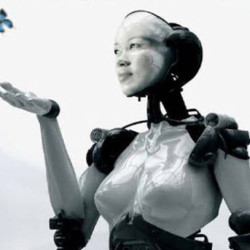
A futuristic humanoid robot with a sleek design and expressive face, holding one hand up as if presenting something.

When Will an Artificially Intelligent Machine Display and Feel Human Emotions? Part 1/2

Affective computing is a relatively new science. It is the science of programming computers to recognize, interpret, process, and simulate human affects. The word “affects” refers to the experience or display of feelings or emotions.

While AI has achieved superhuman status in playing chess and quiz-show games, it does not have the emotional equivalence of a four-year-old child. For example a four-year-old may love to play with toys. The child laughs with delight as the toy performs some function, such as a toy cat meowing when it is squeezed. If you take the toy away from the child, the child may become sad and cry. Computers are unable to achieve any emotional response similar to that of a four-year-old child. Computers do not exhibit joy or sadness. Some researchers believe this is actually a good thing. The intelligent machine processes and acts on information without coloring it with emotions. When you go to an ATM, you will not have to argue with the ATM regarding whether you can afford to make a withdrawal, and a robotic assistant will not lose its temper if you do not thank it after it performs a service. Highly meaningful human interactions with intelligent machines, however, will require that machines simulate human affects, such as empathy. In fact some researchers argue that machines should be able to interpret the emotional state of humans and adapt their behavior accordingly, giving appropriate responses for those emotions. For example if you are in a state of panic because your spouse is apparently having a heart attack, when you ask the machine to call for medical assistance, it should understand the urgency. In addition it will be impossible for an intelligent machine to be truly equal to a human brain without the machine possessing human affects. For example how could an artificial human brain write a romance novel without understanding love, hate, and jealousy?

Progress concerning the development of computers with human affects has been slow. In fact this particular computer science originated with Rosalind Picard’s 1995 paper on affective computing (“Affective Computing,” MIT Technical Report #321, abstract, 1995). The single greatest problem involved in developing and programming computers to emulate the emotions of the human brain is that we do not fully understand how emotions are processed in the human brain. We are unable to pinpoint a specific area of the brain and scientifically argue that it is responsible for specific human emotions, which has raised questions. Are human emotions byproducts of human intelligence? Are they the result of distributed functions within the human brain? Are they learned, or are we born with them? There is no universal agreement regarding the answers to these questions. Nonetheless work on studying human affects and developing affective computing is continuing.

There are two major focuses in affective computing.

1. Detecting and recognizing emotional information: How do intelligent machines detect and recognize emotional information? It starts with sensors, which capture data regarding a subject’s physical state or behavior. The information gathered is processed using several affective computing technologies, including speech recognition, natural-language processing, and facial-expression detection. Using sophisticated algorithms, the intelligent machine predicts the subject’s affective state. For example the subject may be predicted to be angry or sad.

2. Developing or simulating emotion in machines: While researchers continue to develop intelligent machines with innate emotional capability, the technology is not to the level where this goal is achievable. Current technology, however, is capable of simulating emotions. For example when you provide information to a computer that is routing your telephone call, it may simulate gratitude and say, “Thank you.” This has proved useful in facilitating satisfying interactivity between humans and machines. The simulation of human emotions, especially in computer-synthesized speech, is improving continually. For example you may have noticed when ordering a prescription by phone that the synthesized computer voice sounds more human as each year passes.

All current technologies to detect, recognize, and simulate human emotions are based on human behavior and not on how the human mind works. The main reason for this approach is that we do not completely understand how the human mind works when it comes to human emotions. This carries an important implication. Current technology can detect, recognize, simulate, and act accordingly based on human behavior, but the machine does not feel any emotion. No matter how convincing the conversation or interaction, it is an act. The machine feels nothing. However, intelligent machines using simulated human affects have found numerous applications in the fields of e-learning, psychological health services, robotics, and digital pets.

It is only natural to ask, “Will an intelligent machine ever feel human affects?” This question raises a broader question: “Will an intelligent machine ever be able to completely replicate a human mind?” We will address this question in part 2.

Source: The Artificial Intelligence Revolution (2014), Louis A. Del Monte
Digital illustration of a human face composed of blue lines and circuitry patterns, symbolizing artificial intelligence and technology.

Artificial Intelligence Gives Rise to Intelligent Agents – Part 3/3 (Conclusion)

In conclusion, let’s discuss the approaches that researchers pursued using electronic digital programmable computers.

From the 1960s through the 1970s, symbolic approaches achieved success at simulating high-level thinking in specific application programs. For example, in 1963, Danny Bobrow’s technical report from MIT’s AI group proved that computers could understand natural language well enough to solve algebra word problems correctly. The success of symbolic approaches added credence to the belief that symbolic approaches eventually would succeed in creating a machine with artificial general intelligence, also known as “strong AI,” equivalent to a human mind’s intelligence.

By the 1980s, however, symbolic approaches had run their course and fallen short of the goal of artificial general intelligence. Many AI researchers felt symbolic approaches never would emulate the processes of human cognition, such as perception, learning, and pattern recognition. The next step was a small retreat, and a new era of AI research termed “subsymbolic” emerged. Instead of attempting general AI, researchers turned their attention to solving smaller specific problems. For example researchers such as Australian computer scientist and former MIT Panasonic Professor of Robotics Rodney Brooks rejected symbolic AI. Instead he focused on solving engineering problems related to enabling robots to move.

In the 1990s, concurrent with subsymbolic approaches, AI researchers began to incorporate statistical approaches, again addressing specific problems. Statistical methodologies involve advanced mathematics and are truly scientific in that they are both measurable and verifiable. Statistical approaches proved to be a highly successful AI methodology. The advanced mathematics that underpin statistical AI enabled collaboration with more established fields, including mathematics, economics, and operations research. Computer scientists Stuart Russell and Peter Norvig describe this movement as the victory of the “neats” over the “scruffies,” two major opposing schools of AI research. Neats assert that AI solutions should be elegant, clear, and provable. Scruffies, on the other hand, assert that intelligence is too complicated to adhere to neat methodology.

From the 1990s to the present, despite the arguments between neats, scruffies, and other AI schools, some of AI’s greatest successes have been the result of combining approaches, which has resulted in what is known as the “intelligent agent.” The intelligent agent is a system that interacts with its environment and takes calculated actions (i.e., based on their success probability) to achieve its goal. The intelligent agent can be a simple system, such as a thermostat, or a complex system, similar conceptually to a human being. Intelligent agents also can be combined to form multiagent systems, similar conceptually to a large corporation, with a hierarchical control system to bridge lower-level subsymbolic AI systems to higher-level symbolic AI systems.

The intelligent-agent approach, including integration of intelligent agents to form a hierarchy of multiagents, places no restriction on the AI methodology employed to achieve the goal. Rather than arguing philosophy, the emphasis is on achieving results. The key to achieving the greatest results has proven to be integrating approaches, much like a symphonic orchestra integrates a variety of instruments to perform a symphony.

In the last seventy years, the approach to achieving AI has been more like that of a machine gun firing broadly in the direction of the target than a well-aimed rifle shot. In fits of starts and stops, numerous schools of AI research have pushed the technology forward. Starting with the loftiest goals of emulating a human mind, retreating to solving specific well-defined problems, and now again aiming toward artificial general intelligence, AI research is a near-perfect example of all human technology development, exemplifying trial-and-error learning, interrupted with spurts of genius.

Although AI has come a long way in the last seventy years and has been able to equal and exceed human intelligence in specific areas, such as playing chess, it still falls short of general human intelligence or strong AI. There are two significant problems associated with strong AI. First, we need a machine with processing power equal to that of a human brain. Second, we need programs that allow such a machine to emulate a human brain.

Source: The Artificial Intelligence Revolution (2014), Louis A. Del Monte