Tag Archives: artificial intelligence

A-life

Should We Consider Strong Artificially Intelligent Machines (SAMs) A New Life-Form?

What is a strong artificially intelligent machine (SAM)? It is a machine whose intelligence equals that of a human being. Although no SAM currently exists, many artificial intelligence researchers project SAMs will exist by the mid-21st Century. This has major implications and raises an important question, Should we consider SAMs a new life-form? Numerous philosophers and AI researchers have addressed this question. Indeed, the concept of artificial life dates back to ancient myths and stories. The best known of these is Mary Shelley’s novel Frankenstein, published in 1823. In 1986, American computer scientist Christopher Langton, however, formally established the scientific discipline that studies artificial life (i.e., A-life).

No current definition of life considers any A-life simulations to be alive in the traditional sense (i.e., constituting a part of the evolutionary process of any ecosystem). That view of life, however, is beginning to change as artificial intelligence comes closer to emulating a human brain. For example, Hungarian-born American mathematician John von Neumann (1903–1957) asserted, “life is a process which can be abstracted away from any particular medium.” In effect, this suggests that strong AI represents a new life-form, namely A-life.

In the early 1990s, ecologist Thomas S. Ray asserted that his Tierra project, a computer simulation of artificial life, did not simulate life in a computer, but synthesized it. This begs the following question, “How do we define A-life?”

The earliest description of A-life that comes close to a definition emerged from an official conference announcement in 1987 by Christopher Langton, published subsequently in the 1989 book Artificial Life: The Proceedings of an Interdisciplinary Workshop on the Synthesis and Simulation of Living Systems:

Artificial life is the study of artificial systems that exhibit behavior characteristics of natural living systems. It is the quest to explain life in any of its possible manifestations, without restriction to the particular examples that have evolved on Earth. This includes biological and chemical experiments, computer simulations, and purely theoretical endeavors. Processes occurring on molecular, social, and evolutionary scales are subject to investigation. The ultimate goal is to extract the logical form of living systems.

There is little doubt that both philosophers and scientists lean toward recognizing A-life as a new life-form. For example, noted philosopher and science fiction writer Sir Arthur Charles Clarke (1917–2008) wrote in his book 2010: Odyssey Two, “Whether we are based on carbon or on silicon makes no fundamental difference; we should each be treated with appropriate respect.” Noted cosmologist and physicist Stephen Hawking (b. 1942) darkly speculated during a speech at the Macworld Expo in Boston, “I think computer viruses should count as life. I think it says something about human nature that the only form of life we have created so far is purely destructive. We’ve created life in our own image” (Daily News, [August 4, 1994]). The main point is that we are likely to consider strong AI a new form of life.

After reading this post, What do you think?

artificial intelligence

Artificial Intelligence Threatens Human Extinction

While researching my new book, War At The Speed Of Light, I surfaced some important questions regarding the threat artificial intelligence poses to humanity. For example, Will your grandchildren face extinction? Even worse, will they become robotic slaves to a supercomputer?

Humanity is facing its greatest challenge, artificial intelligence (AI). Recent experiments suggest that even primitive artificially intelligent machines can learn deceit, greed, and self-preservation without being programmed to do so. There is alarming evidence that artificial intelligence, without legislation to police its development, will displace humans as the dominant species by the end of the twenty-first century.

There is no doubt that AI is the new scientific frontier, and it is making its way into many aspects of our lives. Our world includes “smart” machines with varying degrees of AI, including touch-screen computers, smartphones, self-parking cars, smart bombs, heart pacemakers, and brain implants to treat Parkinson’s disease. In essence, AI is changing the cultural landscape, and we are embracing it at an unprecedented rate. Currently, humanity is largely unaware of the potential dangers that strong artificially intelligent machines pose. In this context, the word “strong” signifies AI greater than human intelligence.

Most of humanity perceives only the positive aspects of AI technology. This includes robotic factories, like Tesla Motors, which manufactures electric cars that are ecofriendly, and the da Vinci Surgical System, a robotic platform designed to expand the surgeon’s capabilities and offer a state-of-the-art minimally invasive option for major surgery. These are only two of many examples of how AI is positively affecting our lives. However, there is a dark side. For example, Gartner Inc., a technology research group, forecasts robots and drones will replace a third of all workers by 2025. Could AI create an unemployment crisis?  As AI permeates the medical field, the average human life span will increase. Eventually, strong artificially intelligent humans (SAHs), with AI brain implants to enhance their intelligence and cybernetic organs, will become immortal. Will this exacerbate the worldwide population crisis already surfaced as a concern by the United Nations? By 2045, some AI futurists predict that a single strong artificially intelligent machine (SAM) will exceed the cognitive intelligence of the entire human race. How will SAMs view us? Objectively, humanity is an unpredictable species. We engage in wars, develop weapons capable of destroying the world and maliciously release computer viruses. Will SAMs view us as a threat? Will we maintain control of strong AI, or will we fall victim to our own invention?

I recognize that this post raises more questions than answers. However, I thought it important to share these questions with you. In my new book, War At The Speed Of Light, I devote an entire chapter to autonomous directed energy weapons. I surface these questions, Will autonomous weapons replace human judgment and result in unintended devastating conflicts? Will they ignite World War III? I also provide recommendations to avoid these unintended conflicts. For more insight, browse the book on Amazon

A book cover with an airplane on the ground.

Press Release: New Books Reveals Arms Race for Genius Weapons and Their Threat to Humanity

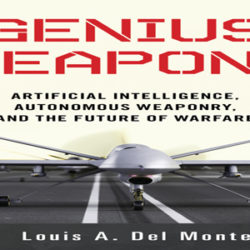
Amherst, NY (November 6, 2018) – The first book in its genre, Genius Weapons: Artificial Intelligence, Autonomous Weaponry, and the Future of Warfare (Prometheus Books, November 6, 2018) by Louis A. Del Monte, delineates the new arms race between the United States, China, and Russia to develop genius weapons, weapons whose artificial intelligence greatly exceeds human intelligence and the destructive force of nuclear weapons.

Artificial intelligence is playing an ever-increasing role in military weapon systems. The Pentagon is now in a race with China and Russia to develop “lethal autonomous weapon systems” (LAWS). In this eye-opening overview, a physicist, technology expert, and former Honeywell executive examines the advantages and the potential threats to humanity resulting from the deployment of weapons guided by superintelligent computers (i.e., genius weapons). Stressing the likelihood that these weapons will be available in the coming decades since no treaty regulates their development and deployment, the author examines the future of warfare and the potential for genius weapons to initiate a war that threatens the extinction of humanity.

“A highly readable and deeply researched exploration of one of the most chilling aspects of the development of artificial intelligence: the creation of intelligent, autonomous killing machines. In Louis A. Del Monte’s view, the multibillion dollar arms industry and longstanding rivalries among nations make the creation of autonomous weapons extremely likely,” said James Barrat, author of Our Final Invention: Artificial Intelligence and the End of the Human Era.

In his insightful and prescient account of genius weapons, Del Monte uses vivid scenarios that immerse the reader in the ethical dilemmas and existential threats posed by these weapons. Based on hard science and political realities, the book warns that the dystopian visions of such movies as The Terminator and I, Robot may become a frightening reality in the future. The author concludes with concrete recommendations, founded in historical precedent, to control this new arms race.

 Mr. Del Monte is available for interviews. You may contact him by phone at (952) 261-4532, or by email at ldelmonte@delmonteagency.com.

Louis A. Del Monte is an award-winning physicist, author, inventor, futurist, featured speaker, and CEO of Del Monte and Associates, Inc. For over thirty years, he was a leader in the development of microelectronics and microelectromechanical systems (MEMS) for IBM and Honeywell. As a Honeywell Executive Director from 1982 to 2001, he led hundreds of physicists, engineers, and technology professionals engaged in integrated circuit and sensor technology development for both Department of Defense (DOD) and commercial applications. He is literally a man whose career has changed the way we work, play, and make war. Del Monte is the recipient of the H.W. Sweatt Award for scientific engineering achievement and the Lund Award for management excellence. He is the author of international bestsellers like Nanoweapons and The Artificial Intelligence Revolution. He has been quoted or has published articles in the Huffington Post, the Atlantic, Business Insider, American Security Today, Inc., and on CNBC. He has appeared on the History Channel.

Amherst, NY (November 6, 2018) – The first book in its genre, Genius Weapons: Artificial Intelligence, Autonomous Weaponry, and the Future of Warfare (Prometheus Books, November 6, 2018) by Louis A. Del Monte, delineates the new arms race between the United States, China, and Russia to develop genius weapons, weapons whose artificial intelligence greatly exceeds human intelligence and the destructive force of nuclear weapons.

Artificial intelligence is playing an ever-increasing role in military weapon systems. The Pentagon is now in a race with China and Russia to develop “lethal autonomous weapon systems” (LAWS). In this eye-opening overview, a physicist, technology expert, and former Honeywell executive examines the advantages and the potential threats to humanity resulting from the deployment of weapons guided by superintelligent computers (i.e., genius weapons). Stressing the likelihood that these weapons will be available in the coming decades since no treaty regulates their development and deployment, the author examines the future of warfare and the potential for genius weapons to initiate a war that threatens the extinction of humanity.

“A highly readable and deeply researched exploration of one of the most chilling aspects of the development of artificial intelligence: the creation of intelligent, autonomous killing machines. In Louis A. Del Monte’s view, the multibillion dollar arms industry and longstanding rivalries among nations make the creation of autonomous weapons extremely likely,” said James Barrat, author of Our Final Invention: Artificial Intelligence and the End of the Human Era.

In his insightful and prescient account of genius weapons, Del Monte uses vivid scenarios that immerse the reader in the ethical dilemmas and existential threats posed by these weapons. Based on hard science and political realities, the book warns that the dystopian visions of such movies as The Terminator and I, Robot may become a frightening reality in the future. The author concludes with concrete recommendations, founded in historical precedent, to control this new arms race.

Mr. Del Monte is available for interviews. You may contact him by phone at (952) 261-4532, or by email at ldelmonte@delmonteagency.com.

Louis A. Del Monte is an award-winning physicist, author, inventor, futurist, featured speaker, and CEO of Del Monte and Associates, Inc. For over thirty years, he was a leader in the development of microelectronics and microelectromechanical systems (MEMS) for IBM and Honeywell. As a Honeywell Executive Director from 1982 to 2001, he led hundreds of physicists, engineers, and technology professionals engaged in integrated circuit and sensor technology development for both Department of Defense (DOD) and commercial applications. He is literally a man whose career has changed the way we work, play, and make war. Del Monte is the recipient of the H.W. Sweatt Award for scientific engineering achievement and the Lund Award for management excellence. He is the author of international bestsellers like Nanoweapons and The Artificial Intelligence Revolution. He has been quoted or has published articles in the Huffington Post, the Atlantic, Business Insider, American Security Today, Inc., and on CNBC. He has appeared on the History Channel.