Category Archives: War

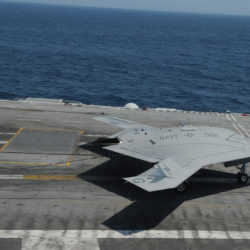
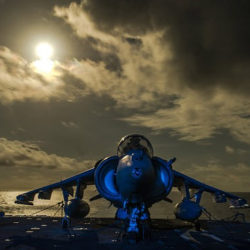
A jet plane sitting on top of an aircraft carrier.

Introduction of Genius Weapons (excerpt)

What is the driving force behind autonomous weapons? There are two forces driving these weapons:

  1. Technology: AI technology, which provides the intelligence of autonomous weapon systems (AWS), is advancing exponentially. Experts in AI predict autonomous weapons, which would select and engage targets without human intervention, will debut within years, not decades. Indeed, a limited number of autonomous weapons already exist. For now, they are the exception. In the future, they will dominate conflict.
  2. Humanity: In 2016, the World Economic Forum Matters (WFM) attendees were asked, “If your country was suddenly at war, would you rather be defended by the sons and daughters of your community, or an autonomous A.I. weapons system?” The majority, 55%, responded they would prefer artificially intelligent (AI) soldiers. This result suggests a worldwide desire to have robots, sometimes referred to as “killer robots,” fight wars rather than risking human lives.

The use of AI technology in warfare is not new. The first large-scale use of “smart bombs” by the United States during Operation Desert Storm in 1991 made it apparent that AI had the potential to change the nature of war. The word “smart” in this context means “artificially intelligent.” The world watched in awe as the United States demonstrated the surgical precision of smart bombs, which neutralized military targets and minimized collateral damage. In general, using autonomous weapon systems in conflict offers highly attractive advantages:

  • Economic: Reducing costs and personnel
  • Operational: Increasing the speed of decision-making, reducing dependence on communications, reducing human errors
  • Security: Replacing or assisting humans in harm’s way
  • Humanitarian: Programming killer robots to respect the international humanitarian laws of war better than humans

Even with these advantages, there are significant downsides. For example, when warfare becomes just a matter of technology, will it make engaging in war more attractive? No commanding officer has to write a letter to the mothers and fathers, wives and husbands, of a drone lost in battle. Politically, it is more palatable to report equipment losses than human causalities. In addition, a country with superior killer robots has both a military advantage and a psychological advantage. To understand this, let us examine the second question posed to attendees of 2016 World Economic Forum Matters7: “If your country was suddenly at war, would you rather be invaded by the sons and daughters of your enemy, or an autonomous A.I. weapon system?” A significant majority, 66%, responded a preference for human soldiers.

In May 2014, a Meeting of Experts on Lethal Autonomous Weapons Systems was held at the United Nations in Geneva8 to discuss the ethical dilemmas such weapons systems pose, such as:

  • Can sophisticated computers replicate the human intuitive moral decision-making capacity?
  • Is human intuitive moral perceptiveness ethically desirable? If the answer is yes, then the legitimate exercise of deadly force should always require human control.
  • Who is responsible for the actions of a lethal autonomous weapons system? If the machine is following a programmed algorithm, is the programmer responsible? If the machine is able to learn and adapt, is the machine responsible? Is the operator or country that deploys LAWS (i.e., lethal autonomous weapon systems) responsible?

In general, there is a worldwide growing concern with regard to taking humans “out of the loop” in the use of legitimate lethal force.

This is an excerpt from my new book, Genius Weapons, now on sale on Amazon. Give yourself and others the gift of knowledge.

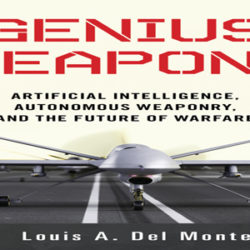
A book cover with an airplane on the ground.

Press Release: New Books Reveals Arms Race for Genius Weapons and Their Threat to Humanity

Amherst, NY (November 6, 2018) – The first book in its genre, Genius Weapons: Artificial Intelligence, Autonomous Weaponry, and the Future of Warfare (Prometheus Books, November 6, 2018) by Louis A. Del Monte, delineates the new arms race between the United States, China, and Russia to develop genius weapons, weapons whose artificial intelligence greatly exceeds human intelligence and the destructive force of nuclear weapons.

Artificial intelligence is playing an ever-increasing role in military weapon systems. The Pentagon is now in a race with China and Russia to develop “lethal autonomous weapon systems” (LAWS). In this eye-opening overview, a physicist, technology expert, and former Honeywell executive examines the advantages and the potential threats to humanity resulting from the deployment of weapons guided by superintelligent computers (i.e., genius weapons). Stressing the likelihood that these weapons will be available in the coming decades since no treaty regulates their development and deployment, the author examines the future of warfare and the potential for genius weapons to initiate a war that threatens the extinction of humanity.

“A highly readable and deeply researched exploration of one of the most chilling aspects of the development of artificial intelligence: the creation of intelligent, autonomous killing machines. In Louis A. Del Monte’s view, the multibillion dollar arms industry and longstanding rivalries among nations make the creation of autonomous weapons extremely likely,” said James Barrat, author of Our Final Invention: Artificial Intelligence and the End of the Human Era.

In his insightful and prescient account of genius weapons, Del Monte uses vivid scenarios that immerse the reader in the ethical dilemmas and existential threats posed by these weapons. Based on hard science and political realities, the book warns that the dystopian visions of such movies as The Terminator and I, Robot may become a frightening reality in the future. The author concludes with concrete recommendations, founded in historical precedent, to control this new arms race.

 Mr. Del Monte is available for interviews. You may contact him by phone at (952) 261-4532, or by email at ldelmonte@delmonteagency.com.

Louis A. Del Monte is an award-winning physicist, author, inventor, futurist, featured speaker, and CEO of Del Monte and Associates, Inc. For over thirty years, he was a leader in the development of microelectronics and microelectromechanical systems (MEMS) for IBM and Honeywell. As a Honeywell Executive Director from 1982 to 2001, he led hundreds of physicists, engineers, and technology professionals engaged in integrated circuit and sensor technology development for both Department of Defense (DOD) and commercial applications. He is literally a man whose career has changed the way we work, play, and make war. Del Monte is the recipient of the H.W. Sweatt Award for scientific engineering achievement and the Lund Award for management excellence. He is the author of international bestsellers like Nanoweapons and The Artificial Intelligence Revolution. He has been quoted or has published articles in the Huffington Post, the Atlantic, Business Insider, American Security Today, Inc., and on CNBC. He has appeared on the History Channel.

Amherst, NY (November 6, 2018) – The first book in its genre, Genius Weapons: Artificial Intelligence, Autonomous Weaponry, and the Future of Warfare (Prometheus Books, November 6, 2018) by Louis A. Del Monte, delineates the new arms race between the United States, China, and Russia to develop genius weapons, weapons whose artificial intelligence greatly exceeds human intelligence and the destructive force of nuclear weapons.

Artificial intelligence is playing an ever-increasing role in military weapon systems. The Pentagon is now in a race with China and Russia to develop “lethal autonomous weapon systems” (LAWS). In this eye-opening overview, a physicist, technology expert, and former Honeywell executive examines the advantages and the potential threats to humanity resulting from the deployment of weapons guided by superintelligent computers (i.e., genius weapons). Stressing the likelihood that these weapons will be available in the coming decades since no treaty regulates their development and deployment, the author examines the future of warfare and the potential for genius weapons to initiate a war that threatens the extinction of humanity.

“A highly readable and deeply researched exploration of one of the most chilling aspects of the development of artificial intelligence: the creation of intelligent, autonomous killing machines. In Louis A. Del Monte’s view, the multibillion dollar arms industry and longstanding rivalries among nations make the creation of autonomous weapons extremely likely,” said James Barrat, author of Our Final Invention: Artificial Intelligence and the End of the Human Era.

In his insightful and prescient account of genius weapons, Del Monte uses vivid scenarios that immerse the reader in the ethical dilemmas and existential threats posed by these weapons. Based on hard science and political realities, the book warns that the dystopian visions of such movies as The Terminator and I, Robot may become a frightening reality in the future. The author concludes with concrete recommendations, founded in historical precedent, to control this new arms race.

Mr. Del Monte is available for interviews. You may contact him by phone at (952) 261-4532, or by email at ldelmonte@delmonteagency.com.

Louis A. Del Monte is an award-winning physicist, author, inventor, futurist, featured speaker, and CEO of Del Monte and Associates, Inc. For over thirty years, he was a leader in the development of microelectronics and microelectromechanical systems (MEMS) for IBM and Honeywell. As a Honeywell Executive Director from 1982 to 2001, he led hundreds of physicists, engineers, and technology professionals engaged in integrated circuit and sensor technology development for both Department of Defense (DOD) and commercial applications. He is literally a man whose career has changed the way we work, play, and make war. Del Monte is the recipient of the H.W. Sweatt Award for scientific engineering achievement and the Lund Award for management excellence. He is the author of international bestsellers like Nanoweapons and The Artificial Intelligence Revolution. He has been quoted or has published articles in the Huffington Post, the Atlantic, Business Insider, American Security Today, Inc., and on CNBC. He has appeared on the History Channel.

A blue fighter jet on a carrier deck under a dramatic cloudy sky with the sun partially visible.

North Korea Blames US for Hostile Tensions – Pyongyang Vows Response

The Korean Central News Agency released a commentary Friday titled, “Who Is Chiefly to Blame for Plagued Situation on Korean Peninsula,” in which blames the US with bringing the region to the brink of nuclear war. It also vows to continue its preparations for a nuclear war.

A nuclear war between the US and North Korea would be a worldwide nightmare, which could open the door to a larger theater conflict with China and Russia. Even if the US refrains from using nuclear weapons, analysts project that a war between North Korea and the United States, along with its allies, could take months to conclude. In those months, North Korea is likely to respond in a number of ways. To understand their potential responses, we need to examine their military capabilities.

Nuclear Weapons and Missiles  

North Korea has between 13-21 nuclear weapons, similar to the atom bombs dropped on Hiroshima and Nagasaki at the end of World War II. In other words, their nuclear weapons are physically large, unlikely to fit on a missile, and measured in kilotons of TNT, not megatons like those of the United States and Russia. Nonetheless, US nuclear weapons during World War II killed 250,000 Japanese. Therefore, if they find any way to deliver their nuclear weapons, millions could die.

One way that North Korea may attempt to deliver its nuclear weapons is by ballistic missiles. North Korea’s missile arsenal includes artillery rockets, derived from World War II designs, to medium-range missiles, of questionable reliability, able to strike targets in the Pacific Ocean. While this appears relatively crude by US military standards, it still presents a threat to the Asian region, even if the missiles only use conventional explosives. Some analysts suggest that North Korea may be intentionally making small atomic bombs, similar to the tactical nuclear weapons of the United States and Russia, to enable deployment in their medium range missiles. Tactical nuclear weapons have a multi-kiloton punch that could devastate cities like Seoul and Tokyo, killing millions.

In 2012, North Korea began parading its intercontinental ballistic missiles, the KN-08 and KN-14, carried and launched by specifically built truck. The missiles are in the early development stage and analysts question if North Korea has the capability to target them accurately. However, there is little doubt that North Korea is focusing on building reliable long-range missiles with the capability to reach the mainland United States.

A second way North Korea could deliver its nuclear weapons is by smuggling them out of North Korea in containers on cargo ships. Using this method, North Korea could inflict serious damage and casualties to ports anywhere in the world. Crime syndicates currently use shipping containers to smuggle narcotics, weapons, stolen property, and humans to countries around the world. With over 17 million shipping containers in circulation, it would be hard to detect those that contain a nuclear weapon, especially if the detonation occurs while the container is still aboard the ship.

Military and Conventional Weapons

North Korea has the world’s largest army, the Korean People’s Army (KPA) with 1,106,000 active and 8,389,000 reserve troops, including the world’s largest Special Forces unit. In short, almost every able-bodied male has extensive military training.

However, beyond the military training, a former defector claims that every North Korean soldier spends 60% of their time exposed to a form of “brainwashing.” Most North Koreans join the KPA when are 17 to 18 years old and serve a mandatory 10 years if they are male, 6 years if they are female. At that age, they are highly impressionable and just beginning to form their values and opinions of the world. North Korea tightly controls all communications and they learn protecting their leader, Kim Jung-un, is their sacred duty, and they must obey all commands. This suggests that any invasion of North Korea will meet staunch resistance and may degrade into guerrilla warfare.

North Korea’s diverse conventional weapons arsenal includes approximately 3,700 tanks, 2,100 armored personnel carriers and infantry fighting vehicles, 17,900 artillery pieces, 11,000 anti-aircraft guns, 10,000 shoulder-launched surface-to-air missiles and anti-tank guided missiles, 1,600 fighter aircraft, and 1,000 warships, among them 70 submarines, making it the world’s largest submarine fleet.

Given the sheer numbers of their conventional weapons, even a preemptive strike would be unlikely to destroy North Korea’s entire capability. Inevitably, they would strike back. South Korea, Japan, and US forces in the region would be their high priority targets. Since Soul, the capital of South Korea, and its 24 million inhabitants, is less than 40 miles south of the North Korean border, even conventional artillery and rockets have the potential to kill millions.

Asymmetrical Weapons

In 2014, the South Korean Defense Ministry estimated that North had stockpiled 2,500 to 5,000 tons of chemical weapons and had a capacity to produce a variety of biological weapons.

North Korea’s tons of chemical weapons include nerve, blister, blood, and vomiting agents, as well as some biological weapons, including anthrax, smallpox, and cholera. North Korea could deliver the chemical and biological weapons via artillery and missiles. They have missiles capable of reaching targets in South Korea and Japan.

It is also possible that North Korea has already smuggled biological weapons into the countries they consider adversarial. Given the “brainwashing” of their soldiers, North Korea could launch “kamikaze” style attacks, sending infected agents to mingle with the adversary’s populace.

North Korea is a signatory to the Geneva Protocol, which prohibits the use of chemical weapons in warfare, and to the Biological and Toxins Weapons Convention (BTWC), which prohibits the development, production and stockpiling of bacteriological (biological) and toxin weapons. However, there is already evidence they will not adhere to either treaty. For example, evidence suggests North Korea is responsible for the assassination of Kim Jong-un’s half-brother Kim Jong-nam, who was critical of Kim Jong-un’s regime. Authorities allege that North Korean agents sprayed VX nerve agent in Kim Jong-nam’s face, causing his death.

The Geneva Conventions, which establish the standards of international law for humanitarian treatment in war, does not cover nanoweapons. In my book, Nanoweapons: A Growing Threat To Humanity (Potomac Books 2017), I made the observation that China’s offensive nanoweapons capabilities may benefit from their alliance with North Korea and vice versa. Therefore, North Korea could deploy the simplest of nanoweapons, such as toxic nanoparticles, which mimic chemical weapons, and still be within the standards of international law.

Conclusions

Any conflict with North Korea is likely to trigger them to use all weapons at their disposal. Such a conflict would leave a million dead.

Efforts to unify the North and South would face extreme ideological barriers. All communication in the North vilifies its adversaries and raises Kim Jung-un to the level of a deity.

Any war with North Korea may open the door to a wider conflict. The Sino-North Korean Mutual Aid and Cooperation Friendship Treaty bind China and North Korea, which includes provisions for either country to come to the aid of the other in the event of an attack.