Category Archives: Universe Mysteries

Abstract blue digital background with glowing horizontal lines and light particles.

What is faster than the speed of light? Quantum Entanglement!

In 1905, Einstein published his now famous special theory of relativity. It is one of the pillars of modern physics. The special theory of relativity asserts that no physical entity can travel faster than light, since the energy required to enable such a velocity would be infinite. Most of the scientific community extended this concept to communication, asserting that no communication could take place faster than the speed of light. Generally, the scientific community regards light as the upper speed limit of the universe. Until recently, there was no data to contradict this widely held belief.

In 1935, a paper by Albert Einstein, Boris Podolsky, and Nathan Rosen described the EPR paradox (i.e., a thought experiment intended to reveal what they believed to be inadequacies of quantum mechanics) and several papers by Erwin Schrödinger shortly thereafter initiated research into an incredible feature of quantum mechanics, “quantum entanglement.” What made this feature of quantum mechanics incredible is that it appears to allow communication to occur faster than the speed of light. However, we are getting a little ahead of ourselves. Let us first understand what quantum entanglement is and how it relates to communication.

Quantum entanglement is a physical phenomenon that occurs when pairs of particles are generated or interact such that the quantum state of each particle is described relative to each other. Let us consider an example to illustrate this phenomenon. When an electron collides with a positron (i.e., the antimatter counter part of an electron), two photons are emitted. An unusual feature of quantum mechanics is the resultant photons are “entangled.” If one photon exhibits spin up (a component of its angular momentum), the other photon will exhibit spin down. They conserve spin. If you separate the photons and change the spin of either photon, the other will immediately change its spin in a manner to conserve spin. For example, if you change the spin of one photon from spin up to spin down, the other photon, even at a significant distance, will change its spin from spin down to spin up. In other words, they continue to conserve spin.

This phenomenon has been widely verified and the scientific community accepts it as a fundamental feature of quantum mechanics. In recent years, further experimentation related to quantum entanglement has shaken one of the fundamental pillars of modern science, namely, the speed of light as the upper limit that mass or information could travel. Recent experiments (Juan Yin, et al. (2013). “Bounding the speed of `spooky action at a distance”. Phys. Rev. Lett. 110, 260407) have shown that the quantum entanglement information transfer occurs at least 10,000 times faster than the speed of light. It might even be faster. Quantum mechanics holds that the quantum change occurs instantaneously. In other words, the separated particles act as if they were one, even when they are separated by a significant distance. “According to quantum physics, entanglement is independent of distance,” physicist Rupert Ursin of the Austrian Academy of Sciences said in a statement to livescience.com (reference below).

The phenomenon of quantum entanglement has been demonstrated experimentally with photons, electrons, molecules and even small diamonds. It is real and an area of active research in physics. There is no widely held theory within the scientific community that explains how the particles are able to communicate faster than the speed of light. There are numerous speculations, which I will not go into in this article in the interest of remaining factual.

Anyone who can explain quantum entanglement to the satisfaction of the scientific community is likely a candidate for the Nobel Prize. It has been a mystery for almost a hundred years.

Sources:

Image: iStockPhoto

A section of a handwritten sheet music with musical notes and annotations in pencil and red ink.

Was the SETI “Wow!” Signal from Aliens?

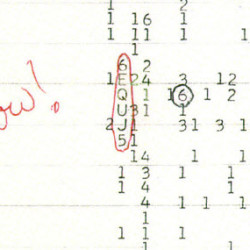
Did we actually receive a message from aliens? On August 15, 1977, while working on a SETI (i.e., Search for Extraterrestrial Intelligence) project at the Big Ear radio telescope of The Ohio State University, Dr. Jerry Ehman detected a strong narrow-band radio signal. The signal lasted for 72 seconds, appeared to be non-terrestrial and originating from outside our solar system.

The Big Ear telescope was fixed and used the rotation of the Earth to scan the sky. At the speed of the Earth’s rotation, and given the width of the Big Ear’s observation window, the Big Ear could observe a given point for just 72 seconds. Therefore, a continuous extraterrestrial signal would be expected to register for exactly 72 seconds. The recorded intensity of that signal would show a gradual peaking for the first 36 seconds, as the signal reached the center of Big Ear’s observation window, and then a gradual decrease. This is exactly what was observed.

Amazed at how closely the signal matched the expected signature of an interstellar communication, Dr. Ehman circled the signal on the computer printout and wrote “Wow!” on its side. This comment became the name of the signal.

Unfortunately, SETI has been unable to confirm the signal, but not for lack of trying. The signal was expected to appear three minutes apart in each of Big Ear’s horns, but that did not happen. Dr. Ehman unsuccessfully looked for recurrences of the signal using Big Ear for months after its detection.

In 1987 and 1989, American data analyst, author, and astronomer, Robert H. Gray, searched for the event using the META array at Oak Ridge Observatory, but did not detect it.

In a July 1995 test of signal detection software, SETI League executive director H. Paul Shuch made several drift-scan observations of the Wow! signal’s coordinates with a 12 meter radio telescope at the National Radio Astronomy Observatory, Green Bank WV. No signal was detected.

In 1995 and 1996, Gray searched for the signal using the Very Large Array, which is significantly more sensitive than Big Ear. Again, no signal was detected.

In 1999, Gray and Simon Ellingsen, an Associate Professor in Physics and Radio astronomy at the University of Tasmania, Australia, searched for recurrences of the event using the 26m radio telescope at the University of Tasmania’s Mount Pleasant Radio Observatory. No signal was detected.

Although, SETI was not able confirm the signal, they were able to determine that the initial signal seemed to have originated from the Sagittarius constellation.

The question “Are we alone in the universe?” is a question humankind has been asking for centuries. The “WOW!” signal appears to suggest we may have company.

Universe's Accelerated Expansion

The Birth of the Universe – The Origin of the Big Bang

This post is based on material from my book,  Unraveling the Universe’s Mysteries, 2012, Louis A. Del Monte (available at Amazon https://amzn.to/Zo1TGn)

At the turn of the Twentieth Century, science held that the universe was eternal and static. This meant it had no beginning. Nor would it ever end. In other words, the universe was in “steady state.” At the beginning of the Twentieth Century, as I mentioned above, telescopes were crude and unable to focus on other galaxies. In addition, no theories of the universe were causing science to doubt the current dogma of a steady-state universe. All of that was about to change.

In 1916, Albert Einstein developed his general theory of relativity. It was termed “general” because it applied to all frames of reference, not only frames at rest or moving at a constant velocity (inertial frames). The general theory of relativity predicted that the universe was either expanding or contracting. This should have been a pivotal clue that the current scientific view of the universe as eternal and static might be wrong. However, Einstein’s paradigm of an eternal and static universe was so strong, he disregarded his own results. He quickly reformulated the equations incorporating a “cosmological constant.” With this new mathematical expression plugged into the equations, the equations of general relativity yielded the answer Einstein believed was right. The universe was in a steady-state. This means it was neither expanding nor contracting. The world of science accepted this, and continued entrenched in its belief of a steady-state universe. However, as telescopes began to improve, this scientific theory was destined to be shattered.

In 1929, Edwin Hubble, using the new Mt. Wilson 100-inch telescope, discovered the universe was expanding. In time, other astronomers confirmed Hubble’s discovery. This forced Einstein to call the cosmological constant his “greatest blunder.” This completely shattered the steady-state theory of the universe. In fact, this discovery was going to pave the way to an even greater discovery, the Big Bang theory.

The Big Bang theory holds that the universe started 13.8 billion years ago as an infinitely dense energy point that expanded suddenly to create the universe. This is an excellent example of why the Big Bang theory belongs to the class of theories referred to as “cosmogonies” (theories that suggest the universe had a beginning). The Big Bang is widely documented in numerous scientific works, and is widely held as scientific fact by the majority of the scientific community.

However, what gave birth to the Big Bang? Where did the initial energy come from?

To unravel this mystery, we will start with an unusual phenomenon observed in the laboratory, namely spontaneous particle production or “virtual particles,” which are particles that form in a laboratory vacuum, apparently coming from nothing. This is a scientific fact, and there is a laundry list that documents virtual particles are real. Some physicists call this spontaneous particle production.

The best-known proponent of the idea that a quantum fluctuation gave birth to the energy of the Big Bang is Canadian-American theoretical physicist, Lawrence Maxwell Krauss. In the simplest terms, Dr. Krauss ascribes the creation of the universe to a quantum fluctuation (i.e., a quantum fluctuation results when a point in space experiences a temporary change in energy), similar to how virtual particles gain existence.

I found Dr. Krauss’ hypothesis convincing, especially in light of what we observe regarding virtual particles. However, one intriguing aspect about virtual particles is that we sometimes observe their occurrence in matter-antimatter pairs. This raised a question. Why would the Big Bang “particle” be a singularity? In this context, we can define a “singularity” as an infinitely energy-dense particle. Numerous observations about virtual particles suggest a “duality.” A “duality,” in this context, would refer to an infinitely dense energy particle pair (one matter particle, and the other an antimatter particle). How would all this play out?

First, we need to postulate a super-universe, one capable of quantum fluctuations. Cosmologists call the super-universe the “Bulk.” The Bulk is “empty” space, which gives existence to infinitely energy-dense matter-antimatter virtual particles. These collide and initiate the Big Bang. If this view of reality is true, it makes the multiverse concept more plausible. Other infinitely energy-dense matter-antimatter particles continually pop in and out of existence in the Bulk, similar to the way that virtual matter-antimatter particles do in the laboratory. When this occurs in the Bulk, a collision between the particles initiates a Big Bang. Therefore, considering the billions of galaxies in the universe, there may be billions of universes in the Bulk.

I have termed this theory the Big Bang Duality, and I discuss it fully in my book, Unraveling the Universe’s Mysteries (2012), available on Amazon (https://amzn.to/Zo1TGn).

Silhouette of a person walking towards bright light at the end of a dark tunnel.

Intuition – Is it a real or just coincidence?

Ever know something without understanding how you know it? According to Google, intuition can be defined as:

  • The ability to understand something immediately, without the need for conscious reasoning
  • A thing that one knows or considers likely from instinctive feeling rather than conscious reasoning

Some people call it a “sixth sense” or a “gut feeling.” Many of us have experienced intuition. For example, did you ever have the feeling someone was watching you, and then look around to find that somebody was watching you?

Cases of intuition appear common and diverse. The processes by which they happen remain mostly unknown. The word intuition comes from Latin verb “intueri,” which translates as “to look inside” or “to contemplate.” Intuition is conceived as a type of inner perception, and some people trust their “gut feelings” as facts. In fact, some scientists contend that intuition is associated with innovation in scientific discovery.

Science cannot completely explain intuition. Intuition has been the study of psychology, a topic of interest in various religions and is a common subject of New Age writings.

Does the human brain have a special ability to acquire knowledge without conscious realization? Is it coincidence or a mystery of the human mind? No one really knows.

Multiple overlapping clock faces with various times, creating a surreal and abstract time concept in blue tones.

What Is Time? – The Existence Equation Conjecture – Part 3/3 (Conclusion)

This three part post is based on original theoretical research presented in my book, Unraveling the Universe’s Mysteries, 2012, Louis A. Del Monte (available at Amazon https://amzn.to/Zo1TGn)

In our last post we were left a significant unanswered question. Where does the enormous negative energy required for existence come from?

There are relatively few candidates. In fact, after much though and research, two emerge.

The gravitational fields of the universe. Gravitation’s reach is infinite. Everything in the universe pulls on everything else. However, to date, no experimental evidence supports that the energy for existence is being syphoned from the universe’s gravitational fields. Although, we know gravitational energy will cause time dilation, and extend a particle’s existence, we do not observe any reduction in gravitational fields between objects. In fact, the force of gravity, as measured on Earth, remains unchanged over centuries of measurement. It is theoretically possible that dark matter blocks any gravitational energy syphoning within a galaxy, but its absence between galaxies allows the gravitational fields between galaxies to be syphoned, and thus causes the distance between galaxies to increase. This squares with observation, but this hypothesis has a serious problem: most distant galaxies are moving away from us at speeds that exceed the speed of light. If this is due to weakening gravitational fields between galaxies, it suggests the galaxies themselves are moving faster than the speed of light, and that violates the special theory of relativity, making it unlikely. Based on the above reasoning, until new data is available to the contrary, syphoning energy from gravitational fields between galaxies does not appear to be a viable candidate.

Dark energy. Is it possible that the universe’s expansion is occurring to sustain its existence? We know that the accelerated expansion of the universe is real. We attribute its expansion to an unknown cause: dark energy. Is the energy required for existence being syphoned from the vacuums that exist between galaxies? If that is the case, as energy is removed from the vacuums between galaxies, mass is equivalently remove, based on Einstein’s famous mass-energy equivalence equation (E = mc2). As energy/mass is removed, the gravitational attraction within the vacuum decreases causing it to expand. In addition, the expansion of space, causing the most distance galaxies to move away faster than the speed of light, can be explained on the basis that those distant galaxies have been around longer and have had more energy removed from the vacuums that separate them. Therefore, the phenomenon of dark energy may be the existence equation conjecture at work (i.e., removing energy from the vacuums of space).

One important question remains. Why doesn’t the space within a galaxy expand? My speculation is that dark matter acts to block any removal of energy from the space within a galaxy. In effect, I am suggesting that dark matter causes a galaxy to act more like one galactic particle.

What does all of the above say about the nature of time? If we are on the right track, it says describing the nature of time requires six crucial elements, all of which are simultaneously true.

  1. Time is change.
  2. Time is a measure of energy, since change requires energy.
  3. Time is a measure of existence.
  4. Movement in time (or existence) requires negative energy.
  5. The energy to fuel time (existence) is enormous. It may be responsible for the life times associated with unstable elementary particles, essentially consuming them, in part, to satisfy the Existence Equation Conjecture. It may be drawing energy from the universe. If correct, it provides insight into the nature of dark energy. Essentially the negative energy we call dark energy is the existence equation conjecture removing energy from the vacuums between galaxies.

This theory of time is speculative, but fits the empirical observations of time. A lot of the speculation rests on the validity of the Existence Equation Conjecture. Is it valid? As shown in appendix 2 of my book, Unraveling the Universe’s Mysteries, it is entirely consistent with data from a high-energy particle-accelerator experiment involving muons moving near the speed of light. The experimental results agree closely with predictions of the Existence Equation Conjecture (within 2%). This data point is consistent with the hypothesis that adding kinetic energy can fuel the energy required for existence. The implications are enormous, and require serious scientific scrutiny.

The Existence Equation Conjecture represents a milestone. If further evaluation continues to confirm the validity of the Existence Equation Conjecture, we have a new insight into the nature of time. Existence (movement in time) requires enormous negative energy. The Existence Equation Conjecture, itself, provides insight into the physical processes underpinning time dilation. It answers the question why a subatomic particle’s life increases with the addition of kinetic or gravitational energy. It offers a solution path to a mystery that has baffled science since 1998, namely the cause of the accelerated expansion of the universe. Lastly, it may contain one of the keys to time travel.