Category Archives: Universe Mysteries

Abstract digital art featuring a radiant white light at the center surrounded by intricate geometric patterns and electric green lines.

The Mysterious Nature of Energy

We scientists talk about energy, and derive equations with energy mathematically expressed in the equation as though we understand energy. The fact is: we do not. It is an indirectly observed quantity. We infer its existence. For example, in physics, we define energy as the ability of a physical system to do work on another physical system. Physics is one context that uses and defines the word energy. However, the word energy has different meanings in different contexts. Even the average person throws the term energy around in phrases like, “I don’t have any energy today,” generally inferring a lack of vigor, force, potency, zeal, push, and the like. The word energy finds its way into both the scientific community and our everyday communications, but the true essence of energy remains an enigma.

The concept of energy is an old concept. It comes from the ancient Greek word, “enérgeia,” which translates “activity or operation.” As previously stated, we do not know the exact essence of energy, but we know a great deal about the effects of energy. To approach a better understanding, consider these four fundamental properties of energy:

1. Energy is transferable from one system to another.

Transferring mass between systems results in a transfer of energy between systems. Mass and energy have been inseparably equated, since 1905, via Einstein’s famous mass–energy equivalence equation, E = mc2, where E is energy, m is mass, and c is the speed of light in a vacuum. This equation is widely held as a scientific fact. Experimental results over the last century strongly validate it. Typically, mass transfers between systems occur at the atomic level as atoms capture subatomic particles or bond to form products of different masses.

Non-matter transfer of energy is possible. For example, a system can transfer energy to another by thermal radiation (heat). The system that absorbs the thermal radiation experiences an increase in energy, typically measured by its temperature. This is how the radiators in a house raise the room temperature. Here is another example: If an object in motion strikes another object, a transfer of kinetic energy results. Consider billiard balls. When one ball strikes another, it imparts kinetic energy to the ball it strikes, causing it to move.

2.  Energy may be stored in systems.

If you pick up a rock from the ground and hold it at shoulder height, you have stored energy between the rock and ground via the gravitation attraction created between the Earth and rock. You may consider this potential energy. When you open your hand, the rock will fall back to the ground. Why? The answer is straightforward. It required your energy to hold the rock in its new position at shoulder height. As soon as you, by opening your hand, released the energy that you were providing, it reduced to a lower energy state when the gravitational field pulled the rock back to the ground.

Any type of energy that is stored is “potential energy,” and all types of potential energy appear as system mass. For example, a compressed metal spring will be slightly more massive than before it was compressed. When you compress the spring, you do work on the system. The work on the system is energy, and that energy is stored in the compressed spring as potential energy. Because of this stored potential energy, the spring becomes more massive.

3. Energy is not only transferable–it is transformable from one form to another.

Our example regarding the rock falling back to the ground is an example of energy transformation. The potential energy was transformed to kinetic energy when you opened your hand and released the rock. This is what caused the rock to fall back to the ground. Here is an industrial example. Hydroelectric plants generate electricity by using water that flows over a falls due to gravity. In effect, they are transforming the falling water (gravitational energy) into another form of energy (electricity).

4. Energy is conserved.

This is arguably the most sacred law in physics. Simply stated: Energy cannot be created or destroyed in an isolated system. The word “isolated” implies the system does not allow other systems to interact with it. A thermos bottle is an example of an isolated system. It is preventing the ambient temperature from changing the temperature inside the thermos. For example, it keeps your coffee hot for a long time. Obviously, it is not a perfectly isolated system since eventually it will lose heat to the atmosphere, and your coffee will cool to the ambient temperature that surrounds the thermos bottle. For example, in your house, the coffee in a cup will cool to room temperature.

In summary, energy may be transferred, stored, and transformed, but it cannot be created or destroyed in an isolated system. This means the total energy of an isolated system does not change.

Next, we will consider energy in different contexts. Unfortunately, since we do not know the true essence of energy, we need to describe it via the effects we observe in the context that we observe them. Here are two contexts:

1)   Cosmology and Astronomy

Stars, nova, supernova, quasar, and gamma-ray bursts are the highest-output mass into energy transformations in the universe. For example, a star is typically a large and massive celestial body, primarily composed of hydrogen. Due to its size, gravity at the star’s core is immense. The immense gravity causes the hydrogen atoms to fuse together to form helium, which causes a nuclear reaction to occur. The nuclear reaction, in effect, transforms mass into energy. In the cosmos, mass-to-energy transformations are due to gravity, and follow Einstein famous equation, E = mc2 (discussed previously). The gravity can result in nuclear fusion, as described in the above example. It can cause a dying star to collapse and form a black hole.

2) Chemistry

Energy is an attribute of the atomic or molecular structure of a substance. For example, an atom or molecule has mass. From Einstein’s mass-energy equivalence equation, (E = mc2), we know the mass equates to energy. In chemistry, an energy transformation is a chemical reaction. The chemical reaction typically results in a structural change of the substance, accompanied by a change in energy. For example, when two hydrogen atoms bond with one oxygen atom, to form a water molecule, energy emits in the form of light.

Other scientific contexts give meaning to the word energy. Two examples are biology and geology. Numerous forms of energy are accepted by the scientific community. The various forms include thermal energy, chemical energy, electric energy, radiant energy, nuclear energy, magnetic energy, elastic energy, sound energy, mechanical energy, luminous energy, and mass. I will not go into each form and context for the sake of brevity. My intent is to illustrate that the word energy in science must be understood within a specific context and form.

As mentioned above, we truly do not know the essence of energy; we infer its existence by its effects. The effects we measure often involve utilizing fundamental concepts of science, such as mass, distance, radiation, temperature, time, and electric charge. Adding to ambiguity, energy is often confused with power. Although we often equate “power” and “energy” in our everyday conversation, scientifically they are not the same. Strictly speaking, in science, power is the rate at which energy is transferred, used, or transformed. For example, a 100-watt light bulb transforms more electricity into light than a 60-watt light bulb. In this example, the electricity is the energy source. Its rate of use in the light bulbs is power. It takes more power to run a 100-watt bulb than a 60-watt bulb. Your electric bill will verify this is true.

What is it about energy that makes it mysterious? Science does not understand the nature of energy. We have learned a great deal about energy in the last century. The word energy has found its way into numerous scientific contexts as well as into our everyday vernacular, but we do not know the fundamental essence of energy. We can infer it exists. Its existence and definition is context sensitive. We do not have any instrument to measure energy directly, independent of the context. Yet, in the last century, we have learned to harness energy in various forms. We use electrical energy to power numerous everyday items, such as computers and televisions. We have learned to unleash the energy of the atom in nuclear reactors to power, for example, cities and submarines. We have come a long way, but the fundamental essence of energy remains an enigma.

In the next post, we will discuss another aspect of energy that haunts the scientific community. Does all reality consist of discrete packets (quantums) of energy? Are mass, space, time, and energy composed of quantized energy? We can make a reasonably strong case that they are. It is counterintuitive because we do not experience reality that way. For example, when you pick up a rock, you do not directly experience the atoms that make up the rock. However, the rock is nothing more than the sum of all its atoms. If all reality is made of quantized energy, we live in a Quantum Universe. What exactly is a Quantum Universe? Stay tuned, and we will explore what a Quantum Universe is in the next post.

Source: Unraveling the Universe’s Mysteries (20120, Louis A. Del Monte
Abstract fractal pattern resembling a cosmic or underwater scene with glowing blue and white textures.

Do We Need M-Theory? Maybe!

Most high school science classes teach the classical view of the atom, incorporating subatomic particles like protons, electrons, and neutrons. This is the particle theory of the atom dating to the early Twentieth Century. In about the 1960s, scientists discovered more subatomic particles. By the 1970s, scientists discovered that protons and neutrons consist of subatomic particles called quarks (an elementary particle not known to have a substructure). In the 1980s, a mathematical model called string theory, was developed. It is a branch of theoretical physics. String theory sought to explain how to construct all particles and energy in the universe via hypothetical one-dimensional “strings.” Subatomic particles are no longer extremely small masses. Instead, they are oscillating lines of energy, hence the name “strings.” In addition, the latest string theory (M-theory) asserts that the universe is eleven dimensions, not the four-spacetime dimensions we currently experience in our daily lives. String theory was one of science’s first attempts at a theory of everything (a complete mathematical model that describes all fundamental forces and matter).

In about the mid-1990s, scientists considered the equivalences of the various string theories, and the five leading string theories were combined into a one comprehensive theory, M-theory. M-theory postulates eleven dimensions of space filled with membranes, existing in the Bulk (super-universe). The Bulk contains an infinite number of membranes, or “branes” for short.

According to M-theory, when two branes collide, they form a universe. The collision is what we observed as the Big Bang when our universe formed. From that standpoint, universes continually form via other Big Bangs (collisions of branes).

Does this explain the true origin of the energy? No! It still begs the question: where does the energy come from to create the membranes? The even-bigger question: is there any scientific proof of the multiverse? Recently, several scientists claim unusual ring patterns on the cosmic microwave background might be the result of other universes colliding with ours. However, even the scientists forwarding this theory suggest caution. It is speculative. At this point, we must admit no conclusive evidence of a multiverse exists. In fact, numerous problems with the multiverse theories are known. This does not mean there are no multiverses. Currently, though, we have no conclusive experimental proof, but do have numerous unanswered questions.

All multiverse theories share three significant problems.

1) None of the multiverse theories explains the origin of the initial energy to form the universe. They, in effect, sidestep the question entirely.

2) No conclusive experimental evidence proves that multiverses exist. This is not to say that they do not exist. It just means we cannot prove they exist.

3) Critics argue it is poor science. We are postulating universes we cannot see or measure in order to explain the universe we can see and measure.

However, in the last hundred years, we have made discoveries, and experimentally verified phenomena that in prior centuries would have been considered science fiction, metaphysics, magic, and unbelievable. We discovered numerous secrets of the universe, once believed to be only the Milky Way galaxy—to now being an uncountable number of galaxies in a space that is expanding exponentially. We also unlocked the secrets of the atom, once believed to be the fundamental building block of matter (from the Greek atomos “uncut”). Currently, we understand the atom consists of electrons, protons, and neutrons, which themselves consist of subatomic particles like quarks. The list of discoveries that have transformed our understanding of reality over the last century is endless. From my perspective, skepticism can be healthy. However, one cannot be entirely closed-minded when it comes to exploring the boundaries of science.

This brings us to the crucial question: Do we need M-Theory? My answer is: Maybe! Right now, it’s the only “mainstream” game in town. It has numerous respected proponents, including world-renowned cosmologist/physicist Stephen Hawking. However, the “mainstream” has been wrong before, and we are in uncharted waters. It may be right, and the mathematics is elegant. The only thing missing is experimental evidence (i.e., proof). On this one, you’ll have to weigh the facts and draw your own conclusion.

Source: Unraveling the Universe’s Mysteries (2012), Louis A. Del Monte

Image: iStockPhoto (licensed)


Extraterrestrial Intelligence

Searching for Potential Alien Artifacts to Establish Proof of their Existence

Similar to the way archaeologists uncover lost civilizations on Earth by analyzing the artifacts left behind, various researchers believe the past presence of advanced aliens could be detected in a similar manner. This is a reasonable approach. It has historically provided evidence of civilizations that appear to have simply vanished. For example, the Mayan calendar is supposedly predicting the end of the world on December 21, 2012. Unfortunately, this is a poor example of a lost civilization, since it never disappeared. In fact, the Maya and their decedents still populate the Maya area, and continue to honor traditions that date back centuries. Millions of Mayans still speak the Mayan language. As for the Maya calendar, most scholars do not interpret it to predict the end of the world.

A real example of a lost civilization can be found in our own North American backyard. The Anasazi lived in the bordering parts of Utah, Arizona, New Mexico, and Colorado. The Anasazi civilization emerged about 1100 BC, and appeared to vanish about 1100 AD. However, did they really vanish? Most archeologist think not. They did abandon their traditional homeland. In a number of cases, the “lost” civilizations are not lost. They move to a different location for reasons that generally relate to survival, like water and food availability. However, the point is that we know about the Anasazi civilization by studying the artifacts lefts behind, including their dwellings, pottery, tools, and the like.

Proponents of ancient alien visits to Earth point to the numerous alien-like artifacts. These include:

  • References in religious texts, such as the Book of Ezekiel (Biblical Old Testament)
  • Physical evidence such as Nazca Lines, which depict drawings that can only be fully seen from the air (Peru)
  • Ancient aircraft-type models, like the Saqqara Bird (1898 excavation of the Pa-di-Imen tomb in Saqqara, Egypt), and small gold model “planes” (Central America and coastal areas of South America)
  • Unusual ancient monuments and ruins such as the Giza pyramids in Egypt, Machu Picchu in Peru, Baalbek in Lebanon, the Moai on Easter Island, and Stonehenge in England. Proponents of ancient alien visits argue these structures could not have been built without alien help. They argue that the ability to build them was beyond the capability of humankind at the time they were built.

This is a sampling that proponents of ancient aliens provide as evidence that the Earth has been visited since ancient times by advanced aliens. Numerous books forward this theory. The most famous was written by Erich von Däniken, and published in 1968 (Chariots of the Gods?).

Obviously, this is a speculative theory, and not everyone agrees. In fact, there is considerable disagreement. Several disagree on religious grounds, like the Christian creationist community. Other critics simply say the evidence is subject to various interpretations. In reality, we have not found irrefutable evidence—the “smoking gun.” For example, if we found an electromagnetic transmitter (a radio) of unknown origin inside a newly discovered 3,000-year-old pyramid, that would be a smoking gun.

Source: Unraveling the Universe’s Mysteries (2012), Louis A. Del Monte

Image: iStockPhoto

M-theory

Using Wormholes as a Time Machine

Scientists have proposed using “wormholes” as a time machine. A wormhole is a theoretical entity in which space-time curvature connects two distant locations (or times). Although we do not have any concrete evidence that wormholes exist, we can infer their existence from Einstein’s general theory of relativity. However, we need more than a wormhole. We need a traversable wormhole. A traversable wormhole is exactly what the name implies. We can move through or send information through it.

If you would like to visualize what a wormhole does, imagine having a piece of paper whose two-dimensional surface represents four-dimensional space-time. Imagine folding the paper so that two points on the surface are connected. I understand that this is a highly simplified representation. In reality, we cannot visualize an actual wormhole. It might even exist in more than four dimensions.

How do we create a traversable wormhole? No one knows, but most scientists believe it would require enormous negative energy. This is interesting, since the Existence Equation Conjecture, discussed in previous posts, implies moving in time requires negative energy. A number of scientists believe the creation of negative energy is possible, based on the study of virtual particles and the Casimir effect.

Assuming we learn how to create a traversable wormhole, how would we use it to travel in time? The traversable wormhole theoretically connects two points in space-time, which implies we could use it to travel in time, as well as space. However, according to the theory of general relativity, it would not be possible to go back in time prior to the creation of the traversable wormhole. This is how physicists like Stephen Hawking explain why we do not see visitors from the future. The reason: the traversable wormhole does not exist yet.

Stephen Hawking did a fascinating time-traveler experiment in his popular TV series, “Into the Universe with Stephen Hawking.” He held a reception for time travelers from the future. He sent the invitations out after the reception had already occurred. His hope was that someone in the far-distant future would come across the invitation, and travel back in time to attend the reception. In the TV series, you see the reception room and Stephen Hawking, but no time travelers. He was disappointed.

However, we have four possible explanations why no time travelers attended:

1.    The invitation did not survive into the far-distant future, a future whose science enabled time travel to the past.

2.    Time travel into the past is not possible in the future, regardless of how far into the future the invitations survive.

3.    The human race does not exist in the distant future, destroyed by our own hand, or a cosmic calamity.

4.    Time travelers showed up at the party, but it was in another universe (an alternate reality suggested by the “Many-Worlds of Quantum Mechanics” theory). Perhaps in that reality, the TV series broadcasts a reception room filled with time travelers.

Although, we are discussing time travel, it is essential to note that wormholes imply connections between different points in space. This means that they may provide a faster-than-light connection between two planets, for example. Although faster-than-light travel is not possible, the wormhole may represent a shortcut. Travel inside the wormhole may remain below the speed of light, but be faster than the time it would take light to traverse the same two points outside the wormhole. Think of this simple picture.

You are on one side of the mountain. If you want to travel to the other side of the mountain by traversing its circumference, the journey will take longer than using a tunnel that connects to the other side of the mountain. The speed you travel is the same, but the tunnel allows a shortcut, and it appears that you traveled faster.

Will we ever be able to create traversable wormholes? Theoretically, it appears possible. Experiments are being conducted, as I write, using the Large Hadron Collider to create small wormholes, small black holes, and dark matter. The next decade holds considerable promise to address these questions.

Source: Unraveling the Universe’s Mysteries (2013), Louis A. Del Monte

Image: iStockPhoto (licensed)

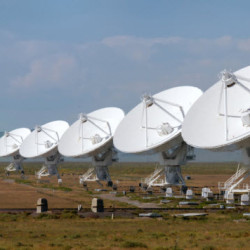
A row of large white satellite dishes under a partly cloudy sky in an open field.

Searching for Radio Emissions from Advanced Aliens

Since our discovery of the radio in 1895, we have been beaming radio transmissions into space. Most scientists believe the invention of the radio and radio telescopes would be a natural technological evolution by any intelligent life. Therefore, it would be reasonable to conclude that advanced aliens may have transmitted proof of their existence. The timeframe of their transmissions would depend on when they evolved. If their evolution were concurrent with ours, their transmissions would have started about a century ago. However, if they evolved millions of years ahead of us, their transmissions could have started millions of years ago.

In fact, the whole notion of listening for radio transmissions from aliens dates back to 1896, when Nikola Tesla promoted the idea that the radio could be used to contact advanced extraterrestrial life. In the early 1900s, Guglielmo Marconi, the inventor of the radio, claimed to have picked up Martian radio signals. Other iconic scientists, like Lord Kelvin, credited with inventing the telegraph, added fuel to the radio search for advanced aliens by publicly stating that the radio represented a possible way to detect and even contact them.

When scientists of the stature of Tesla, Marconi, and Kelvin speak, the world listens. In 1924, Mars was closer to Earth than any time in the last 100 years before or since. Obviously, this would be an excellent time to listen for radio transmissions from Mars. To avoid cluttering the Martian signals with our own, a “National Radio Silence Day” was promoted by the United States. For a 36-hour period, during August 21-23, 1924, all radios were silent for five minutes at the beginning of each hour. Concurrently, a dirigible was used to lift a radio up in order to receive signals 3 kilometers above the United States Naval Observatory. A select few listened, including the chief cryptographer of the U.S. Army, William F. Friedman. No radio transmissions from Mars were reported.

The most famous human enterprise listening for alien radio transmissions is SETI, which is not a single organization, but rather a group of organizations that employ radio technology to search for advanced extraterrestrial life. This includes Harvard University, the University of California, Berkeley, and the SETI Institute. Astronomer Frank Drake, using a small radio telescope, undertook the first SETI experiment in 1960. In 1961, the first SETI conference was held at Green Bank, West Virginia. From this humble beginning, SETI was launched. It is still highly active in its search for extraterrestrial radio transmissions as of this writing.

SETI technology has improved vastly. They are searching more frequencies than ever before. However, to date we have no confirmable evidence. SETI researchers have intercepted signals twice, once in 1977 and once in 2003, that may have been alien in nature, but they were not able to confirm the results. In fact, after more than five decades of searching, no confirmable radio transmission evidence of advanced aliens exists. However, to be fair to SETI, we need to examine their two greatest obstacles.

1.    Scale Problems—The universe is enormous, and SETI has had to confine its search to sun-like solar systems within about 200 light years of Earth. Our galaxy is about 100,000 light years across. This may appear as if they have examined about 20% of our galaxy, but that would be incorrect. They focus on high-probability solar systems (ones similar to our own), and thinly slice space looking for the radio transmission. Therefore, the real number is much less than 20%. If it is viewed in terms of the volume, SETI has covered one-fifteen millionth of our own Milky Way galaxy. This, however, is likely to improve. If we add the recent upgrades that SETI made in 2007, namely the Allen Telescope Array, located in northern California, SETI is able to extend its search radius to 25,000 light years. This enables SETI to examine the 40 billion solar systems closer to the center of our galaxy. Still though, we are looking for a needle in a very large galactic haystack.

2.    Technical Hurdles—Our transmitted radio and television signals disperse relatively rapidly in space. They would require extremely sensitive radio telescopes to detect. To understand this, imagine someone holding a candle at night a few feet from you. You are able to see it clearly. This is because numerous photons from the candle are reaching your eyes. Next, imagine that person moves farther away from you. The farther away the person moves, the dimmer the candle becomes. After a while, you will not be able to see the candle at all. The photons of the candle spread out over distance. Initially, when you were close to the candle, numerous photons reached your eyes. As the candle moved farther away, the photons spread out over a larger area, and fewer of them reach your eyes. This is why the candle became dimmer. Eventually, the candle was so far away, too few photons were reaching your eyes for your eyes to sense them.

SETI estimates that even with a sensitive radio telescope, as the extremely large Arecibo Observatory radio telescope in Puerto Rico, the Earth’s radio and televisions transmissions would only be detectable at a distance within 0.3 light years. Therefore, unless the advanced aliens used highly directed transmissions, we would likely not detect them. In addition, if the advanced aliens compressed their data, similar to data downloads from the Internet, the compressed data would appear as noise to us. In addition, advanced aliens may be using frequencies we are not monitoring or do not penetrate our atmosphere. The list of technical hurdles is numerous. Their sheer number and complexity has cast doubt on the entire SETI methodology. Critics believe the SETI efforts are futile, since the technical hurdles regarding the interception of advanced alien radio transmissions are enormous.

Image: iStockphoto (licensed)