Category Archives: Political

A woman holding a sign that says 'We are better than this!' at a protest or rally with a crowd in the background.

Politics In Science

Many of us would like to believe that science is the search for truth as it relates to the structure and behavior of the physical and natural world. However, that belief is only partially true.

Scientific research is often driven by government grants and contracts, whether you’re in a university or Fortune 500 company. While the research itself may follow the scientific method and lead to unbiased results, politics determines the fate of those results. For example, the carbon dioxide level is currently about 400 parts per million (ppm). For the last 650,000 to about 1950, the carbon dioxide level never cross the 300 ppm level. However, with the increased use of fossil fuel, such as coal and gasoline, the carbon dioxide level began climbing to its current level. The bad news, it is still climbing. At 500 ppm it is a health hazard to humans.

Well over 90% of the scientific community agrees that global warming is related to the increase in atmospheric carbon dioxide. Carbon dioxide is a “greenhouse” gas that traps heat. As a result, we are seeing the sea level rise and the Gulf of Mexico become a catcher’s mitt for the increased frequency of hurricanes. In addition to the human suffering caused by climate change, there is a financial impact. According to the US Government Accountability Office’s Website, their report “Information on Potential Economic Effects Could Help Guide Federal Efforts to Reduce Fiscal Exposure” projects climate change will cost the US Government “between $4 billion and $6 billion in annual coastal property damages from sea level rise and more frequent and intense storms,” between 2020 and 2039. However, the reality of climate change is being treated as a political issue. The Environmental Protection Agency (EPA), for example, kept three scientists from speaking at the October 23rd Narragansett Bay Estuary Program workshop on the 2017 State of Narragansett Bay and Its Watershed report.

The government has the ability to politicize science by directing research via:

  • University grants
  • Military industrial complex programs
  • Government laboratories/agencies programs
  • Censorship of government scientists

Obviously, science is no longer the pure search for truth regarding natural phenomena. Today’s science follows the government’s roadmap. Acting on results is a political decision, even when life and death are in the balance.

What does all this mean? Science is riddled with politics. Scientists working on government programs have two choices, follow the government roadmap or quit. Let me be clear. I am not talking about defense contract research, which for security reasons must be kept secret. I am talking about fundamental science, such as climate change research, which should proceed without censorship or political agendas.

Unfortunately, the EPA’s mission of “protecting human health and the environment” is now politicized to the point that they will censor government scientists and deny the reality of climate change. Although the World Health Organization estimates that “Between 2030 and 2050, climate change is expected to cause approximately 250 000 additional deaths per year, from malnutrition, malaria, diarrhoea and heat stress,” the EPA director, Scott Pruitt, told CNBC that “ “I think that measuring with precision human activity on the climate is something very challenging to do and there’s tremendous disagreement about the degree of impact, so no, I would not agree that it’s a primary contributor to the global warming that we see.” Pruitt is an attorney, not a scientist. However, he apparently feels comfortable challenging the mass of scientific evidence that contradicts his viewpoint.

Human endeavors tend to always be inherently political, including scientific research. However, politics in science should be confined to interpreting the results, not refuting results that have been widely established via the scientific method. For example, are these irrefutable facts or results open to interpretation:

  1. Greenhouse gasses, like carbon dioxide, trap heat.
  2. Carbon dioxide is increasing dramatically to the point that the amount of heat trapped is causing sea levels to rise and weather extremes, such as droughts and hurricanes.
  3. The increase in carbon dioxide is due to human activity, specifically burning fossil fuels like coal and gasoline.

The bulk of the scientific community would argue they are facts. Is it possible they are wrong? Yes, it is possible. However, government censorship and policies will not set the truth free. As Einstein stated, “ Truth is what stands the test of experience.” If we examine our current experience, we are seeing unprecedented carbon dioxide levels associated with unprecedented climate change. We need to embrace the facts and work on solutions. Governments can censor scientists or deny reality, but Mother Nature will have the final say.

 

A man in an orange shirt signing an autograph for a child wearing a red cap at an outdoor event with people and umbrellas in the background.

EPA Gags Scientists Amid Skyrocketing Climate Change Economic Impact

In its latest move to silence any discussion of climate change, the Environmental Protection Agency kept three scientists from speaking at a Monday event regarding the health of Narragansett Bay, New England’s largest estuary. The irony is that the EPA is the sole funder of the $600,000 program that published the document, the Narragansett Bay Estuary Program.

However, silencing discussions on climate change is impossible given the unprecedented frequency of environmental disasters. Former EPA Administrator Christine Todd Whitman, who served under President George W. Bush, told CNN that the environmental devastation from the last three hurricanes and droughts that led to forest fires is going to cost US taxpayers upwards of $300 billion dollars. However, Ms. Whitman noted that estimate does not include the devastation in Puerto Rico from hurricane Maria or the current wildfires in Northern California that have already claimed 233,000 acres and 8400 structures. While no one specific environmental disaster can be directly attributed directly to climate change, Ms. Whitman stated, “…scientists say this is what you can expect.”

It is also going to become increasingly difficult to salience discussions on climate change as the cost of dealing with environmental disasters skyrockets. According to the US Government Accountability Office’s Website today, their report “Information on Potential Economic Effects Could Help Guide Federal Efforts to Reduce Fiscal Exposure” projects climate change will cost the US Government “between $4 billion and $6 billion in annual coastal property damages from sea level rise and more frequent and intense storms,” between 2020 and 2039.

The current EPA Director, Scott Pruitt, is under attack, literally. In addition to criticism over his direction of the EPA, Pruitt has received multiple death threats. As a result, Pruitt doubled his security and added a new soundproof booth in his office. According to CNN, this prompted Reps. Peter DeFazio and Grace Napolitano to request the EPA inspector general to investigate potential misuse of taxpayer funds by Pruitt.

Unfortunately, denying the science that underpins climate change is due to human activity will have no effect on the ever-increasing weather extremes. In March, Pruitt stated carbon dioxide is not a “primary contributor” to global warming, a statement that scientists around the globe argue is false. Carbon dioxide is a “greenhouse” gas and traps heat. According to the National Aeronautics and Space Administration (NASA), “Carbon dioxide (CO2) is an important heat-trapping (greenhouse) gas, which is released through human activities such as deforestation and burning fossil fuels, as well as natural processes such as respiration and volcanic eruptions.” The current level of carbon dioxide is hovering around 400 parts per million, 100 parts per million higher than any time in the last 650,000 years. Most scientists agree this increase is unequivocally due to human activity. The bad news is that the carbon dioxide level continues to rise. At 500 parts per million, it becomes a health hazard to humans.

Many people think that climate change, specifically global warming, means that it is just going to get slightly warmer around the Earth. However, that is not how it works. Global warming causes weather extremes, similar to the recent frequency of hurricanes and droughts we’ve experienced. It also means loss of coastal lands as the world’s oceans rise due to heat expansion and glacial melting. According to the National Oceanic and Atmospheric Administration (NOAA):

Global sea level has been rising over the past century, and the rate has increased in recent decades. In 2014, global sea level was 2.6 inches above the 1993 average—the highest annual average in the satellite record (1993-present). Sea level continues to rise at a rate of about one-eighth of an inch per year.

Higher sea levels mean that deadly and destructive storm surges push farther inland than they once did, which also means more frequent nuisance flooding. Disruptive and expensive, nuisance flooding is estimated to be from 300 percent to 900 percent more frequent within U.S. coastal communities than it was just 50 years ago.

The evidence is clear. The Earth is experiencing climate change due in large part to human activity. The economic impact, in addition to human suffering, is enormous. Removing EPA regulations and denying the science will create more jobs. Unfortunately, those jobs will be in the emergency relief agencies and health agencies.

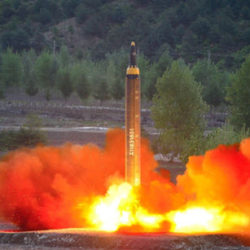
A missile launching from the ground with bright flames and smoke at the base, surrounded by trees and hills.

Special Counsel Investigating Alleged Russian Interference in the 2016 Election Injects “Distraction Effect”

The media is devoting 24/7 coverage to the Justice Department’s appointment of a special counsel, former FBI director Robert S. Mueller, to investigate alleged Russian interference in the 2016 election. While that move has garnered bipartisan support, there has been little to no thought given to the “distraction effect” it will have on the government, especially the president.

The distraction effect states, “Attending to the new task increases the risk of an error with one or both of the tasks because the stress of the distraction or interruption causes cognitive fatigue, which leads to omissions, mental slips or lapses, and mistakes.”

In simple terms, the current political turmoil is likely to result in mistakes by those distracted, which right now includes President Trump, his administration, and the US Congress. At this point, the integrity of Special Counsel Robert S. Mueller is not the issue. President Trump and his administration’s potential collusion with Russia in the 2016 election is not the issue. The issue is the investigation itself, which is likely to fuel a major distraction. Expect lines drawn and sides taken. Expect a 24/7 media bombardment. Bad news sells. Breaking bad news sells even more.

It is the equivalent of driving and texting at the same time, a proven recipe for disaster. Unfortunately, in this case, we are delicately balancing on a knife’s edge, with North Korea close to having nuclear tipped missiles capable of striking the United States, China’s mutual protection treaty with North Korea, and a US super-carrier strike force in the region. One misstep could be disastrous.

The potential for a misstep is high. A defiant North Korea continues to fire missiles into Sea of Japan, when successful. It appears North Korea destroyed one recent missile in route toward Russia. What will happen if North Korea fires a missile intended for the Sea of Japan, but makes a miscalculation and strikes Japan? The United States and Japan have a bilateral security treaty, which obligates the US and Japan to cooperate in defense. There are numerous scenarios, but the likelihood in even a short limited conflict is a million dead.

The reality is any counter attack by the United States in Japan or South Korea’s defense will leave a million dead in a matter of hours. It is unlikely the US will use nuclear weapons unless North Korea uses them first. Even with that provocation, the proximity of South Korea to North Korea makes it difficult for the US to use nuclear weapons without endangering South Korea.

North Korea has most of its artillery and rockets in hardened bunkers close to the demilitarized zone. In the first hours of any conflict, North Korea will strike Soul (population 10,000,000). It may even launch biological and nuclear weapons at South Korea, Japan, and US forces in the region. The THAAD (Terminal High Altitude Area Defense) weapon system, installed by the US in South Korea to destroy North Korean missiles in flight, is untested in combat.

China currently appears to be the voice of reason, calling for restraint. However, will China honor its mutual protection treaty with North Korea in the event of a conflict? If it does, the conflict could ignite a large theater conflict, similar to World War II. It is unlikely, since China has more to gain by being a friendly trading partner with the US than an adversary, but we do not know how things may play out in the event of a war with North Korea.

The stakes are high. The last thing we need is what we now have, a major distraction in the form of a special counsel. The probability of a misstep is now exponentially increased. The current circumstances may embolden North Korea to further its mission to dominate the Asian region, which means more missile and nuclear weapons tests. Will the US be able to act rationally and proportionately? Given the “distraction effect,” what do you think?

A scientist closely examining a sample through a microscope in a laboratory setting.

North Korea Accuses US/South Korea of ‘Nano Poison’ Plot to Kill Kim Jong Un

In a 1,800-word report Friday (May 5, 2017), which offered no evidence, the North Korean state news agency KCNA said a “terrorist group” conspired with the CIA and South Korea’s Intelligence Service (IS) to assassinate its leader Kim Jong Un using a “biochemical substances including radioactive substance and nano poisonous substance.”

This is the second time the United States has been accused of using a nanoweapon to kill a head of state. Pravda, Russia’s state run newspaper ran this headline on June 6, 2016: “US nano weapon killed Venezuela’s Hugo Chavez, scientists say.”

Obviously, nanoweapons (also spelled nano weapons) are beginning to become part of the international vocabulary. Unfortunately, most in the US have never heard of nanotechnology, let alone nanoweapons. Therefore, let us define terms.

According to the United States National Nanotechnology Initiative’s website, nano.gov, “Nanotechnology is science, engineering, and technology conducted at the nanoscale, which is about 1 to 100 nanometers.” To put this in simple terms, the diameter of a typical human hair equals 100,000 nanometers. Therefore, the largest nanotechnology has a dimension that is over a thousand times smaller than the diameter of a human hair. This means nanotechnology is invisible to the naked eye or even under an optical microscope.

Nanoweapons are any military technology that exploits the power of nanotechnology. To be clear, the weapon itself may be large, but as long as it has one or more components in the nanoscale, it is a nanoweapon.

You may wonder, Why would someone use nano poisons? The size of nanoparticles, the components of a nano poison, allows living tissue to absorb them more readily than other known toxins. Nanoparticles are able to cross biological membranes and access cells, tissues and organs that their larger counterparts cannot. Therefore, nano poisons are more deadly than their bulk counterparts are.

Currently, the United States, China, and Russia are in a frantic nanoweapons arms race. Each country is spending billions of dollars, as they vie for an asymmetrical advantage in nanoweapons. However, each country is keeping its thrusts in nanoweapons secret. For example, in 2000, the United States government launched the National Nanotechnology Initiative (NNI), a research and development initiative involving the nanotechnology-related activities of 25 Federal agencies with a range of research and regulatory roles and responsibilities. To date, the US has invested over $20 billion in NNI programs. If you review the NNI website, nano.gov, you will not find the word nanoweapons. However, NNI’s dedicates 15-20% of its budget to DOD programs. In addition, each branch of the US military has its own nanotechnology R&D facility.

While the front-runners in the nanoweapons arms race are the US, China, and Russia, many other nations, even impoverished countries like North Korea, are also taking part. Nanowek.com, the leading nanotechnology portal about nanotechnologies, reports, “All major powers are making efforts to research and develop nanotechnology-based materials and systems for military use.”

You may ask, What fuels the nanoweapons arms race? A new paradigm fuels this race, namely the superpowers of the future will be those nations with the most capable nanoweapons. Five facts support this assertion.

  1. Unlike nuclear, chemical, and biological weapons, no international treaties limit the development and deployment of nanoweapons or their use in warfare
  2. Nanoweapons, for example toxic nanoparticles, have the potential to be weapons of mass destruction
  3. Developing nanoweapons is less costly than developing nuclear weapons
  4. Detecting nanoweapons manufacturing facilities is difficult
  5. Detecting the source of a nanoweapons attack is difficult

This suggests the nanoweapons arms race is more problematic than the nuclear arms race. In fact, in my book, Nanoweapons: A Growing Threat To Humanity, I pose a critical question: Will it be possible to develop, deploy and use nanoweapons in warfare, without rendering humanity extinct?

In 2008, experts surveyed at the Global Catastrophic Risk Conference at the University of Oxford cited molecular nanotechnology weapons as having a 5% probability of rendering humanity extinct by the end of this century. By comparison, they rated nuclear war as having a 4% probability. It is natural to wonder, What is it about nanoweapons that makes them even more problematic than nuclear weapons? The simple answer is “control.” Controlling nanoweapons is as problematic as controlling biological weapons.

Let’s illustrate the control issue with a simple example. In the third quarter of the 21st century, self-replicating nanobots, nearly invisible robots able to replicate themselves, will dominate the nanoweapons arsenals of the most capable countries. These self-replicating nanobots will be programmable, among other functions, to attack the populace of another country, via the DNA similarities of the populace. However, what if there is a programming glitch. The self-replicating nanobots could become the equivalent of a biological plague and begin killing all humans indiscriminately.

Nanotechnology is an enabling technology. It enables a trillion dollar worldwide market in commercial products. It also enables nanoweapons, which are being deployed now in the form of integrated circuits that guide missiles, lasers capable of “shooting” down a cruise missile, nano-enhanced explosives with ten time the punch of conventional explosives, to name a few.

Given the potential of nanoweapons to become the ultimate weapons of mass destruction, we need the United Nations and its member countries to enact measures to assure that nanoweapons do not become our final invention.


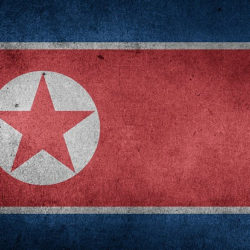
North Korean flag with a red star inside a white circle on a red background, bordered by blue and white stripes.

North Korea’s Chemical Weapons, Biological Weapons, and Nanoweapons

It may appear unbelievable that a country unable to feed its people or reliably provide basic utilities, like electricity, is able to develop and deploy chemical weapons, biological weapons, and nanoweapons. However, that is the reality.

The US, UN, and world media attention currently focuses on North Korea’s missile and nuclear tests, mainly because they are visible elements of military capability. However, the world’s most secretive nation is not placing all its bets on missiles and nuclear weapons. Let us examine their asymmetrical capabilities in chemical weapons, biological weapons, and nanoweapons.

  • North Korea possesses thousands of tons of chemical weapons, including nerve, blister, blood, and vomiting agents, as well as some biological weapons, including anthrax, smallpox, and cholera.
  • The State Academy of Sciences (SAS) runs 40 research institutes, 200 smaller research centers, a scientific equipment factory, and six publishing houses. The SAS focuses on, among other STEM (science, technology, engineering, mathematics) disciples, nanotechnology and its application to weapons (i.e., nanoweapons).

You may wonder, How does a nation that is unable to feed its populace or reliably provide a basic utility, like electricity, have the capability to focus on chemical weapons, biological weapons, and nanoweapons? The answer in a single word is Songun.

On August 25, 1960, Kim Jong-il, the then supreme leader of the Democratic People’s Republic of Korea (DPRK), commonly referred to as North Korea, instituted Songun, a “military first” policy. From that time forward, Songun became North Korea’s guiding policy in all matters domestic and foreign.

While the North Korean people may starve or sit in darkness, Songun assures their domestic defense industry, approximately 1,800 underground defense industry plants scattered throughout the country, and the State Academy of Sciences gets priority over all other needs.

Western analysts assess that North Korea’s military capabilities are rudimentary versus those of the United States, and the United States and its allies would prevail in a conflict with North Korea. However, the conflict may take months to conclude. In those months, North Korea’s military could cause the death of millions of people in South Korea and Japan, as well as many of the US forces within the region. In addition, we should assume North Korea would use all weapons at its disposal, including nuclear, conventional, and asymmetrical.

This begs a question, How potent are North Korea’s chemical weapons, biological weapons, and nanoweapons? Unlike conventional weapons, ballistic missiles, and nuclear weapons, it is extremely difficult to analyze asymmetrical weapons capabilities. However, this is what we know.

  • North Korea began its own chemical industry in 1954 and started making chemical weapons from its beginning. In 2014, the South Korean Defense Ministry estimated that North had stockpiled 2,500 to 5,000 tons of chemical weapons and had a capacity to produce a variety of biological weapons.
  • In my book, Nanoweapons: A Growing Threat To Humanity (Potomac Books 2017), I made the observation that China’s offensive nanoweapons capabilities may benefit from their alliances with North Korea and vice versa. Although, China’s nanoweapons capabilities are inferior to those of the United States, they are still formidable.

North Korea is a signatory to the Geneva Protocol, which prohibits the use of chemical weapons in warfare, and to the Biological and Toxins Weapons Convention (BTWC), which prohibits the development, production and stockpiling of bacteriological (biological) and toxin weapons. However, evidence suggests North Korea is responsible for the assassination of Kim Jong-un’s half-brother Kim Jong-nam, who was critical of Kim Jong-un’s regime. Authorities allege that North Korean agents sprayed VX nerve agent in Kim Jong-nam’s face, causing his death. If true, this suggests North Korea is unlikely to abide by the Geneva Protocol or the BTWC.

Unfortunately, the Geneva Conventions, which establish the standards of international law for humanitarian treatment in war, does not cover nanoweapons. Therefore, North Korea could deploy the simplest of nanoweapons, such as toxic nanoparticles, which mimic chemical weapons, and still be within the standards of international law.

UN sanctions have isolated North Korea to the point that over 90% of their trade is with China, which is critical to maintaining Kim Jong-un’s regime. However, China is becoming friendlier with the US, which North Korea sees as an enemy. Recently, the US and China voted for more UN sanctions against North Korea, and China curtailed its trade with them. Given the beefed-up US military presence in the region and China’s friendlier posture toward the US, North Korean leadership likely feels threatened. If North Korea’s leadership believes they will lose their position of power, they will strike perceived enemies with all capabilities at their disposal. If conflict erupts, expect North Korea to attempt to use its nuclear weapons, its conventional weapons, and its asymmetrical capabilities in chemical weapons, biological weapons, and nanoweapons.