Category Archives: Nanoweapons

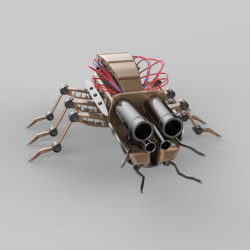
A mechanical insect with metal legs and two large barrel-shaped eyes resembling gun barrels.

Will the United States Use Nanoweapons to Resolve the North Korean Crisis?

Unless you’re working in the field, you probably never heard about U.S. nanoweapons. This is intentional. The United States, as well as Russia and China, are spending billions of dollars per year developing nanoweapons, but all development is secret. Even after Pravda.ru’s June 6, 2016 headline, “US nano weapon killed Venezuela’s Hugo Chavez, scientists say,” the U.S. offered no response. Earlier this year, May 5, 2017, North Korea claimed the CIA plotted to kill Kim Jong Un using a radioactive nano poison, similar to the nanoweapon Venezuelan scientists claim the U.S. used to assassinate former Venezuelan President Hugo Chavez. All major media covered North Korea’s claim. These accusations are substantial, but are they true? Let’s address this question.


Unfortunately, until earlier this year, nanoweapons gleaned little media attention. However, in March 2017 that changed with the publication of my book, Nanoweapons: A Growing Threat to Humanity (2017 Potomac Books), which inspired two articles. On March 9, 2017, American Security Today published “Nanoweapons: A Growing Threat to Humanity – Louis A. Del Monte,” and on March 17, 2017, CNBC published “Mini-nukes and mosquito-like robot weapons being primed for future warfare.” Suddenly, the genie was out of the bottle. The CNBC article became the most popular on their website for two days following its publication and garnered 6.5K shares. Still compared to other classes of military weapons, nanoweapons remain obscure. Factually, most people never even heard the term. If you find this surprising, recall most people never heard of stealth aircraft until their highly publicized use during the first Iraq war in 1990. Today, almost everyone that reads the news knows about stealth aircraft. This may become the case with nanoweapons, but for now, it remains obscure to the public.


Given their relative obscurity, we’ll start by defining nanoweapons. A nanoweapon is any military weapon that exploits the power of nanotechnology. This, of course, begs another question: What is nanotechnology? According to the United States National Nanotechnology Initiative’s website, nano.gov, “Nanotechnology is science, engineering, and technology conducted at the nanoscale, which is about 1 to 100 nanometers.” To put this in simple terms, the diameter of a typical human hair equals 100,000 nanometers. This means nanotechnology is invisible to the naked eye or even under an optical microscope.
If the U.S. chooses to use nanoweapons covertly, they most likely will use:


  • Toxic nanoparticles – These are toxic particles a nanoscale diameter, which means their surface area to volume ratio is enormous. What makes them extremely effective as a poison is that they are able to cross biological membranes that their bulk counterparts are unable to cross. Therefore, they can be readily absorbed. They are more toxic than their due to the large surface area to volume ratio, which allows them to be extremely chemically reactive.


If the U.S. chooses to use nanoweapons in open conflict with North Korea, it will likely be:


  • Nanoelectronic Weapon Systems – Nanoelectronics are integrated circuits with features in the nanoscale. Intel is shipping nanoelectronic microprocessors for use in commercial computer applications. Because of their nanoscale features, they are smaller, faster, and use less power to operate. This makes them ideal for military weapon systems, like guided missiles.


The U.S. has a formidable nanoweapons arsenal. Even as they use them covertly and in open conflict, it may not be apparent that the technology that underpins the weapons is nanotechnology, thus making them by definition nanoweapons.


When will that change? It will change when something big happens. Imagine billions of toxic nanoparticles released on an adversary’s army, causing death and chaos. This would significantly reduce the adversary’s military effectiveness. In all likelihood, it may take weeks or months for the adversary to determine the cause. Imagine millions of nanobots attacking an adversary’s army, again causing death and chaos. In effect, killer insect-like nanobots would be a technological plague.


Ironically, the next big thing in military weapons is small. Barely mentioned in the media, nanoweapons are as effective and lethal as their larger more visible counterparts. In time, a nation’s military might will be a measure of its nanoweapons capabilities, as well as it nuclear and more conventional capabilities. In fact, by the second half of this century, nanoweapon capabilities are likely to determine the superpowers.
A futuristic, sleek turbine engine with a conical front and illuminated blue accents in a dark setting.

Stephen Hawking Proposes Nanotechnology Spacecraft to Reach ‘Second Earth’ in 20 years

Renowned physicist Stephen Hawking is proposing a nanotechnology spacecraft that can travel at a fifth of the speed of light. At that speed, it could reach the nearest star in 20 years and send back images of a suspected “Second Earth” within 5 years. That means if we launched it today, we would have our first look at an Earth-like planet within 25 years.

Hawking proposed a nano-spacecraft, termed “Star Chip,” at the Starmus Festival IV: Life And The Universe, Trondheim, Norway, June 18 – 23, 2017. Hawking told attendees that every time intelligent life evolves it annihilates itself with “war, disease and weapons of mass destruction.” He asserted this as the primary reason why advanced civilizations from another part of the Universe are not contacting Earth and the primary reason we need to leave the Earth. His advocates we colonize a “Second Earth.”

Scientific evidence appears to support Hawking’s claim. The SETI Institute has been listening for evidence of extraterrestrial radio signals, a sign of advanced extraterrestrial life, since 1984. To date, their efforts have been futile. SETI claims, rightly, that the universe is vast, and they are listening to only small sectors, which is much like finding a needle in a haystack. Additional evidence that Hawking may be right about the destructive nature of intelligent life comes from experts surveyed at the 2008 Global Catastrophic Risk Conference at the University of Oxford, whose poll suggested a 19% chance of human extinction by the end of this century, citing the top four most probable causes:

  1. Molecular nanotechnology weapons – 5% probability
  2. Super-intelligent AI – 5% probability
  3. Wars – 4% probability
  4. Engineered pandemic – 2% probability

Hawking envisions the nano-spacecraft to be a tiny probe propelled on its journey by a laser beam from Earth, much the same way wind propels sailing vessels. Once it reaches its destination, Hawking asserts, “Once there, the nano craft could image any planets discovered in the system, test for magnetic fields and organic molecules, and send the data back to Earth in another laser beam.”

Would Hawking’s nano-spacecraft work? Based on the research I performed during my career and in preparation for writing my latest book, Nanoweapons: A Growing Threat to Humanity (Potomac Books, 2017), I judge his concept is feasible. However, it would require significant engineering, as well as funding, to move from Hawking’s concept to a working nano-spacecraft, likely billions of dollars and decades of work. However, in Nanoweapons, I described the latest development of bullets that contain nanoelectronic guidance systems that allow the bullets to guide themselves, possibly to shoot an adversary hiding around a corner. Prototypes already exist.

Hawking’s concept is compelling. Propelling a larger conventional spacecraft using a laser would not attain the near light speed necessary to reach a distant planet. Propelling it with rockets would also fall short. According to Einstein’s theory of relativity, a large conventional spacecraft would require close to infinite energy to approach the speed of light. Almost certainly, Hawking proposed a nano-spacecraft for just that reason. Its mass would be small, perhaps measured in milligrams, similar to the weight of a typical household fly.

Hawking’s concept represents a unique application of nanotechnology that could give humanity its first up-close look at an inhabitable planet. What might we see? Perhaps it already harbors advanced intelligent life that chose not to contact Earth, given our hostile nature toward each other. Perhaps it harbors primitive life similar to the beginning of life on Earth. We have no way of knowing without contact.

You may choose to laugh at Hawking’s proposal. However, Hawking is one of the top scientists on Earth and well aware of advances in any branch of science he speaks about. I judge his concerns are well founded and his nano-spacecraft concept deserves serious consideration.

A digital globe surrounded by floating smartphones and computer screens with binary code and circuit board background.

Are Advancements in Artificial Intelligence Sowing the Seeds of Humanity’s Annihilation?

In the past two decades, we have watched the United States military engage in three wars, two in Iraq and one in Afghanistan, and posture itself as the most technically advanced fighting force on Earth. For example, during this period, we witnessed the deployment of many new weapons, most notably:

  • Stealth Aircraft – from the F-117 Nighthawk (1981–2008), dubbed the “bat plane,” to the latest addition, the F-35 Lightning II
  • Smart bombs – bombs guided precisely to targets via a laser or geographic coordinates
  • The GBU-43/B Massive Ordnance Air Blast Bomb – a conventional bomb with a 8-ton warhead capable of delivering a 11-ton TNT equivalent destructive blast, which some analysts attribute to its nano-catalysts, as discussed in my recently publish book, Nanoweapons: A Growing Threat to Humanity
  • Computer Technology/Artificial Intelligence – the inclusion of computers, as well as artificial intelligence (AI), in almost every aspect of warfare and by every branch of the US military
  • Cyber Warfare – the United States, like other nations employing professional hackers as “cyber soldiers,” sees cyberspace as a battlefield and established a new cyber strategy in April 2015

The United States, and other nations, uses supercomputers to design advanced weapons, including fledgling autonomous and semi-autonomous weapons. The process is termed “computer aided design” or CAD. In addition, the advanced weapon typically employ a computer to make it artificially intelligent. We term such a weapon as a “smart weapon.” The term “smart” in this context means “artificially intelligent.”

The weapons the United States deploys currently would have been the subject of science fictions just a few decades back. However, the relentless advance of computer technology, as well as artificial intelligence, brought them to fruition. This begs a question, What drives this relentless advance?

Moore’s law describes the driving force behind computer technology and artificial intelligence. In 1975, Gordon E. Moore, the co-founder of Intel and Fairchild Semiconductor, observed that the number of transistors in a dense integrated circuit doubles approximately every two years. The semiconductor industry adopted Moore’s law to plan their product offerings. Thus, it became a self-fulfilling prophecy, even to this day. In view of Moore’s law, Intel executive David House predicted that integrated circuit performance would double every 18 months, resulting from the combined effects of increasing the transistor density and decreasing the transistor size. This implies computer power will double every eighteen months, since integrated circuits are the lifeblood of computers. Since computers are a pillar of artificial intelligence (AI), capabilities in AI are also increasing exponentially.

On the surface, this may appear beneficial, advances in weapons increasing our security and computer advances enabling us to address complex problems. However, advances in computer technology are reaching critical milestones. Most researchers in AI expect computers will equate to human intelligence by approximately 2025. Those same researchers predict that computers will exceed the combined intelligence of all humans by 2050, which researchers term the “singularity.”

What will singularity-level computers think about humanity? Wars, nuclear weapons capable of destroying the Earth, and the malicious release of computer viruses, mar our history. Will singularity-level computers, alarmed by this information, seek to rid the Earth of humans? That is one possibility I discuss in my book, The Artificial Intelligence Revolution. By increasing our reliance on computers, in society and warfare, we are increasing their capability to eliminate us.

This frames the issue, namely that singularity-level computers may become adversarial and seek to annihilate humanity. However, being aware of this possibility allows us to guard against it. The most obvious path would be to build-in safeguards, such as “hardwired” circuitry, in addition to directives in software.

Given the deity-like intelligence of singularity computers, the task of controlling them will be difficult. However, if we fail to do so, we put the survival of humanity at risk.

Close-up of a detailed human skull and crossed bones on a textured surface.

Are Nanoweapons Paving the Road to Human Extinction?

Nanotechnology researchers continue their relentless journey to develop nanobots and they are succeeding. Nanomedicine is using nanobots to cure to cancer. Military nanotechnologies, especially nanobots, will emerge as the defining weapons of the twenty first century.

The United States military already deploys nanoweapons, such as nanotechnology based lasers, toxic nanoparticles, nanoparticle catalysts, and nano electronics. These nanoweapons give the United States significant capabilities in asymmetrical warfare. However, the US military’s  greatest quest is the development of nanobots, tiny robots built with nanotechnology.

What is it about nanobots that make them the ideal weapons? Let us address this question by taking several examples. About a third of all US fighter planes today are drones. Today’s drones are approximately one-third the size of a manned fighter jet, like the F-35. However, a new class of drones is in development, bird and even insect size drones. For example, in 2014, the Army Research Laboratory announced the creation of a “fly drone” weighing only a small fraction of a gram. This drone could conceivable fly into an adversary’s command post and provide surveillance or into the adversary’s dining area to deposit a nano poison. An insect fly drone provides the military with both surveillance and assignation capabilities. This gives a completely new meaning to “fly on the wall.”

As electronic processors shrink into the nanoscale, becoming nanoprocessors, about 1/1000 the diameter of a human hair, conceivably they could provide the fly drone with artificial intelligence. In effect, it could autonomously carry out its programmed mission.

You may wonder, How does all of this threaten human extinction? To address this question, imagine a scenario where the US military releases millions of artificially intelligent fly drones within an adversary’s boarders, programmed to target the populace via commonalities in their DNA. If each fly drone had the capability to assassinate a few people, conceivably they could wipe out an entire nation.

Although this may sound like science fiction, the United States is within a decade of having the capability. The US Army is already testing a fly drone. As for poisons, as little as 100 nano grams of  botulism H will kill a human. That quantity of poison is too small to see or taste, yet lethal and small enough for a fly drone to carry. In my book, Nanoweapons: A Growing Threat To Humanity, I classify this type of weapon as a strategic nanoweapon. This classification parallels strategic nuclear weapons that have the capability to destroy nations.

While artificially intelligent insect drones are already a scary proposition, the next step in their development is even more frightening, namely self-replicating insect drones, or more generically self- replicating nanobots. Given the exponential advance in nano electronics and artificial intelligence, characterized by Moore’s law, it is likely we will see the emergence of self-replicating nanobots in the 2050s.

Self-replicating nanobots are the ultimate invention. In medicine, they will flow through our blood preventing diseases and curing injuries. In military applications, they will have the capability to completely destroy an adversary, from its populace to its structures. This scenario was depicted in the sci-fi movie, The Day the Earth Stood Still.

Strategic nanoweapons, like their nuclear counterparts, pose a threat to humanity. The major issue is control. Will we be able to deploy strategic nanoweapons and maintain control over them? If, for example, we lost control of self-replicating nanobots, we would face a technological plague, one that we currently have no way of stopping.

In a decade, we will see the emergence of nanobots. In medicine, they will cure cancer. In warfare, they may kill millions. In the 2050s, we will see the emergence of self-replicating nanobots. In medicine, they will offer immortality. In warfare, they will pose a threat to humanity.

A detailed pencil sketch of a dynamic humanoid robotic figure in an action pose.

The Second Technological Singularity: Self-replicating Nanobots

It is widely accepted that when artificial intelligence exceeds the sum total intelligence of the human race, we will have reached a technological singularity. It qualifies as a technological singularity because it represents the first time a machine is more intelligence that all humanity. In my book, The Artificial Intelligence Revolution, I project this will occur during the 2040s. My projection aligns with the prediction of most researchers in the field.

We will reach a second technological singularity with the development of self-replicating nanobots. This begs a question, What are self-replicating nanobots? Self-replicating nanobots are robots built using nanotechnology that are able to perform programmed functions and reproduce. This raises another question, What is nanotechnology? According to the United States National Nanotechnology Initiative’s website, nano.gov, “Nanotechnology is science, engineering, and technology conducted at the nanoscale, which is about 1 to 100 nanometers.” For comparison, a human hair diameter is 100,000 nm.

The development of self-replicating nanobots qualifies as a technological singularity because it represents the development of the first artificial life forms, having rudimentary intelligence to carry out programmed functions, along with the ability to reproduce. You can think of them as the technological equivalent of bacteria and viruses. Researchers working in the fields of nanotechnology have varied opinions when this will occur. I think the divergence in projecting this singularity comes from looking at it as an isolated occurrence. Many researchers in nanotechnology lack equivalent expertise in artificial intelligence. Having worked in both fields, and authored books in both fields (The Artificial Intelligence Revolution and Nanoweapons: A Growing Threat To Humanity), I assert from experience the second singularity (i.e., the development of self-replicating nanobots) is dependent on the first singularity (i.e., an intelligent machine that exceeds the cognitive intelligence of humanity). Let us discuss why this is the case.

In technologically advanced countries, computers play a role in the design of almost all products, from fighter jets to golf balls. The fabric of society in technologically advanced countries is dependent on computers. When an aeronautical engineer designs an aircraft or a civil engineer designs a bridge, computers are intimately involved. It is fair to assert that without computers, our society would not be viable.

Nanotechnology is also becoming an integral part of technologically advanced societies, from nanotechnology-based cosmetics to nano drugs that hold the promise to cure cancer. Nanotechnology is becoming critical to building the structures of society, making steel and concrete stronger, lighter, and even self-cleaning. The worldwide market for commercial nanotechnology products is a trillion dollars. Even though most people may not be aware of it, they are likely using nanotechnology-based products daily.

Intelligent machines and nanotechnology have a strong symbiotic relationship. Integrated circuits, with nanotechnology features, power modern computers. Modern computers play a critical role in developing integrated circuits. Computer processing power is doubling approximately every eighteen months. This trend, first observed by Intel co-founder Gordon More, is termed Moore’s Law. It has held for over five decades. By contrast, nanotechnology is relatively new, emerging as a science in the late 1980s. Its importance, however, quickly became evident. In 2000, President Clinton established the National Nanotechnology Initiative, a research and development initiative involving the nanotechnology-related activities of 25 Federal agencies. Since its inception, the United States government has allocated over $20,000,000,000 to developing nanotechnology.

This brings us to a critical question, When will self-replicating nanobots be developed? Given the strong symbiotic relationship between computer power and nanotechnology, we may see both technologies progressing faster than their historical trends. My rationale is that an advance in one technology fosters advances in the other. I judge this synergy may accelerate the advancement of both technologies. Further, when intelligent machines exceed the cognitive intelligence of humanity (i.e., the first technological singularity), humanity will have the computing power required to develop self-replicating nanobots (i.e., the second technological singularity). If my judgement is correct, humanity will develop self-replicating nanobots during the 2050s.

With the advent of self-replicating nanobots, we will have the potential to use them medically to treat diseases like cancer at the cellular level. In fact, we are already doing that with medical nanobots today. On May 15, 2015, Pfizer announced it is “partnering” with Dr. Ido Bachelet, manager of Bar-Ilan University’s robot laboratory, on DNA nanobots. Next Big Future reports, “Bachelet has developed a method of producing innovative DNA molecules with characteristics that can be used to ‘program’ them to reach specific locations in the body and carry out pre-programmed operations there in response to stimulation from the body.” In this case, the pre-programming involves detecting cancer cells and delivering an existing cancer drug treatment directly to a cancerous cell, bypassing healthy cells. This is currently going into human trials as I write. Although these are not self-replicating nanobots, it provide a solid conceptual framework to understand how self-replicating nanobot my revolutionize medicine. Unfortunately, there is also a dark side.

Self-replicating nanobots can become a weapon. For example, one adversary could program self-replicating nanobots to target another adversary’s populace. It would be the technological equivalent of biological warfare. In the 2008 film, The Day the Earth Stood Still, the alien robot “GORT” disintegrates into a swarm of self-replicating nanobots shaped like bugs that cover Earth and destroy all humans and artificial structures by seemingly devouring them within seconds. Although this is science fiction, it points out a significant issue with self-replicating nanobots, namely the potential to lose control over them. If that were to happen, it could write the last line in human history.