Category Archives: Categories

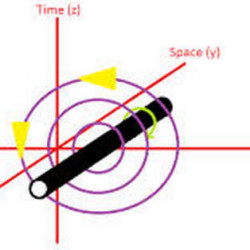
A diagram showing a black rod in space with concentric circles and arrows, labeled with time (x) and space (y) axes.

Tipler cylinder time travel – Is It Possible?

The Tipler cylinder is a cylinder of dense matter and infinite length. Historically, Dutch mathematician Willem Jacob van Stockum (1910–1944) found Tipler cylinder solutions to Einstein’s equations of general relativity in 1924. Hungarian mathematician/physicist Cornel Lanczos (1893–1974) found similar Tipler cylinder solutions in 1936. Unfortunately, neither Stockum nor Lanczos made any observations that their solutions implied closed timelike curves (i.e., time travel to the past).

In 1974, American mathematical physicist/cosmologist Frank Tipler’s analysis of the above solutions uncovered that a massive cylinder of infinite length spinning at high speed around its long axis could enable time travel. Essentially, if you walk around the cylinder in a spiral path in one direction, you can move back in time, and if you walk in the opposite direction, you can move forward in time. This solution to Einstein’s equations of general relativity is known as the Tipler cylinder. The Tipler cylinder is not a practical time machine, since it needs to be infinitely long. Tipler suggests that a finite cylinder may accomplish the same effect if its speed of rotation increases significantly. However, the practicality of building a Tipler cylinder was discredited by Stephen Hawking, who provided a mathematical proof that according to general relativity it is impossible to build a time machine in any finite region that contains no exotic matter with negative energy. The Tipler cylinder does not involve any negative energy. Tipler’s original solution involved a cylinder of infinite length, which is easier to analyze mathematically, and although Tipler suggested that a finite cylinder might produce closed timelike curves if the rotation rate were fast enough, Hawking’s proof appears to rule this out. According to  Hawking, “it can’t be done with positive energy density everywhere! I can prove that to build a finite time machine, you need negative energy.”

One caveat, Hawking’s proof appears in his 1992 paper on the “chronology protection conjecture,” which has come under serious criticism by numerous physicists. Their main objection to the Hawking’s conjecture is that he did not employ quantum gravity to make his case. On the other hand, Hawking and others have not been able to develop a widely accepted theory of quantum gravity. Hawking did just about the only thing he could do under the circumstances. He used Einstein’s formulation of gravity as found in the general theory of relativity. Another fact, Hawking’s proof regarding the Tipler cylinder is somewhat divorced from the main aspects of his paper and could be viewed to stand on its own. However, in science we are always judged by the weakest link in our theory. Thus, with a broad brush, the chronology protection conjecture has been discredited, and even Hawking has acknowledged some of its short comings.

Where does that leave us with a finite Tipler cylinder time machine? In limbo! There is no widely accepted proof that a finite Tipler cylinder spinning at any rate would be capable of time travel. There is also another problem. We lack any experimental evidence of a spinning Tipler cylinder influencing time.

Source: How to Time Travel (2013), Louis A. Del Monte
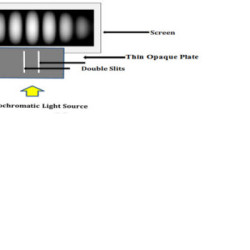
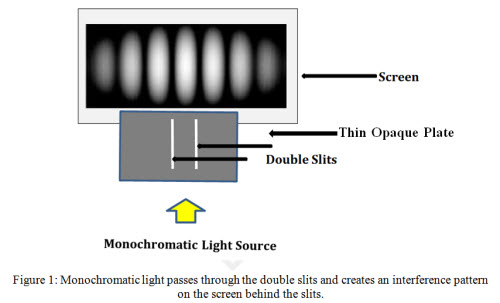
Diagram of a double slit experiment setup showing a monochromatic light source, double slit, and interference pattern on a screen.

The Classic Double Slit Experiment Is a 100 Year Old Time Travel Paradox that Continues to Baffles Modern Science

First, let’s define a time travel paradox. It is an occurrence that apparently violates some aspect of causality typically associated with time travel. Many science students are introduced to the oddities of the double slit experiment in an advanced high school science class or in an entry level college science class. The double slit experiment is a paradox that has to do with the the future changing the present or the past. The effect has been known for well over a hundred years. It continues to this day to baffle science.

There are numerous versions of the double-slit experiment. In its classic version, a coherent light source, for example a laser, illuminates a thin plate containing two open parallel slits. The light passing through the slits causes a series of light and dark bands on a screen behind the thin plate. The brightest bands are at the center, and the bands become dimmer the farther they are from the center. See the figure below:

3-17-2014 3-08-41 AM Double Slit Fig 1 small

The series of light and dark bands on the screen would not occur if light were only a particle. If light consisted of only particles, we would expect to see only two slits of light on the screen, and the two slits of light would replicate the slits in the thin plate. Instead, we see a series of light and dark patterns, with the brightest band of light in the center, and tapering to the dimmest bands of light at either side of the center. This is an interference pattern and suggests that light exhibits the properties of a wave. We know from other experiments—for example, the photoelectric effect (see glossary), which I discussed in my first book, Unraveling the Universe’s Mysteries—that light also exhibits the properties of a particle. Thus, light exhibits both particle- and wavelike properties. This is termed the dual nature of light. This portion of the double-slit experiment simply exhibits the wave nature of light. Perhaps a number of readers have seen this experiment firsthand in a high school science class.

The above double-slit experiment demonstrates only one element of the paradoxical nature of light, the wave properties. The next part of the double-slit experiment continues to puzzle scientists. There are five aspects to the next part.

  1. Both individual photons of light and individual atoms have been projected at the slits one at a time. This means that one photon or one atom is projected, like a bullet from a gun, toward the slits. Surely, our judgment would suggest that we would only get two slits of light or atoms at the screen behind the slits. However, we still get an interference pattern, a series of light and dark lines, similar to the interference pattern described above. Two inferences are possible:
    1. The individual photon light acted as a wave and went through both slits, interfering with itself to cause an interference pattern.
    2. Atoms also exhibit a wave-particle duality, similar to light, and act similarly to the behavior of an individual photon light described (in part a) above.
  2. Scientists have placed detectors in close proximity to the screen to observe what is happening, and they find something even stranger occurs. The interference pattern disappears, and only two slits of light or atoms appear on the screen. What causes this? Quantum physicists argue that as soon as we attempt to observe the wavefunction of the photon or atom, it collapses. Please note, in quantum mechanics, the wavefunction describes the propagation of the wave associated with any particle or group of particles. When the wavefunction collapses, the photon acts only as a particle.
  3. If the detector (in number 2 immediately above) stays in place but is turned off (i.e., no observation or recording of data occurs), the interference pattern returns and is observed on the screen. We have no way of explaining how the photons or atoms know the detector is off, but somehow they know. This is part of the puzzling aspect of the double-slit experiment. This also appears to support the arguments of quantum physicists, namely, that observing the wavefunction will cause it to collapse.
  4. The quantum eraser experiment—Quantum physicists argue the double-slit experiment demonstrates another unusual property of quantum mechanics, namely, an effect termed the quantum eraser experiment. Essentially, it has two parts:
    1. Detectors record the path of a photon regarding which slit it goes through. As described above, the act of measuring “which path” destroys the interference pattern.
    2. If the “which path” information is erased, the interference pattern returns. It does not matter in which order the “which path” information is erased. It can be erased before or after the detection of the photons.

This appears to support the wavefunction collapse theory, namely, observing the photon causes its wavefunction to collapse and assume a single value.

  1. If the detector replaces the screen and only views the atoms or photons after they have passed through the slits, once again, the interference pattern vanishes and we get only two slits of light or atoms. How can we explain this? In 1978, American theoretical physicist John Wheeler (1911–2008) proposed that observing the photon or atom after it passes through the slit would ultimately determine if the photon or atom acts like a wave or particle. If you attempt to observe the photon or atom, or in any way collect data regarding either one’s behavior, the interference pattern vanishes, and you only get two slits of photons or atoms. In 1984, Carroll Alley, Oleg Jakubowicz, and William Wickes proved this experimentally at the University of Maryland. This is the “delayed-choice experiment.” Somehow, in measuring the future state of the photon, the results were able to influence their behavior at the slits. In effect, we are twisting the arrow of time, causing the future to influence the past. Numerous additional experiments confirm this result.

Let us pause here and be perfectly clear. Measuring the future state of the photon after it has gone through the slits causes the interference pattern to vanish. Somehow, a measurement in the future is able to reach back into the past and cause the photons to behave differently. In this case, the measurement of the photon causes its wave nature to vanish (i.e., collapse) even after it has gone through the slit. The photon now acts like a particle, not a wave. This paradox is clear evidence that a future action can reach back and change the past.

To date, no quantum mechanical or other explanation has gained widespread acceptance in the scientific community. We are dealing with a time travel paradox that illustrates reverse causality (i.e., effect precedes cause), where the effect of measuring a photon affects its past behavior. This simple high-school-level experiment continues to baffle modern science. Although quantum physicists explain it as wavefunction collapse, the explanation tends not to satisfy many in the scientific community. Irrefutably, the delayed-choice experiments suggest the arrow of time is reversible and the future can influence the past.

Source: How to Time Travel (2013), Louis A. Del Monte
Abstract fractal pattern resembling a cosmic or underwater scene with glowing blue and white textures.

Do We Need M-Theory? Maybe!

Most high school science classes teach the classical view of the atom, incorporating subatomic particles like protons, electrons, and neutrons. This is the particle theory of the atom dating to the early Twentieth Century. In about the 1960s, scientists discovered more subatomic particles. By the 1970s, scientists discovered that protons and neutrons consist of subatomic particles called quarks (an elementary particle not known to have a substructure). In the 1980s, a mathematical model called string theory, was developed. It is a branch of theoretical physics. String theory sought to explain how to construct all particles and energy in the universe via hypothetical one-dimensional “strings.” Subatomic particles are no longer extremely small masses. Instead, they are oscillating lines of energy, hence the name “strings.” In addition, the latest string theory (M-theory) asserts that the universe is eleven dimensions, not the four-spacetime dimensions we currently experience in our daily lives. String theory was one of science’s first attempts at a theory of everything (a complete mathematical model that describes all fundamental forces and matter).

In about the mid-1990s, scientists considered the equivalences of the various string theories, and the five leading string theories were combined into a one comprehensive theory, M-theory. M-theory postulates eleven dimensions of space filled with membranes, existing in the Bulk (super-universe). The Bulk contains an infinite number of membranes, or “branes” for short.

According to M-theory, when two branes collide, they form a universe. The collision is what we observed as the Big Bang when our universe formed. From that standpoint, universes continually form via other Big Bangs (collisions of branes).

Does this explain the true origin of the energy? No! It still begs the question: where does the energy come from to create the membranes? The even-bigger question: is there any scientific proof of the multiverse? Recently, several scientists claim unusual ring patterns on the cosmic microwave background might be the result of other universes colliding with ours. However, even the scientists forwarding this theory suggest caution. It is speculative. At this point, we must admit no conclusive evidence of a multiverse exists. In fact, numerous problems with the multiverse theories are known. This does not mean there are no multiverses. Currently, though, we have no conclusive experimental proof, but do have numerous unanswered questions.

All multiverse theories share three significant problems.

1) None of the multiverse theories explains the origin of the initial energy to form the universe. They, in effect, sidestep the question entirely.

2) No conclusive experimental evidence proves that multiverses exist. This is not to say that they do not exist. It just means we cannot prove they exist.

3) Critics argue it is poor science. We are postulating universes we cannot see or measure in order to explain the universe we can see and measure.

However, in the last hundred years, we have made discoveries, and experimentally verified phenomena that in prior centuries would have been considered science fiction, metaphysics, magic, and unbelievable. We discovered numerous secrets of the universe, once believed to be only the Milky Way galaxy—to now being an uncountable number of galaxies in a space that is expanding exponentially. We also unlocked the secrets of the atom, once believed to be the fundamental building block of matter (from the Greek atomos “uncut”). Currently, we understand the atom consists of electrons, protons, and neutrons, which themselves consist of subatomic particles like quarks. The list of discoveries that have transformed our understanding of reality over the last century is endless. From my perspective, skepticism can be healthy. However, one cannot be entirely closed-minded when it comes to exploring the boundaries of science.

This brings us to the crucial question: Do we need M-Theory? My answer is: Maybe! Right now, it’s the only “mainstream” game in town. It has numerous respected proponents, including world-renowned cosmologist/physicist Stephen Hawking. However, the “mainstream” has been wrong before, and we are in uncharted waters. It may be right, and the mathematics is elegant. The only thing missing is experimental evidence (i.e., proof). On this one, you’ll have to weigh the facts and draw your own conclusion.

Source: Unraveling the Universe’s Mysteries (2012), Louis A. Del Monte

Image: iStockPhoto (licensed)


Aliens and UFOs

Are UFOs Time Travelers from the Future?

Internet searches for the keyword acronym “UFO” (unidentified flying object) are among the most popular on the Internet. According to Google, there are five million global searches per month for the keyword acronym “UFO” (without the quotes).

Let us start with a little background. Surprisingly, the United States Air Force (USAF) officially created the acronym “UFO” in 1953. Their intent was to replace the more popular phrases such as “flying saucers” and “flying discs” because of the variety of shapes reported. In their official statement, the United States Air Force defined the term UFO as “any airborne object which, by performance, aerodynamic characteristics, or unusual features, does not conform to any presently known aircraft or missile type, or which cannot be positively identified as a familiar object.”

The phenomena, namely UFO sightings, are worldwide. Various governments and civilian committees have studied them. The conclusions reached by the various organizations that have studied them vary significantly. Some conclude UFOs do not represent a threat and are of no scientific value (see, e.g., 1953 CIA Robertson Panel, USAF Project Blue Book, Condon Committee). Others conclude the exact opposite (see, e.g., 1999 French COMETA study, 1948 USAF Estimate of the Situation, Sturrock Panel).

Given the sheer volume of unexplained sightings by credible witnesses, including military, police, and civilian witnesses, there is little doubt that the UFO phenomenon is real and worldwide, and for the most part, there is no widely accepted public or scientific explanation of what they are or what their intentions might be.

Three popular speculations regarding UFOs are:

  1. They are future generations of humans who have mastered the science of time travel, and they are coming back either to observe us or to carry out other intentions.
  2. They are technologically advanced aliens from another planet who have mastered the science of time travel, and they are coming here either to observe us or to carry out other intentions.
  3. They are secret government (United States or any government) experimental spacecraft, and by some accounts they are reverse engineered from advanced alien spacecraft in the government’s possession.

In my estimation, the ninety-page 1999 French COMETA study (the English translation stands for “Committee for In-Depth Studies”) is the most authoritative source of UFO information and provides a thoughtful, balanced view. Here are the facts that led me to this position:

  • The COMETA membership consisted of an independent group of mostly former “auditors” (i.e., defense and intelligence analysts) at the Institute of Advanced Studies for National Defense, or IHEDN, a high-level French military think tank, and by various other highly qualified experts. The independence of the group lends credence that the findings and conclusions would not be censored.
  • The French government did not sponsor it. This lends credence that the COMETA members were objective and not politically guided.
  • The COMETA study was carried out over several years. This lends credence that the COMETA study is a thorough account of UFO phenomena, not a hastily put out government press release.

The 1999 COMETA study concluded:

  1. About 5% of the UFO cases studied were inexplicable.
  2. The best hypothesis to explain them was the extraterrestrial hypothesis (ETH), but they acknowledged this is not the only possible hypothesis.
  3. The authors accused the US government of engaging in a massive cover-up of UFO evidence.

According to the 1999 COMETA study, a small but significant percentage of UFOs are likely of extraterrestrial origin. Does this rule out that they are future generations of humans, visiting the past? In my opinion, it does not. Even the conclusions of the 1999 COMETA study did not rule out this possibility. However, there is no conclusive evidence either way.

You will find an English translation of the 1999 COMETA study at this website address: https://www.ufoevidence.org/newsite/files/COMETA_part2.pdf.

The main questions regarding time travel and UFOs are:

  • Are the UFOs future generations of humans, time traveling back to our past and present?
  • Are the UFOs alien spacecraft, or secret government experimental spacecraft, able to traverse great distances using technologies essential to time travel, like a matter-antimatter propulsion system?

I suggest you read the complete 1999 COMETA study and draw your own conclusions.

Source: How to Time Travel (2013), Louis A. Del Monte

Extraterrestrial Intelligence

Searching for Potential Alien Artifacts to Establish Proof of their Existence

Similar to the way archaeologists uncover lost civilizations on Earth by analyzing the artifacts left behind, various researchers believe the past presence of advanced aliens could be detected in a similar manner. This is a reasonable approach. It has historically provided evidence of civilizations that appear to have simply vanished. For example, the Mayan calendar is supposedly predicting the end of the world on December 21, 2012. Unfortunately, this is a poor example of a lost civilization, since it never disappeared. In fact, the Maya and their decedents still populate the Maya area, and continue to honor traditions that date back centuries. Millions of Mayans still speak the Mayan language. As for the Maya calendar, most scholars do not interpret it to predict the end of the world.

A real example of a lost civilization can be found in our own North American backyard. The Anasazi lived in the bordering parts of Utah, Arizona, New Mexico, and Colorado. The Anasazi civilization emerged about 1100 BC, and appeared to vanish about 1100 AD. However, did they really vanish? Most archeologist think not. They did abandon their traditional homeland. In a number of cases, the “lost” civilizations are not lost. They move to a different location for reasons that generally relate to survival, like water and food availability. However, the point is that we know about the Anasazi civilization by studying the artifacts lefts behind, including their dwellings, pottery, tools, and the like.

Proponents of ancient alien visits to Earth point to the numerous alien-like artifacts. These include:

  • References in religious texts, such as the Book of Ezekiel (Biblical Old Testament)
  • Physical evidence such as Nazca Lines, which depict drawings that can only be fully seen from the air (Peru)
  • Ancient aircraft-type models, like the Saqqara Bird (1898 excavation of the Pa-di-Imen tomb in Saqqara, Egypt), and small gold model “planes” (Central America and coastal areas of South America)
  • Unusual ancient monuments and ruins such as the Giza pyramids in Egypt, Machu Picchu in Peru, Baalbek in Lebanon, the Moai on Easter Island, and Stonehenge in England. Proponents of ancient alien visits argue these structures could not have been built without alien help. They argue that the ability to build them was beyond the capability of humankind at the time they were built.

This is a sampling that proponents of ancient aliens provide as evidence that the Earth has been visited since ancient times by advanced aliens. Numerous books forward this theory. The most famous was written by Erich von Däniken, and published in 1968 (Chariots of the Gods?).

Obviously, this is a speculative theory, and not everyone agrees. In fact, there is considerable disagreement. Several disagree on religious grounds, like the Christian creationist community. Other critics simply say the evidence is subject to various interpretations. In reality, we have not found irrefutable evidence—the “smoking gun.” For example, if we found an electromagnetic transmitter (a radio) of unknown origin inside a newly discovered 3,000-year-old pyramid, that would be a smoking gun.

Source: Unraveling the Universe’s Mysteries (2012), Louis A. Del Monte

Image: iStockPhoto