According to the most accepted theory of the Big Bang, the early universe underwent a rapid exponential expansion. The rapid exponential expansion was termed “inflation” by American physicist Alan Guth in 1980. While the mechanism for inflation remains a mystery, the basic theory makes a number of predictions that explain the universe we observe today. For example, it explains why the universe is flat (i.e. obeys Euclidian geometry), homogeneous (i.e. uniform), and isotropic (i.e. the same in all directions). Without inflation, the Big Bang’s initial expansion would allow various interactions between the energetic entities resulting in a highly curved, heterogeneous universe. Although the cause of the initial inflation remains a mystery, it is widely accepted as part of Big Bang cosmology.
In this article, I will propose a mechanism for inflation. Much of what I will discuss is also discussed in my book, Unraveling the Universe’s Mysteries, available at Amazon.com.
The basic problem of explaining the cause of inflation begins with the fundamental model of the Big Bang. The majority of the scientific community holds the Big Bang was an infinitely dense point (i.e. region) of energy that suddenly underwent a rapid exponential expansion (i.e. inflation). The problem with this model is that it does not provide a mechanism for inflation. As an example, consider a glass filled with water at room temperature. Next, imagine we gently introduce a drop of water-soluble ink, at room temperature, in the center of the water at the glass’ surface. What would we expect? Generally, we would expect the ink to begin to expand, via dilution in the water, at some constant rate. Eventually the entire glass would be a uniform solution of ink and water. We would not expect the ink to undergo inflation (i.e. a rapid exponential dilution). In this example, the drop of ink represents the infinitely energy-dense early universe just prior to the Big Bang.
In my book, Unraveling the Universe’s Mysteries, I make the case that the Big Bang is not the result of a single infinitely dense energy point. Instead I suggest the Big Bang is the result of a collision of two infinitely dense energy points–one matter and the other antimatter. I term this theory of the Big Bang the Big Bang Duality theory. Explaining the Big Bang Duality theory is beyond the scope of this article. However, if you are willing to entertain it as a possibility, it makes explaining the early inflation of the universe relatively simple.
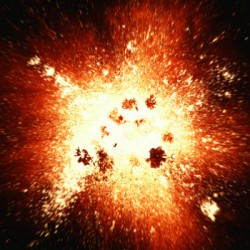
Consider what occurs when a particle of matter collides with a particle of antimatter. Essentially, we get a small explosion of energy, often resulting in matter and photons. The key point is that the Big Bang Duality theory posits a collision of two infinitely dense energy points–one matter and the other antimatter–which would result in an immense explosion, resulting in the initial inflation of the universe.
Of course, there is a key question: Is there any experimental evidence that would suggest the Big Bang Duality theory is valid? The short answer is yes. For example, it explains the almost near absence of antimatter in the universe. As mentioned earlier, a full discussion of the Big Bang Duality theory is delineated in Unraveling the Universe’s Mysteries.
It is hard to believe that the Big Bang was not a single point of energy, but rather two points of energy (one matter and the other antimatter) that collided to initiate inflation and form the universe we observe today. Welcome to the edge of science, where physics and metaphysics blur.