Category Archives: Artificial Intelligence

A computer monitor displaying a colorful digital artwork of a woman's face surrounded by vibrant icons and symbols.

Why Are Most Artificial Intelligence Applications Female?

Have you noticed that artificial intelligence applications you interact with, such as Google Now, Siri, and Cortana, are female? That’s not a coincidence. There are several reasons:

  • Karl Fredric MacDorman, a computer scientist and expert in human-computer interaction at Indiana University-Purdue University Indianapolis, attributes the “female” AI to the gender of the AI technologists that develop the applications. Men dominate the field of artificial intelligence research and application.
  •  Kathleen Richardson, a social anthropologist, claims that female AI is less threatening than male AI, thus more appealing.
  • Debbie Grattan, a veteran voice over artist for brands like Apple, Samsung, and Wal-Mart, claims, “Because females tend to be the more nurturing gender by nature, their voices are often perceived as a helper, more compassionate, understanding, and non-threatening.”

Stanford University Professor Clifford Nass, author of “The Man Who Lied to His Laptop: What Machines Teach Us About Human Relationships,” argues, “It’s much easier to find a female voice that everyone likes than a male voice that everyone likes.” Nass adds, “It’s a well-established phenomenon that the human brain is developed to like female voices.”

There is little doubt that the gender of choice for AI interactions with humans is female. However, you may ask, “What about the Terminator movie?” The Terminator was male. Why? The answer is to make the “Terminator” more threatening a male persona was chosen. This makes an important point. Selection of the AI voice is context sensitive. Although, male voices can come across more threatening, they also come across with more authority. This suggests that robotic police officers are likely to be “male.”

A lot of AI applications have no voice. This is especially true of military applications of AI, including United States Air Force drones and Navy torpedoes. Even some consumer AI applications find no need for a voice, such as the “popcorn” setting on your microwave.

The bottom line is simple. AI applications that seek to interact with humans in a friendly helpful manner tend to have a female voice. AI applications that want to “speak” with authority will typically have a male voice. However, many AI applications, including those that kill humans, are voiceless.

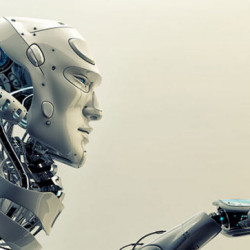
A detailed side view of a futuristic humanoid robot with intricate mechanical components against a plain background.

Are You Destined to Become a Cyborg?

The most basic definition of a cyborg is a being with both organic and cybernetic (artificial) parts. Taking this definition too literally, however, would suggest that almost every human in a civilized society is a cyborg. For example, if you have a dental filling, then you have an artificial part, and by the above definition, you are (literally) a cyborg. If we choose to restrict the definition to advanced artificial parts/machines, however, we must realize that many humans have artificial devices to replace hips, knees, shoulders, elbows, wrists, jaws, teeth, skin, arteries, veins, heart valves, arms, legs, feet, fingers, and toes, as well as “smart” medical devices, such as heart pacemakers and implanted insulin pumps to assist their organic functions. This more restrictive interpretation qualifies them as cyborgs. This definition, however, does not highlight the major element (and concern) regarding becoming a cyborg, namely, strong-AI brain implants.

While humans have used artificial parts for centuries (such as wooden legs), generally they still consider themselves human. The reason is simple: Their brains remain human. Our human brains qualify us as human beings. In my book, The Artificial Intelligence Revolution (2014), I predicted that by 2099 most humans will have strong-AI brain implants and interface telepathically with SAMs (i.e., strong artificially intelligent machines). I also argued the distinction between SAMs and humans with strong-AI brain implants will blur. Humans with strong-AI brain implants will identify their essence with SAMs. These cyborgs (strong-AI humans with cybernetically enhanced bodies), whom I call SAH (i.e., strong artificially intelligent human) cyborgs, represent a potential threat to humanity. It is unlikely that organic humans will be able to intellectually comprehend this new relationship and interface meaningfully (i.e., engage in dialogue) with either SAMs or SAHs.

Let us try to understand the potential threats and benefits related to what becoming a SAH cyborg represents. From the standpoint of intelligence, SAH cyborgs and SAMs will be at the top of the food chain. Humankind (organic humans) will be one step down. We, as organic humans, have been able to dominate the planet Earth because of our intelligence. When we no longer are the most intelligent entities on Earth, we will face numerous threats, similar to the threats we pose to other species. This will include extinction of organic humans, slavery of organic humans, and loss of humanity (strong-AI brain implants cause SAHs to identify with intelligent machines, not organic humans).

While the above summaries capsulize the threats posed by SAMs and SAHs, I have not discussed the benefits. There are significant benefits to becoming a SAH cyborg, including:

  • Enhanced intelligence: Imagine knowing all that is known and being able to think and communicate at the speed of SAMs. Imagine a life of leisure, where robots do “work,” and you spend your time interfacing telepathically with other SAHs and SAMs.
  • Immortality: Imagine becoming immortal, with every part of your physical existence fortified, replaced, or augmented by strong-AI artificial parts, or having yourself (your human brain) uploaded to a SAM. Imagine being able to manifest yourself physically at will via foglets (tiny robots that are able to assemble themselves to replicate physical structures).

Will you become a cyborg? Yes, many of us already qualify as cyborgs, based on the discussion above. Will we become SAH cyborgs? I think it likely, based on how quickly humans adopt medical technology. The lure of superior intelligence and immortality may be irresistible.

My point in writing this article was to delineate the pros and cons of becoming a SAH cyborg? Many young people will have to decide if that is the right evolutionary path for themselves.

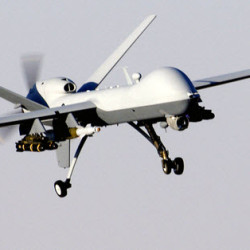
A white military drone equipped with missiles flying against a clear sky.

The Robot Wars Are Coming

When I say “the robot wars are coming,” I am referring to the increase in the US Department of Deference’s use of robotic systems and artificial intelligence in warfare.

Recently, September 12, 2014, the US Department of Defense released a report, DTP 106: Policy Challenges of Accelerating Technological Change: Security Policy and Strategy Implications of Parallel Scientific Revolutions. Its authors, James Kadtke and Linton Wells II, delineate the potential benefits and concerns of Robotics, Artificial Intelligence and associated technologies, as they relate to the future of warfare, stating: “This paper examines policy, legal, ethical, and strategy implications for national security of the accelerating science, technology, and engineering (ST&E) revolutions underway in five broad areas: biology, robotics, information, nanotechnology, and energy (BRINE), with a particular emphasis on how they are interacting. The paper considers the time frame between now and 2030 but emphasizes policy and related choices that need to be made in the next few years.” Their  conclusions were shocking:

  • They express concerns about maintaining the US Department of Defense’s present technological preeminence, as other nations and companies in the private sector take the lead in developing robotics, AI and human augmentation such as exoskeletons.
  • They warn that “The loss of domestic manufacturing capability for cutting-edge technologies means the United States may increasingly need to rely on foreign sources for advanced weapons systems and other critical components, potentially creating serious dependencies. Global supply chain vulnerabilities are already a significant concern, for example, from potential embedded “kill switches,” and these are likely to worsen.”
  • The most critical concern they express, in my view, is “In the longer term, fully robotic soldiers may be developed and deployed, particularly by wealthier countries, although the political and social ramifications of such systems will likely be significant. One negative aspect of these trends, however, lies in the risks that are possible due to unforeseen vulnerabilities that may arise from the large scale deployment of smar automated systems, for which there is little practical experience. An emerging risk is the ability of small scale or terrorist groups to design and build functionally capable unmanned systems which could perform a variety of hostile missions.”

It becomes obvious by reading this report and numerous similar reports, that the face of warfare is rapidly changing. It’s hard to believe we’ve come to this point, if you consider that 15 years ago Facebook and Twitter did not exist and Google was just getting started. However, even 15 years ago, drones played a critical role in warfare. For example, it was a Predator mission that located Osama bin Laden in Afghanistan in 2000. While drones were used as early as World War II for surveillance, it wasn’t until 2001 that missile-equipped drones were completed with the deployment of Predators drones, armed with Hellfire missiles. Today, one in every three fighter planes is a drone. How significant is this change? According to Richard Pildes, a professor of constitutional law at New York University’s School of Law, “Drones are the most discriminating use of force that has ever been developed. The key principles of the laws of war are necessity, distinction and proportionality in the use of force. Drone attacks and targeted killings serve these principles better than any use of force that can be imagined.”

Where is this all headed? Within the near future, the US military will deploy completely autonomy “Kill Bots.” There are robots that are programmed to engage and destroy the enemy without human oversight or control. Science fiction? No! According a 2014 media release from officials at the Office of Naval Research (ONR), a technological breakthrough will allow any unmanned surface vehicle (USV) to not only protect Navy ships, but also, for the first time, autonomously “swarm” offensively on hostile vessels. In my opinion, autonomous Predator drones are likely either being developed or have been developed, but the information remains classified.

Artificial intelligence and robotic systems are definitely changing the face of warfare. Within a decade, I judge, based on the current trends, that about half of the offensive capability of the US Department of Deference will consist of Kill Bots in one form or another, and a large percentage of them will be autonomous.

This suggest two things to me regarding the future of warfare:

  1. Offensively fighting wars will become more palatable to the US public because machines, not humans, will perform the lion’s share of the most dangerous missions.
  2. US adversaries are also likely to use Kill Bots against us, as adversarial nations develop similar technology.

This has prompted a potential United Nations moratorium on autonomous weapons systems. To quote the US DOD report DTP 106, “Perhaps the most serious issue is the possibility of robotic systems that can autonomously decide when to take human life. The specter of Kill Bots waging war without human guidance or intervention has already sparked significant political backlash, including a potential United Nations moratorium on autonomous weapons systems. This issue is particularly serious when one considers that in the future, many countries may have the ability to manufacture, relatively cheaply, whole armies of Kill Bots that could autonomously wage war. This is a realistic possibility because today a great deal of cutting-edge research on robotics and autonomous systems is done outside the United States, and much of it is occurring in the private sector, including DIY robotics communities. The prospect of swarming autonomous systems represents a challenge for nearly all current weapon systems.”

There is no doubt that the robot wars are coming. The real question is: Will humanity survive the robot wars?


Abstract digital illustration of a glowing microchip with data streams and blue light effects.

Will Artificial Intelligence Result in the Merger of Man and Machine?

Will humankind’s evolution merge with strong artificially intelligent machines (SAMs)? While no one really knows the answer to this question, many who are engaged in the development of artificial intelligence assert the merger will occur. Let’s understand what this means and why it is likely to occur.

While humans have used artificial parts for centuries (such as wooden legs), generally they still consider themselves human. The reason is simple: Their brains remain human. Our human brains qualify us as human beings. However,  by 2099 most humans will have strong-AI brain implants and interface telepathically with SAMs. This means the distinction between SAMs and humans with strong-AI brain implants, or what is termed “strong artificially intelligent humans” (i.e., SAH cyborgs), will blur. There is a strong probability, when this occurs, humans with strong-AI brain implants will identify their essence with SAMs. These cyborgs (strong-AI humans with cybernetically enhanced bodies), SAH cyborgs, represent a potential threat to humanity, which we’ll discuss below. It is unlikely that organic humans will be able to intellectually comprehend this new relationship and interface meaningfully (i.e., engage in dialogue) with either SAMs or SAHs.

Let us try to understand the potential threats and benefits related to what becoming a SAH cyborg represents. In essence, the threats are the potential extinction of organic humans, slavery of organic humans, and loss of humanity (strong-AI brain implants may cause SAHs to identify with intelligent machines, not organic humans, as mentioned above). Impossible? Unlikely? Science fiction? No! Let understand first why organic humans may choose to become SAH cyborgs.

There are significant benefits to becoming a SAH cyborg, including:

  • Enhanced intelligence: Imagine knowing all that is known and being able to think and communicate at the speed of SAMs. Imagine a life of leisure, where robots do “work,” and you spend your time interfacing telepathically with other SAHs and SAMs.
  • Immortality: Imagine becoming immortal, with every part of your physical existence fortified, replaced, or augmented by strong-AI artificial parts, or having yourself (your human brain) uploaded to a SAM. Imagine being able to manifest yourself physically at will via foglets (tiny robots that are able to assemble themselves to replicate physical structures). In my book, The Artificial Intelligent Revolution, I delineate the technology trends that suggests by the 2040s humans will develop the means to instantly create new portions of ourselves, either biological or non-biological, so that people can have a physical body at one time and not at another, as they choose.

To date, predictions regarding regarding most of humankind becoming SAH cyborgs by 2099 is on track to becoming a reality. An interesting 2013 article by Bryan Nelson, “7 Real-Life Human Cyborgs” (www.mnn.com/leaderboard/stories/7-real-life-human-cyborgs), demonstrates this point. The article provides seven examples of living people with significant strong-AI enhancements to their bodies who are legitimately categorized as cyborgs. In addition, in 2011 author Pagan Kennedy wrote an insightful article in The New York Times Magazine, “The Cyborg in Us All” that states: “Thousands of people have become cyborgs, of a sort, for medical reasons: cochlear implants augment hearing and deep-brain stimulators treat Parkinson’s. But within the next decade, we are likely to see a new kind of implant, designed for healthy people who want to merge with machines.”

Based on all available information, the question is not whether humans will become cyborgs but rather when a significant number of humans will become SAH cyborgs. Again, based on all available information, I believe this will begin to significantly occur the 2040. I am not saying that in 2040 all humans will become SAH cyborgs but that a significant number will qualify as SAH cyborgs. I do predict, along with other AI futurists, that by 2099 most humans in technologically advanced nations will become SAH cyborgs. I also predict the leaders of many of those nations will be SAH cyborgs. The reasoning behind my last prediction is simple. SAH cyborgs will be intellectually and physically superior to organic humans in every regard. In effect, they will be the most qualified to assume leadership positions.

The quest for immortality appears to be an innate human longing and may be the strongest motivation for becoming a SAH cyborg. In 2010 cyborg activist and artist Neil Harbisson and his longtime partner, choreographer Moon Ribas, established the Cyborg Foundation, the world’s first international organization to help humans become cyborgs. They state they formed the Cyborg Foundation in response to letters and e-mails from people around the world who were interested in becoming a cyborg. In 2011 the vice president of Ecuador, Lenin Moreno, announced that the Ecuadorian government would collaborate with the Cyborg Foundation to create sensory extensions and electronic eyes. In 2012 Spanish film director Rafel Duran Torrent made a short documentary about the Cyborg Foundation. In 2013 the documentary won the Grand Jury Prize at the Sundance Film Festival’s Focus Forward Filmmakers Competition and was awarded $100,000.

At this point you may think that being a SAH cyborg makes logical sense and is the next step in humankind’s evolution. This may be the case, but humankind has no idea how taking that step may affect what is best in humanity, for example, love, courage, and sacrifice. My view, based on how quickly new life-extending medical technology is accepted, is that humankind will take that step. Will it serve us? I have strong reservations, but I leave it to your judgment to answer that question.



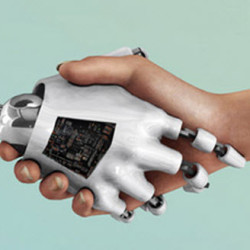
A human hand holding a robotic hand with visible mechanical and circuit details, symbolizing human-robot interaction.

By 2030 Your Best Friend May Be a Computer

AI has changed the cultural landscape. Yet the change has been so gradual that we hardly have noticed the major impact it has. Some experts, including myself, predict that in about fifteen years, the average desktop computer will have a mind of its own, literally. This computer will be your intellectual equal and will even have a unique personality. It will be self-aware. Instead of just asking simple questions about the weather forecast, you may be confiding your deepest concerns to your computer and asking it for advice. It will have migrated from personal assistant to personal friend. You likely will give it a name, much in the same way we name our pets. You will be able to program its personality to have interests similar to your own. It will have face-recognition software, and it will recognize you and call you by name, similar to the computer HAL 9000 in Arthur C. Clarke’s 2001: A Space Odyssey. The conversations between you and your “personal friend” will appear completely normal. Someone in the next room who is not familiar with your voice will not be able to tell which voice belongs to the computer and which voice belongs to you.

This is a good place for us to ask an important question: “How can we determine whether an intelligent machine has become conscious (self-aware)?” We do not have a way yet to determine whether even another human is self-aware. I only know that I am self-aware. I assume that since we share the same physiology, including similar human brains, you are probably self-aware as well. However, even if we discuss various topics, and I conclude that your intelligence is equal to mine, I still cannot prove you are self-aware. Only you know whether you are self-aware.

The problem becomes even more difficult when dealing with an intelligent machine. The gold standard for an intelligent machine’s being equal to the human mind is the Turing test, which I discuss in chapter 5. As of today no intelligent machine can pass the Turing test unless its interactions are restricted to a specific topic, such as chess. However, even if an intelligent machine does pass the Turing test and exhibits strong AI, how can we be sure it is self-aware? Intelligence may be a necessary condition for self-awareness, but it may not be sufficient. The machine may be able to emulate consciousness to the point that we conclude it must be self-aware, but that does not equal proof.

Even though other tests, such as the ConsScale test, have been proposed to determine machine consciousness, we still come up short. The ConsScale test evaluates the presence of features inspired by biological systems, such as social behavior. It also measures the cognitive development of an intelligent machine. This is based on the assumption that intelligence and consciousness are strongly related. The community of AI researchers, however, does not universally accept the ConsScale test as proof of consciousness. In the final analysis, I believe most AI researchers agree on only two points:

  1. There is no widely accepted empirical definition of consciousness (self-awareness).
  2. A test to determine the presence of consciousness (self-awareness) may be impossible, even if the subject being tested is a human being.

The above two points, however, do not rule out the possibility of intelligent machines becoming conscious and self-aware. They merely make the point that it will be extremely difficult to prove consciousness and self-awareness.

There is little doubt that intelligent machines by the year 2030 will be able to interact with organic humans, much the same way we are able to interact with each other. If it is programmed to share your interests and has strong affective computing capabilities (i.e., affective computing relates to machines having human-like emotions), you may well consider it a friend, even a best friend. Need proof? Just observe how additive computer games are to people in all walks of life and various age groups. Now imagine an intelligent machine that is able to not only play computer based games, but discuss any subject you’d like to discuss. I predict interactions with such machines will become additive and may even reduce human to human interactions.