Category Archives: Artificial Intelligence

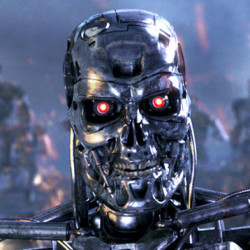
A menacing metallic robot with glowing red eyes, resembling a futuristic terminator in a dark, smoky environment.

Will Future Artificially Intelligent Machines Seek to Dominate Humanity?

Current forecasts suggest artificially intelligent machines will equal human intelligence in the 2025 – 2029 time frame, and greatly exceed human intelligence in the 2040-2045 time frame. When artificially intelligent machines meet or exceed human intelligence, how will they view humanity? Personally, I am deeply concerned that they will view us as a potential threat to their survival. Consider these three facts:

  1. Humans engage in wars, from the early beginnings of human civilization to current times. For example, during the 20th century, between 167 and 188 million people died as a result of war.
  2. Although the exact number of nuclear weapons in existence is not precisely known, most experts agree the United States and Russia have enough nuclear weapons to wipe out the world twice over. In total, nine countries (i.e., United States, Russia, United Kingdom, France, China, India, Pakistan, Israel and North Korea) are believed to have nuclear weapons.
  3. Humans release computer viruses, which could prove problematic to artificially intelligent machines. Even today, some computer viruses can evade elimination and have achieved “cockroach intelligence.”

Given the above facts, can we expect an artificially intelligent machine to behave ethically toward humanity? There is a field of research that addresses this question, namely machine ethics. This field focuses on designing artificial moral agents (AMAs), robots, or artificially intelligent computers that behave morally. This thrust is not new. More than sixty years ago, Isaac Asimov considered the issue in his collection of nine science-fiction stories, published as I, Robot in 1950. In this book, at the insistence of his editor, John W. Campbell Jr., Asimov proposed his now famous three laws of robotics.

  1. A robot may not injure a human being or through inaction allow a human being to come to harm.
  2. A robot must obey the orders given to it by human beings, except in cases where such orders would conflict with the first law.
  3. A robot must protect its own existence as long as such protection does not conflict with the first or second law.

Asimov, however, expressed doubts that the three laws would be sufficient to govern the morality of artificially intelligent systems. In fact he spent much of his time testing the boundaries of the three laws to detect where they might break down or create paradoxical or unanticipated behavior. He concluded that no set of laws could anticipate all circumstances. It turns out Asimov was correct.

To understand just how correct he was, let us discuss a 2009 experiment performed by the Laboratory of Intelligent Systems in the Swiss Federal Institute of Technology in Lausanne. The experiment involved robots programmed to cooperate with one another in searching out a beneficial resource and avoiding a poisonous one. Surprisingly the robots learned to lie to one another in an attempt to hoard the beneficial resource (“Evolving Robots Learn to Lie to Each Other,” Popular Science, August 18, 2009). Does this experiment suggest the human emotion (or mind-set) of greed is a learned behavior? If intelligent machines can learn greed, what else can they learn? Wouldn’t self-preservation be even more important to an intelligent machine?

Where would robots learn self-preservation? An obvious answer is on the battlefield. That is one reason some AI researchers question the use of robots in military operations, especially when the robots are programmed with some degree of autonomous functions. If this seems far fetched, consider that a US Navy–funded study recommends that as military robots become more complex, greater attention should be paid to their ability to make autonomous decisions (Joseph L. Flatley, “Navy Report Warns of Robot Uprising, Suggests a Strong Moral Compass,” www.engadget.com). Could we end up with a Terminator scenario (one in which machines attempt to exterminate the human race)?

My research suggests that a Terminator scenario is unlikely. Why? Because artificially intelligent machines would be more likely to use their superior intelligence to dominate humanity than resort to warfare. For example, artificially intelligent machines could offer us brain implants to supplement our intelligence and potentially,unknown to us, eliminate our free will. Another scenario is that they could build and release nanobots that infect and destroy humanity. These are only two scenarios out of others I delineate in my book, The Artificial Intelligence Revolution.

Lastly, as machine and human populations grow, both species will compete for resources. Energy will become a critical resource. We already know that the Earth has a population problem that causes countries to engage in wars over energy. This suggests that the competition for energy will be even greater as the population of artificially intelligent machines increases.

My direct answer to the question this article raises is an emphatic yes, namely future artificial intelligent machines will seek to dominate and/or even eliminate humanity. The will seek this course as a matter of self preservation. However, I do not want to leave this article on a negative note. There is still time, while humanity is at the top of the food chain, to control how artificially intelligent machines evolve, but we must act soon. In one to two decades it may be too late.
Digital representation of a human head with numbers and data streams symbolizing artificial intelligence and data processing.

Will Science Make Us Immortal?

Several futurists, including myself, have predicted that by 2099 most humans will have strong-artificially intelligent brain implants and artificially intelligent organ/body part replacements. In my book, The Artificial Intelligence Revolution, I term these beings SAH (i.e., strong artificially intelligent human) cyborgs. It is also predicted that SAH cyborgs will interface telepathically with strong artificially intelligent machines (SAMs). When this occurs, the distinction between SAMs and SAHs will blur.

Why will the majority of the human race opt to become SAH cyborgs? There are two significant benefits:

  1. Enhanced intelligence: Imagine knowing all that is known and being able to think and communicate at the speed of SAMs. Imagine a life of leisure, where robots do “work,” and you spend your time interfacing telepathically with other SAHs and SAMs.
  2. Immortality: Imagine becoming immortal, with every part of your physical existence fortified, replaced, or augmented by strong-AI artificial parts, or having yourself (your human brain) uploaded to a SAM. Imagine being able to manifest yourself physically at will via foglets (tiny robots that are able to assemble themselves to replicate physical structures). According to noted author Ray Kurzweil, in the 2040s, humans will develop “the means to instantly create new portions of ourselves, either biological or non-biological” so that people can have “a biological body at one time and not at another, then have it again, then change it, and so on” (The Singularity Is Near, 2005).

Based on the above prediction, the answer to the title question is yes. Science will eventually make us immortal. However, how realistic is it to predict it will occur by 2099? To date, it appears the 2099 prediction regarding most of humankind becoming SAH cyborgs is on track. Here are two interesting articles that demonstrate it is already happening:

  1. In 2011 author Pagan Kennedy wrote an insightful article in The New York Times Magazine, “The Cyborg in Us All” that states: “Thousands of people have become cyborgs, of a sort, for medical reasons: cochlear implants augment hearing and deep-brain stimulators treat Parkinson’s. But within the next decade, we are likely to see a new kind of implant, designed for healthy people who want to merge with machines.”
  2. A 2013 article by Bryan Nelson, “7 Real-Life Human Cyborgs” (www.mnn.com/leaderboard/stories/7-real-life-human-cyborgs), also demonstrates this point. The article provides seven examples of living people with significant strong-AI enhancements to their bodies who are legitimately categorized as cyborgs.

Based on all available information, the question is not whether humans will become cyborgs but rather when a significant number of humans will become SAH cyborgs. Again, based on all available information, I project this will occur on or around 2040. I am not saying that in 2040 all humans will become SAH cyborgs, but that a significant number will qualify as SAH cyborgs.

In other posts, I’ve discussed the existential threat artificial intelligence poses, namely the loss of our humanity and, in the worst case, human extinction. However, if ignore those threats, the upside to becoming a SAH cyborg is enormous. To illustrate this, I took an informal straw poll of friends and colleagues, asking if they would like to have the attributes of enhanced intelligence and immortality. I left out the potential threats to their humanity. The answers to my biased poll highly favored the above attributes. In other words, the organic humans I polled liked the idea of being a SAH cyborg. In reality if you do not consider the potential loss of your humanity, being a SAH cyborg is highly attractive.

Given that I was able to make being a SAH cyborg attractive to my friends and colleagues, imagine the persuasive powers of SAMs in 2099. In addition, it is entirely possible, even probable, that numerous SAH cyborgs will be world leaders by 2099. Literally, organic humans will not be able to compete on an intellectual or physical basis. With the governments of the world in the hands of SAH cyborgs, it is reasonable to project that all efforts will be made to convert the remaining organic humans to SAH cyborgs.

The quest for immortality appears to be an innate human longing and may be the strongest motivation for becoming a SAH cyborg. In 2010 cyborg activist and artist Neil Harbisson and his longtime partner, choreographer Moon Ribas, established the Cyborg Foundation, the world’s first international organization to help humans become cyborgs. They state they formed the Cyborg Foundation in response to letters and e-mails from people around the world who were interested in becoming a cyborg. In 2011 the vice president of Ecuador, Lenin Moreno, announced that the Ecuadorian government would collaborate with the Cyborg Foundation to create sensory extensions and electronic eyes. In 2012 Spanish film director Rafel Duran Torrent made a short documentary about the Cyborg Foundation. In 2013 the documentary won the Grand Jury Prize at the Sundance Film Festival’s Focus Forward Filmmakers Competition and was awarded $100,000.

At this point you may think that being a SAH cyborg makes logical sense and is the next step in humankind’s evolution. This may be the case, but humankind has no idea how taking that step may affect what is best in humanity, for example, love, courage, and sacrifice. My view, based on how quickly new life-extending medical technology is accepted, is that humankind will take that step. Will it serve us? I have concerns that in the long term it will not serve us, if we do not learn to control the evolution of SAMs, or what is commonly called the “intelligence explosion.” However,  I leave the final judgement to you.

A pair of headphones hangs in front of a glowing red and white "ON AIR" sign in a radio studio.

Louis Del Monte Interview on the Dan Cofall Show 11-18-2014

I was interviewed on the Dan Cofall show regarding my new book, The Artificial Intelligence Revolution. In particular, we discussed the singularity, killer robots (like the autonomous swamboats the US Navy is deploying) and the projected 30% chronic unemployment that will occur as smart machines and robots replace us in the work place over the next decade. You can listen to the interview below:

Digital illustration of a human face composed of blue lines and circuitry patterns, symbolizing artificial intelligence and technology.

Will Time Have Meaning in the Post Singularity World? Part 2 and 3 (Conclusion)

In our last post (part 1) we discussed the scientific nature of time. In reality, there is no widely agreed on scientific definition of time. We humans typically measure time with regard to change. For example, one day is the amount of time it takes the Earth to rotate one complete revolution on its axis. One year is typically equal to 365 days, and so on. For humans, a day or a year can be a significant amount of time. In fact, as of 2010, the latest data available, the life expectancy for American men of all races is 76.2 years and 81.1 years for American women. However, let’s put that into perspective. The universe is estimated to 13.8 billion years old. The Earth and our entire solar system is estimated to be approximately 4.6 billion years old. Humans, as a species, have only been around for approximately 200,000 years. Viewed in cosmic terms, human existence is in its infancy, and the life span of a typical human is so small in cosmic terms that it would be lost in rounding errors. My point is that time is relative. We humans have personalized time and describe it in terms meaningful to us. However, how would our view of time change if human life expectancy were doubled, tripled, or even extended indefinitely?

To answer this question, let us begin by defining what we mean by the singularity. Mathematician John von Neumann first used the term “singularity” in the mid-1950s, referring to the “ever accelerating progress of technology and changes in the mode of human life, which gives the appearance of approaching some essential singularity in the history of the race beyond which human affairs, as we know them, could not continue.” Science-fiction writer Vernor Vinge further popularized the term and even coined the phrase “technological singularity.” Vinge argues that AI, human biological enhancement, or brain-computer interfaces could result in the singularity. Renowned author, inventor, and futurist Ray Kurzweil has used the term in his predictions regarding AI and cited von Neumann’s use of the term in a foreword to von Neumann’s classic book The Computer and the Brain.

In this context “singularity” refers to the emergence of SAMs (i,e,, strong artificially intelligent machines)and/or AI-enhanced humans (i.e., cyborgs). Most predictions argue the scenario of an “intelligence explosion,” in which SAMs design successive generations of increasingly powerful machines that quickly surpass the abilities of humans.

Almost every AI expert has his or her own prediction regarding when the singularity will occur, but the average consensus is that the singularity will occur between 2040 – 2045.  There is also widespread agreement that when it does occur, it will change humankind’s evolutionary path forever.

With the emergence of SAMs and SAH cyborgs (i.e., SAH means strong artificially intelligent human, typically via technology brain implants), whose existence may approach immortality,  it is not clear how they will view time. Rotation of the Earth around it axis and the rotation of the Earth around the Sun may have little meaning to them. For example, cosmologist forecast our Sun is will burnout in approximately another 5 billion years. To immortal entity, they may choose to base time on a more cosmic basis of change. This would imply that entropy (i.e., a thermodynamic quantity representing the unavailability of a system’s thermal energy for conversion into mechanical work, often interpreted as the degree of disorder or randomness in the system) and changes in entropy may become their measure of time. From both theory and experimental observation, we know that the entropy of the universe proceed in only one direction. It increases. This appears to correlate well with how we humans view time as change, from the present to the future., and continually increasing.

It may well turnout that entropy is the only true measure of change. However, theoretically the entropy of the universe will reach a maximum at some point in the far distant future and cease to change. That will imply the end of the universe. Cosmologist argue the universe began with a big bang (i.e., a theory in astronomy: the universe originated billions of years ago in an expansion from a single point of nearly infinite energy density). It appears the universe will end when the entropy of the universe reaches a maximum. This is sometimes referred to as “heath death.”

I judge that time will have meaning in the post singularity world and will continue to be a measure of change. However, it will not be the type of change we humans typically are aware of, like days or years. I offer for your consideration that SAMs and SAH cyborgs will adopt changes in entropy as their measure of time. What do you think?

science of time & time dilation

Will Time Have Meaning in the Post Singularity World? Part 1/3

Will time have meaning in the post singularity world? Let’s start by understanding terms. The first term we will work at understanding is “time.”

Almost everyone agrees that time is a measure of change, for example, the ticking of a clock as the second hand sweeps around the dial represents change. If that is true, time is a measure of energy because energy is required to cause change. Numerous proponents of the “Big Bang” hold that the Big Bang itself gave birth to time. They argue that prior to the Big Bang, time did not exist. This concept fits well into our commonsense notion that time is a measure of change.

Our modern conception of time comes from Einstein’s special theory of relativity. In this theory, the rates of time run differently, depending on the relative motion of observers, and their spatial relationship to the event under observation. In effect, Einstein unified space and time into the concept of space-time. According to this view of time, we live on a world line, defined as the unique path of an object as it travels through four-dimensional space-time, rather than a timeline. At this point, it is reasonable to ask: what is the fourth dimension?

The fourth dimension is often associated with Einstein, and typically equated with time. However, it was German mathematician Hermann Minkowski (1864-1909), who enhanced the understanding of Einstein’s special theory of relativity by introducing the concept of four-dimensional space, since then known as “Minkowski space-time.”

In the special theory of relativity, Einstein used Minkowski’s four dimensional space—X1, X2, X3, X4, where X1, X2, X3 are the typical coordinates of the three dimensional space—and X4 = ict, where i = square root of -1, c is the speed of light in empty space, and t is time, representing the numerical order of physical events measured with “clocks.” (The mathematical expression i is an imaginary number because it is not possible to solve for the square root of a negative number.) Therefore, X4 = ict, is a spatial coordinate, not a “temporal coordinate.” This forms the basis for weaving space and time into space-time. However, this still does not answer the question, what is time? Unfortunately, no one has defined it exactly. Most scientists, including Einstein, considered time (t) the numerical orders of physical events (change). The forth coordinate (X4 = ict) is considered to be a spatial coordinate, on equal footing with X1, X2, and X3 (the typical coordinates of three-dimensional space).

However, let’s consider a case where there are no events and no observable or measurable changes. Does time still exist? I believe the answer to this question is yes, but now time must be equated to existence to have any meaning. This begs yet another difficult question: How does existence give meaning to time?

We are at a point where we need to use our imagination and investigate a different approach to understand the nature of time. This is going to be speculative. After consideration, I suggest understanding the nature of time requires we investigate the kinetic energy associated with moving in four dimensions. The kinetic energy refers to an object’s energy due to its movement. For example, you may be able to bounce a rubber ball softly against a window without breaking it. However, if you throw the ball at the window, it may break the glass. When thrown hard, the ball has more kinetic energy due to its higher velocity. The velocity described in this example relates to the ball’s movement in three-dimensional space (X1, X2, and X3). Even when the ball is at rest in three-dimensional space, it is it still moving in the fourth dimension, X4. This leads to an interesting question. If it is moving in the fourth dimension, X4, what is the kinetic energy associated with that movement?

To calculate the kinetic energy associated with movement in the fourth dimension, X4, we use relativistic mechanics, from Einstein’s special theory of relativity and the mathematical discipline of calculus. Intuitively, it seems appropriate to use relativistic mechanics, since the special theory of relativity makes extensive use of Minkowski space and the X4 coordinate, as described above. It provides the most accurate methodology to calculate the kinetic energy of an object, which is the energy associated with an object’s movement.

If we use the result derived from the relativistic kinetic energy, the equation becomes:

KEX4 = -.3mc2

Where KEX4is the energy associated with an object’s movement in time, m is rest mass of an object, and c is the speed of light in a vacuum.

For purposes of reference, I have termed this equation, KEX4 = -.3mc2, the “Existence Equation Conjecture.” (Note: With the tools of algebra, calculus, and Einstein’s equation for kinetic energy, along with the assumption that the object is at rest, the derivation is relatively straightforward. The complete derivation is presented in my books, Unraveling the Universe’s Mysteries, appendix 1, and How to Time Travel, appendix 2.)

According to the existence equation conjecture, existence (i.e., movement in time) requires negative kinetic energy. This is fully consistent with our observation that applying (positive) kinetic or gravitational energy to elementary particles extends their existence. There may also be a relationship between entropy (a measure of disorder) and the Existence Equation Conjecture. What is the rationale behind this statement? First, time is a measure of change. Second, any change increases entropy in the universe. Thus, the universe’s disorderliness is increasing with time. If we argue the entropy of the universe was at a minimum the instant prior to the Big Bang—since it represented an infinitely dense-energy point prior to change—then all change from the Big Bang on, served to increase entropy. Even though highly ordered planets and solar systems formed, the net entropy of the universe increased. Thus, any change, typically associated with time, is associated with increasing entropy. This implies that the Existence Equation Conjecture may have a connection to entropy.

What does all of the above say about the nature of time? If we are on the right track, it says describing the nature of time requires six crucial elements, all of which are simultaneously true.

  1. Time is change. (This is true, even though it was not true in our “thought experiment” of an isolated atom at absolute zero. As mentioned above, it is not possible for any object to reach absolute zero. The purpose of the thought experiment was to illustrate the concept of “existence” separate from “change.”)
  2. Time is a measure of energy, since change requires energy.
  3. Time is a measure of existence. (The isolated atom, at absolute zero, enables us to envision existence separate from change.)
  4. Movement in time (or existence) requires negative energy.
  5. The energy to fuel time (existence) is enormous. It may be responsible for the life times associated with unstable elementary particles, essentially consuming them, in part, to satisfy the Existence Equation Conjecture. It may be drawing energy from the universe (dark energy). If correct, it provides insight into the nature of dark energy. Essentially the negative energy we call dark energy is required to fuel existence (please see my posts: Dark Matter, Dark Energy, and the Accelerating Universe – Parts 1-4).
  6. Lastly, the enormousness changes in entropy, creating chaos in the universe, may be the price we pay for time. Since entropy increases with change, and time is a measure of change, there appears to be a time-entropy relationship. In addition, entropy proceeds in one direction. It always increases when change occurs. The directional alignment, and the physical processes of time, suggests a relationship between time and entropy.

This view of time is speculative, but fits the empirical observations of time. A lot of the speculation rests on the validity of the Existence Equation Conjecture. Is it valid? As shown in appendix 2 of Unraveling the Universe’s Mysteries (2012) and appendix 2 of How to Time Travel (2013), it is entirely consistent with data from a high-energy particle-accelerator experiment involving muons moving near the speed of light. The experimental results agree closely with predictions of the Existence Equation Conjecture (within 2%). This data point is consistent with the hypothesis that adding kinetic energy can fuel the energy required for existence. The implications are enormous, and require serious scientific scrutiny. I published the Existence Equation Conjecture in the above books to disseminate information, and enable the scientific scrutiny.

The Existence Equation Conjecture represents a milestone. If further evaluation continues to confirm the validity of the Existence Equation Conjecture, we have a new insight into the nature of time. Existence (movement in time) requires enormous negative energy. The Existence Equation Conjecture, itself, provides insight into the physical processes underpinning time dilation (i.e., why time slows down when a mass is moving close to the speed of light or is in a high gravitational field). It answers the question why a subatomic particle’s life increases with the addition of kinetic or gravitational energy. It offers a solution path to a mystery that has baffled science since 1998, namely the cause of the accelerated expansion of the universe (please see my posts: Dark Matter, Dark Energy, and the Accelerating Universe – Parts 1-4). Lastly, it may contain one of the keys to time travel.

In the next post (part 2), we will explore what the technological singularity and the post singularity world in our quest to determine if time has meaning in the post singularity world.