All posts by admin

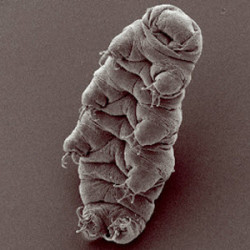
A highly magnified electron microscope image of a tardigrade, a tiny water-dwelling micro-animal known for its resilience.

What kind of life might we find on other planets? Extremophiles!

In the last five decades, we have come to learn that life can be highly adaptable. Starting with the discovery of extremophiles in the 1960s, our entire understanding of how life may have evolved on Earth has been undergoing a reassessment. The early Earth would have presented a relatively inhospitable environment, suggesting to scientists that the earliest forms of life may have been extremophiles.

What is an extremophile? An extremophile is an organism that can thrive in an extreme condition that would be detrimental to most life on Earth. Let us take an example of the most complex of all known extremophiles, the tardigrade.

Tardigrades (also known as “water bears”) are 1 millimeter (0.039 in) long when fully grown, with 4 pairs of legs, each with 4-8 claws also known as “disks.” The animals are prevalent in moss and lichen and viewable with a low-power microscope.

What makes them an extremophile? The tardigrade can withstand temperatures as low as minus 273 degrees Celsius (near absolute zero) and as hot as 151 degrees Celsius (well above the boiling point of water, which is 100 degrees Celsius). It is also able to withstand pressures about six times that found in the deepest ocean trenches and ionizing radiation at doses hundreds of times higher than humans can survive. The big surprise is they can also live in the vacuum of space.

The average human can live without water for about three days, without food for about ten days, if the external environment is hospitable to humans. However, the tardigrade can go without both food and water for more than 10 years. They dry out to the point where they are less than 3% water, but can rehydrate, forage, and reproduce.

The discovery of extremophiles makes finding life on other planets and moons, even within our own solar system, more likely. For example, just recently researchers discovered bacterium, Planococcus halocryophilus OR1, in permafrost (permanently frozen ground) on Ellesmere Island (part of the Qikiqtaaluk Region of the Canadian territory of Nunavut). The organism thrives at 5 degrees Fahrenheit (minus 15 degrees Celsius). This discovery offers clues as to the type of life we may find on Mars or Saturn’s moon Enceladus, both of which contain water ice and surface temperatures well below freezing.

What we humans consider hospitable conditions may actually be lethal to extremophiles. For example, the microorganism Ferroplasma acidiphilum needs large amounts of iron to survive. The iron amounts they thrive in would kill most other life forms. On Earth, many extremophiles live deep underground, which was previously thought to be a dead zone for life, due to the absence of sunlight. However, now we know that the majority of our planet’s bacteria live underground.

The planet Mars has two polar ice caps, which consist primarily of water ice. What might we find as we explore these and the surrounding regions? Saturn’s moon Enceladus appears to have liquid water under its icy surface. Because of Enceladus’s apparent water near the surface, it is a prime candidate for extraterrestrial life in the form of extremophiles.

In my YouTube video, introducing my book, Unraveling the Universe’s Mysteries, I predicted that we would likely find extraterrestrial life in our own solar system within the next twenty years. I stand by that prediction. In fact, I believe I am being conservative.

I suggest we prepare ourselves. We may be on the verge of discovering life in our own solar system.

Sources:

Image: Wikipedia Commons – The tardigrade Hypsibius dujardini

Abstract blue digital background with glowing horizontal lines and light particles.

What is faster than the speed of light? Quantum Entanglement!

In 1905, Einstein published his now famous special theory of relativity. It is one of the pillars of modern physics. The special theory of relativity asserts that no physical entity can travel faster than light, since the energy required to enable such a velocity would be infinite. Most of the scientific community extended this concept to communication, asserting that no communication could take place faster than the speed of light. Generally, the scientific community regards light as the upper speed limit of the universe. Until recently, there was no data to contradict this widely held belief.

In 1935, a paper by Albert Einstein, Boris Podolsky, and Nathan Rosen described the EPR paradox (i.e., a thought experiment intended to reveal what they believed to be inadequacies of quantum mechanics) and several papers by Erwin Schrödinger shortly thereafter initiated research into an incredible feature of quantum mechanics, “quantum entanglement.” What made this feature of quantum mechanics incredible is that it appears to allow communication to occur faster than the speed of light. However, we are getting a little ahead of ourselves. Let us first understand what quantum entanglement is and how it relates to communication.

Quantum entanglement is a physical phenomenon that occurs when pairs of particles are generated or interact such that the quantum state of each particle is described relative to each other. Let us consider an example to illustrate this phenomenon. When an electron collides with a positron (i.e., the antimatter counter part of an electron), two photons are emitted. An unusual feature of quantum mechanics is the resultant photons are “entangled.” If one photon exhibits spin up (a component of its angular momentum), the other photon will exhibit spin down. They conserve spin. If you separate the photons and change the spin of either photon, the other will immediately change its spin in a manner to conserve spin. For example, if you change the spin of one photon from spin up to spin down, the other photon, even at a significant distance, will change its spin from spin down to spin up. In other words, they continue to conserve spin.

This phenomenon has been widely verified and the scientific community accepts it as a fundamental feature of quantum mechanics. In recent years, further experimentation related to quantum entanglement has shaken one of the fundamental pillars of modern science, namely, the speed of light as the upper limit that mass or information could travel. Recent experiments (Juan Yin, et al. (2013). “Bounding the speed of `spooky action at a distance”. Phys. Rev. Lett. 110, 260407) have shown that the quantum entanglement information transfer occurs at least 10,000 times faster than the speed of light. It might even be faster. Quantum mechanics holds that the quantum change occurs instantaneously. In other words, the separated particles act as if they were one, even when they are separated by a significant distance. “According to quantum physics, entanglement is independent of distance,” physicist Rupert Ursin of the Austrian Academy of Sciences said in a statement to livescience.com (reference below).

The phenomenon of quantum entanglement has been demonstrated experimentally with photons, electrons, molecules and even small diamonds. It is real and an area of active research in physics. There is no widely held theory within the scientific community that explains how the particles are able to communicate faster than the speed of light. There are numerous speculations, which I will not go into in this article in the interest of remaining factual.

Anyone who can explain quantum entanglement to the satisfaction of the scientific community is likely a candidate for the Nobel Prize. It has been a mystery for almost a hundred years.

Sources:

Image: iStockPhoto

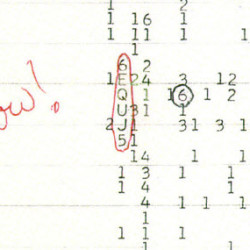
A section of a handwritten sheet music with musical notes and annotations in pencil and red ink.

Was the SETI “Wow!” Signal from Aliens?

Did we actually receive a message from aliens? On August 15, 1977, while working on a SETI (i.e., Search for Extraterrestrial Intelligence) project at the Big Ear radio telescope of The Ohio State University, Dr. Jerry Ehman detected a strong narrow-band radio signal. The signal lasted for 72 seconds, appeared to be non-terrestrial and originating from outside our solar system.

The Big Ear telescope was fixed and used the rotation of the Earth to scan the sky. At the speed of the Earth’s rotation, and given the width of the Big Ear’s observation window, the Big Ear could observe a given point for just 72 seconds. Therefore, a continuous extraterrestrial signal would be expected to register for exactly 72 seconds. The recorded intensity of that signal would show a gradual peaking for the first 36 seconds, as the signal reached the center of Big Ear’s observation window, and then a gradual decrease. This is exactly what was observed.

Amazed at how closely the signal matched the expected signature of an interstellar communication, Dr. Ehman circled the signal on the computer printout and wrote “Wow!” on its side. This comment became the name of the signal.

Unfortunately, SETI has been unable to confirm the signal, but not for lack of trying. The signal was expected to appear three minutes apart in each of Big Ear’s horns, but that did not happen. Dr. Ehman unsuccessfully looked for recurrences of the signal using Big Ear for months after its detection.

In 1987 and 1989, American data analyst, author, and astronomer, Robert H. Gray, searched for the event using the META array at Oak Ridge Observatory, but did not detect it.

In a July 1995 test of signal detection software, SETI League executive director H. Paul Shuch made several drift-scan observations of the Wow! signal’s coordinates with a 12 meter radio telescope at the National Radio Astronomy Observatory, Green Bank WV. No signal was detected.

In 1995 and 1996, Gray searched for the signal using the Very Large Array, which is significantly more sensitive than Big Ear. Again, no signal was detected.

In 1999, Gray and Simon Ellingsen, an Associate Professor in Physics and Radio astronomy at the University of Tasmania, Australia, searched for recurrences of the event using the 26m radio telescope at the University of Tasmania’s Mount Pleasant Radio Observatory. No signal was detected.

Although, SETI was not able confirm the signal, they were able to determine that the initial signal seemed to have originated from the Sagittarius constellation.

The question “Are we alone in the universe?” is a question humankind has been asking for centuries. The “WOW!” signal appears to suggest we may have company.

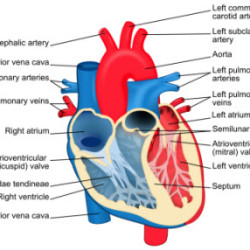
Detailed anatomical diagram of the human heart with labeled parts including atria, ventricles, valves, and major arteries and veins.

Your Heart Beats 2.5 Billion Times during Your Lifetime

Science has discovered that almost all mammals, with the exception of humans, have about the same number of heartbeats in their lifetime, approximately 1 million.

However, humans are outliers in that we get over 2 billion beats. According to Nova (source below), the human heart beats about 100,000 times in one day and about 35 million times in a year. During an average lifetime, the human heart will beat more than 2.5 billion times.

This may seem counter intuitive because when you sleep, your heart rate is slower and when you exercise or become excited, your heart rate is faster. Therefore, based on life style and temperament, you would expect each person to have a different number of heartbeats in their lifetime. According to OMG Facts (source below), you would be wrong. You would also expect different mammals, with different lifespans, to have a different number of heartbeats during their lives. However, this is not the case either.

According to theoretical physicist, Geoffrey West, there exist simple scaling laws relating animal metabolism to body mass. Larger animals live longer, but they metabolize slower, manifested in slower heart rates. Smaller animals live shorter lives, but have heartbeats that are more frequent. For example, animals from rabbits to elephants have lifespans with just about an equal number of heartbeats, approximately one billion.

Therefore, if you equate lifespan to heartbeats, most mammals experience almost the same length of life, with humans being an exception.

The moral of this story is simple. As a human, you have about twice the number of heartbeats of other mammals. Use them wisely.

Sources:


Image: Wikipedia Common


A scientist wearing a lab coat, mask, and gloves operating a laboratory instrument with a blue screen.

3D Printers To Make Human Compatible Replacement Organs

In 1984, Chuck Hull of 3D Systems Corp developed the world’s first working 3D printer. 3D printing, also known as additive manufacturing, is a process of making a three-dimensional solid object of virtually any shape from a digital model. It is called additive manufacturing because 3D printing is achieved using an additive process, where successive layers of material, like such as plastic, ceramics, glass or metal, are laid down in different shapes to manufacture parts.

Today, the market for 3D printers is estimated at 2.2 billion dollars, and companies like Boeing, General Electric and Honeywell are using the printers. Traditionally, 3D printers have been used for both prototyping and manufacturing. Applications include architecture, construction, industrial design, automotive, aerospace, military, engineering, civil engineering, dental and medical industries, fashion, footwear, jewelry, eyewear, education, geographic information systems, food, and new applications are continually surfacing. One new application is in biotech (human tissue replacement).

In 2012, 3D printing technology began to be studied by biotechnology firms and academia. Possible applications include tissue engineering, in which organs and body parts are built by depositing layers of living cells onto a gel medium or sugar matrix and slowly built up to form three-dimensional structures including vascular systems. This field of research is being referred to as organ printing, bioprinting, body part printing, and computer-aided tissue engineering. One such company, Organovo, a San Diego-based company that focuses on regenerative medicine, is using 3D printers to print functional human tissue for medical research and regenerative therapies.

In 2013, Chinese scientists found ways of printing ears, livers and kidneys, with living tissue. Researchers at Hangzhou Dianzi University invented their own 3D printer for the complex task, dubbed the “Regenovo.” Regenovo’s developer, Xu Mingen, said that it takes the printer less than an hour to produce either a mini liver sample or a four to five inch ear cartilage sample. In the same year, researchers at the University of Hasselt, in Belgium, successfully printed a new jawbone for an 83-year-old Belgian woman, who is now able to chew, speak and breathe normally again with her new jawbone.

Eventually, medical researchers predict to be able to use the printed tissue to make organs for organ replacement. However, growing functional organs is still at least 10 years away, said Shaochen Chen, a professor of nano-engineering at the University of California, San Diego, and an expert that uses bioprinting in researching regenerative medicine. Other researchers, like Xu Mingen of Hangzhou Dianzi University, agree. This suggests that growing human compatible functional organs is only one or two decades away.

The image is a picture of Materials Engineer working in an Advanced Manufacture Laboratory with a 3D printing Machine.