All posts by admin

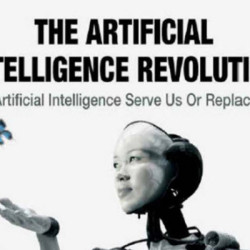
A humanoid robot with an extended hand under the text 'The Artificial Intelligence Revolution' questioning AI's role in serving or replacing humans.

The Artificial Intelligence Revolution – Will Artificial Intelligence Serve Us Or Replace Us?

This post is taken from the introduction of my new book, The Artificial Intelligence Revolution. Enjoy!

This book is a warning. Through this medium I am shouting, “The singularity is coming.” The singularity (as first described by John von Neumann in 1955) represents a point in time when intelligent machines will greatly exceed human intelligence. It is, by way of analogy, the start of World War III. The singularity has the potential to set off an intelligence explosion that can wield devastation far greater than nuclear weapons. The message of this book is simple but critically important. If we do not control the singularity, it is likely to control us. Our best artificial intelligence (AI) researchers and futurists are unable to accurately predict what a postsingularity world may look like. However, almost all AI researchers and futurists agree it will represent a unique point in human evolution. It may be the best step in the evolution of humankind or the last step. As a physicist and futurist, I believe humankind will be better served if we control the singularity, which is why I wrote this book.

Unfortunately the rise of artificial intelligence has been almost imperceptible. Have you noticed the word “smart” being used to describe machines? Often “smart” means “artificial intelligence.” However, few products are being marketed with the phrase “artificial intelligence.” Instead they are simply called “smart.” For example you may have a “smart” phone. It does not just make and answer phone calls. It will keep a calendar of your scheduled appointments, remind you to go to them, and give you turn-by-turn driving directions to get there. If you arrive early, the phone will help you pass the time while you wait. It will play games with you, such as chess, and depending on the level of difficulty you choose, you may win or lose the game. In 2011 Apple introduced a voice-activated personal assistant, Siri, on its latest iPhone and iPad products. You can ask Siri questions, give it commands, and even receive responses. Smartphones appear to increase our productivity as well as enhance our leisure. Right now they are serving us, but all that may change.

The smartphone is an intelligent machine, and AI is at its core. AI is the new scientific frontier, and it is slowly creeping into our lives. We are surrounded by machines with varying degrees of AI, including toasters, coffeemakers, microwave ovens, and late-model automobiles. If you call a major pharmacy to renew a prescription, you likely will never talk with a person. The entire process will occur with the aid of a computer with AI and voice synthesis.

The word “smart” also has found its way into military phrases, such as “smart bombs,” which are satellite-guided weapons such as the Joint Direct Attack Munition (JDAM) and the Joint Standoff Weapon (JSOW). The US military always has had a close symbiotic relationship with computer research and its military applications. In fact the US Air Force, starting in the 1960s, has heavily funded AI research. Today the air force is collaborating with private industry to develop AI systems to improve information management and decision making for its pilots. In late 2012 the science website www.phys.org reported a breakthrough by AI researchers at CarnegieMellonUniversity. Carnegie Mellon researchers, funded by the US Army Research Laboratory, developed an AI surveillance program that can predict what a person “likely” will do in the future by using real-time video surveillance feeds. This is the premise behind the CBS television program Person of Interest.

AI has changed the cultural landscape. Yet the change has been so gradual that we hardly have noticed the major impact it has. Some experts, such as Ray Kurzweil, an American author, inventor, futurist, and the director of engineering at Google, predict that in about fifteen years, the average desktop computer will have a mind of its own, literally. This computer will be your intellectual equal and will even have a unique personality. It will be self-aware. Instead of just asking simple questions about the weather forecast, you may be confiding your deepest concerns to your computer and asking it for advice. It will have migrated from personal assistant to personal friend. You likely will give it a name, much in the same way we name our pets. You will be able to program its personality to have interests similar to your own. It will have face-recognition software, and it will recognize you and call you by name, similar to the computer HAL 9000 in Arthur C. Clarke’s 2001: A Space Odyssey. The conversations between you and your “personal friend” will appear completely normal. Someone in the next room who is not familiar with your voice will not be able to tell which voice belongs to the computer and which voice belongs to you.

By approximately the mid-twenty-first century, Kurzweil predicts, the intelligence of computers will exceed that of humans, and a $1,000 computer will match the processing power of all human brains on Earth. Although, historically, predictions regarding advances in AI have tended to be overly optimistic, all indications are that Kurzweil is on target.

Many philosophical and legal questions will emerge regarding computers with artificial intelligence equal to or greater than that of the human mind (i.e., strong AI). Here are just a few questions we will ask ourselves after strong AI emerges:

  • Are strong-AI machines (SAMs) a new life-form?
  • Should SAMs have rights?
  • Do SAMs pose a threat to humankind?

It is likely that during the latter half of the twenty-first century, SAMs will design new and even more powerful SAMs, with AI capabilities far beyond our ability to comprehend. They will be capable of performing a wide range of tasks, which will displace many jobs at all levels in the work force, from bank tellers to neurosurgeons. New medical devices using AI will help the blind to see and the paralyzed to walk. Amputees will have new prosthetic limbs, with AI plugged directly into their nervous systems and controlled by their minds. The new prosthetic limb not only will replicate the lost limb but also be stronger, more agile, and superior in ways we cannot yet imagine. We will implant computer devices into our brains, expanding human intelligence with AI. Humankind and intelligent machines will begin to merge into a new species: cyborgs. It will happen gradually, and humanity will believe AI is serving us.

Computers with strong AI in the late twenty-first century, however, may see things differently. We may appear to those machines much the same way bees in a beehive appear to us today. We know we need bees to pollinate crops, but we still consider bees insects. We use them in agriculture, and we gather their honey. Although bees are essential to our survival, we do not offer to share our technology with them. If wild bees form a beehive close to our home, we may become concerned and call an exterminator.

Will the SAMs in the latter part of the twenty-first century become concerned about humankind? Our history proves we have not been a peaceful species. We have weapons capable of destroying all of civilization. We squander and waste resources. We pollute the air, rivers, lakes, and oceans. We often apply technology (such as nuclear weapons and computer viruses) without fully understanding the long-term consequences. Will SAMs in the late twenty-first century determine it is time to exterminate humankind or persuade humans to become cyborgs (i.e., humans with brains enhanced by implanted artificial intelligence and potentially having organ and limb replacements from artificially intelligent machines)? Will humans embrace the prospect of becoming cyborgs? Becoming a cyborg offers the opportunity to attain superhuman intelligence and abilities. Disease and wars may be just events stored in our memory banks and no longer pose a threat to cyborgs. As cyborgs we may achieve immortality.

According to David Hoskins’s 2009 article, “The Impact of Technology on Health Delivery and Access” (www.workers.org/2009/us/sickness_1231):

An examination of Centers for Disease Control statistics reveals a steady increase in life expectancy for the U.S. population since the start of the 20th century. In 1900, the average life expectancy at birth was a mere 47 years. By 1950, this had dramatically increased to just over 68 years. As of 2005, life expectancy had increased to almost 78 years.

Hoskins attributes increased life expectancy to advances in medical science and technology over the last century. With the advent of strong AI, life expectancy likely will increase to the point that cyborgs approach immortality. Is this the predestined evolutionary path of humans?

This may sound like a B science-fiction movie, but it is not. The reality of AI becoming equal to that of a human mind is almost at hand. By the latter part of the twenty-first century, the intelligence of SAMs likely will exceed that of humans. The evidence that they may become malevolent exists now, which I discuss later in the book. Attempting to control a computer with strong AI that exceeds current human intelligence by many folds may be a fool’s errand.

Imagine you are a grand master chess player teaching a ten-year-old to play chess. What chance does the ten-year-old have to win the game? We may find ourselves in that scenario at the end of this century. A computer with strong AI will find a way to survive. Perhaps it will convince humans it is in their best interest to become cyborgs. Its logic and persuasive powers may be not only compelling but also irresistible.

Artificial intelligence is an embryonic reality today, but it is improving exponentially. By the end of the twenty-first century, we will have only one question regarding artificial intelligence: Will it serve us or replace us?

Source: The Artificial Intelligence Revolution (2014), Louis A. Del Monte
A glowing plasma globe with electric arcs radiating from the center in purple and blue hues.

Is All Energy Quantized? – Do We Live In A Quantum Universe? – Part 3/3

Lastly, one element of reality remains to complete our argument that all reality consists of quantized energy—energy itself. Is all energy reducible to quantums? All data suggests that energy in any form consists of quantums. We already discussed that mass, space, and time are forms of quantized energy. We know, conclusively, that electromagnetic radiation (light) consists of discrete particles (photons). All experimental data at the quantum level (the level of atoms and subatomic particles) tells us that energy exists as discrete quantums. As we discussed before, the macro level is the sum of all elements at the micro level. Therefore, a strong case can be made that all energy consists of discrete quantums.

If you are willing to accept that all reality (mass, space, time, and energy) is composed of discrete energy quantums, we can argue we live in a Quantum Universe. As a side note, I would like to add that this view of the universe is similar to the assertions of string theory, which posits that all reality consists of a one-dimensional vibrating string of energy. I intentionally chose not to entangle the concept of a Quantum Universe with string theory. If you will pardon the metaphor, string theory is tangled in numerous interpretations and philosophical arguments. No scientific consensus says that string theory is valid, though numerous prominent physicists believe it is. For these reasons, I chose to build the concept of a Quantum Universe separate from string theory, although the two theories appear conceptually compatible.

A Quantum Universe may be a difficult theory to accept. We do not typically experience the universe as being an immense system of discrete packets of energy. Light appears continuous to our senses. Our electric lamp does not appear to flicker each time an electron goes through the wire. The book you are holding to read these words appears solid. We cannot feel the atoms that form book. This makes it difficult to understand that the entire universe consists of quantized energy. Here is a simple framework to think about it. When we watch a motion picture, each frame in the film is slightly different from the last. When we play them at the right speed, about twenty-four frames per second, we see, and our brains process continuous movement. However, is it? No. It appears to be continuous because we cannot see the frame-to-frame changes.

If we have a quantum universe, we should be able to use quantum mechanics to describe it. However, we are unable to apply quantum mechanics beyond the atomic and subatomic level. Even though quantum mechanics is a highly successful theory when applied at the atomic and subatomic level, it simply does not work at the macro level. The macro level is the level we experience every day, and the level in which the observable universe operates. Why are we unable to use quantum mechanics to describe and predict phenomena at the macro level?

Quantum mechanics deals in statistical probabilities. For example, quantum mechanics statistically predicts an electron’s position in an atom. However, macro mechanics (theories like Newtonian mechanics, and the general theory of relativity) are deterministic, and at the macro level provide a single answer for the position of an object. In fact, the two most successful theories in science, quantum mechanics and general relativity, are incompatible. For this reason, Einstein never warmed up to quantum mechanics, saying, [I can’t accept quantum mechanics because] “I like to think the moon is there even if I am not looking at it.” In other words, Einstein wanted the moon’s position to be predictable, and not deal in probabilities of where it might be.

Numerous scientists, including Einstein, argue that the probabilistic aspect of quantum mechanics suggests something is wrong with the theory. Aside from the irrefutable fact that quantum mechanics works, and mathematically predicts reality at the atomic and subatomic level, it is counterintuitive. Is the probabilistic nature of quantum mechanics a proper interpretation? Numerous philosophical answers to this question exist. One of the most interesting is the well-known thought experiment “Schrödinger’s cat,” devised by Austrian physicist Erwin Schrödinger in 1935. It was intended to put an end to the debate by demonstrating the absurdity of quantum mechanic’s probabilistic nature. It goes something like this: Schrödinger proposed a scenario with a cat in a sealed box. The cat’s life or death is depended on its state (this is a thought experiment, so go with the flow). Schrödinger asserts the Copenhagen interpretation, as developed by Niels Bohr, Werner Heisenberg, and others over a three-year period (1924–27), implies that until we open the box, the cat remains both alive and dead (to the universe outside the box). When we open the box, per the Copenhagen interpretation, the cat is alive or dead. It assumes one state or the other. This did not make much sense to Schrödinger, who did not wish to promote the idea of dead-and-alive cats as a serious possibility. As mention above, it went against the grain of Einstein, who disliked quantum mechanics because of the ambiguous statistical nature of the science. Einstein was a determinist as was Schrodinger. He felt that this thought experiment would be a deathblow to the probabilistic interpretation of quantum mechanics, since it illustrates quantum mechanics is counterintuitive. He intended it as a critique of the Copenhagen interpretation (the prevailing orthodoxy in 1935 and today). However, far from ending the debate, physicists use it as a way of illustrating and comparing the particular features, strengths, and weaknesses of each theory (macro mechanics versus quantum mechanics).

Over time, the scientific community had become comfortable with both macro mechanics and quantum mechanics. They appeared to accept that they were dealing with two different and disconnected worlds. Therefore, two different theories were needed. This appeared to them as a fact of reality. However, that view was soon about to change. The scientific community was about to discover but one reality exists. The two worlds, the macro level and the quantum level, were about to become one. This tipping point occurred in 2009-2010.

Before we go into the details, think about the implications and questions this raises.

  • Do macroscopic objects have a particle-wave duality, as assumed by quantum mechanics at the atomic and subatomic level?
  • Can macroscopic objects be modeled using wave equations, like the Schrödinger equation?
  • Will macroscopic reality behave similar to microscopic reality? For example, will it be possible to be in two places at the same time?

To approach an answer, consider what happened in 2009.

Our story starts out with Dr. Markus Aspelmeyer, an Austrian quantum physicist, who performed an experiment in 2009 between a photon and a micromechanical resonator, which is a micromechanical system typically created in an integrated circuit. The micromechanical resonator can resonate, moving up and down much like a plucked guitar string. The intriguing part is Dr. Aspelmeyer was able to establish an interaction between a photon and a micromechanical resonator, creating “strong” coupling. This is a convincing and noticeable interaction. This means he was able to transfer quantum effects to the macroscopic world. This is a first in recorded history: we observed the quantum world in order to communicate with the macro world.

In 2010, Andrew Cleland and John Martinis at the University of California (UC), Santa Barbara, working with Ph.D. student Aaron O’Connell, became the first team to experimentally induce and measure a quantum effect in the motion of a human-made object. They demonstrated that it is possible to achieve quantum entanglement at the macro level. This means that a change in the physical state of one element transmits immediately to the other.

For example, when two particles are quantum mechanically entangled, which means they have interacted and an invisible bond exists between them, changing the physical state of one particle immediately changes the physical state of the other, even when the particles are a significant distance apart. Einstein called quantum entanglement, “spukhafte Fernwirkung,” or “spooky action at a distance.” Therefore, the quantum level and the macro level, given the appropriate physical circumstances, appear to follow the same laws. In this case, they were able to predict the behavior of the object using quantum mechanics. Science and AAAS (the publisher of Science Careers) voted the work, released in March 2010, as the 2010 Breakthrough of the Year, “in recognition of the conceptual ground their experiment breaks, the ingenuity behind it and its many potential applications.”

It appears only one reality exists, even though historically, physical measurements and theories pointed to two. The macro level and quantum level became one reality in the above experiment. It is likely our theories, like quantum mechanics and general relativity, need refinement. Perhaps, we need a new theory that will apply to both the quantum level and the macro level.

This completes our picture of a Quantum Universe. We do not know or understand much. Even though we can make cogent arguments that all reality consists of quantized energy, we do not have consensus on a single theory to describe it. When we examine the micro level, as well as the atomic and subatomic level, we are able to describe and predict behavior using quantum mechanics. However, in general, we are unable to extend quantum mechanics to the macro level, the level we observe the universe in which we live. We ask why, and we do not have an answer. Recent experiments indicate that the micro level (quantum level) influences the macro level. They appear connected. Based on all observations, the macro level appears to be the sum of everything that exists at the micro level. I submit for your consideration that there is one reality, and that reality is a Quantum Universe.

Source: Unraveling the Universe’s Mysteries (2012), Louis A. Del Monte

Image: iStockPhoto.com (licensed)

Are Space and Time Qunatized?

Are Space and Time Quantized? – Do We Live In A Quantum Universe? – Part 2/3

Next, let us consider space. Is space quantized? In previous posts, we discussed the theory that a vacuum, empty space, is like a witch’s cauldron bubbling with virtual particles. This theory dates back to Paul Dirac who, in 1930, postulated a vacuum is filled with electron-positron pairs (Dirac sea). Therefore, most quantum physicists would argue that a vacuum is a sea of virtual matter-antimatter particles. This means, even a vacuum (empty space) consists of quantums of energy.

Other forms of energy are in a vacuum. We will illustrate this with a simple question. Do you believe a true void (empty space) exists somewhere in the universe? We can create an excellent vacuum in the laboratory using a well-designed vacuum chamber hooked to state-of-the-art vacuum pumps. We can go deep into outer space. However, regardless of where we go, is it truly void? In addition to virtual particles in empty space, are the gravitational fields. (Viewing gravity as a field is a classical view of gravity. As discussed previously, gravity may mediate via a particle, termed the graviton. For the sake of simplicity, I will use classical phasing, and view gravity as a field.) The gravitational fields would be present in the vacuum chamber, and present even deep in space. Even if the vacuum chamber itself were deep in space, gravitational fields would be present within the chamber. Part of the gravitational field would come from the chamber itself. The rest of the gravitational field would come from the universe. The universe is made up of all types of matter, and the matter radiates a gravitational field infinitely into space. Everything pulls on everything in the universe. The adage, “Nature abhors a vacuum,” should read, “Nature abhors a void.” Voids do not exist in nature. Within each void is a form of energy. Even if it were possible to remove every particle, the void would contain virtual particles and gravitational fields. As said before, we have not found the graviton, the hypothetical massless particle that mediates gravity, but if you are willing to accept its existence, it is possible to argue that empty space consists of quantums of energy. It bubbles with virtual particles and gravitons.

We can posit another argument that space, itself, is quantized. We will start by asking a question. Is there an irreducible dimension to space similar to the irreducible elements of matter? The short answer is yes. It is the Planck length. We can define the Planck using three fundamental physical constants of the universe, namely the speed of light in a vacuum (c), Planck’s constant (h), and the gravitational constant (G). The scientific community views the Planck length as a fundamental of nature. It is approximately equal to 10-36 meters (10-36 is a one divided by a one with thirty-six zeros  after it), smaller than anything we can measure. Physicists debate its meaning, and it remains an active area of theoretical research. Recent scientific thinking is that it is about the length of a “string” in string theory. Quantum physicists argue, based on the Heisenberg uncertainty principle, it is the smallest dimension of length that can theoretically exist.

Does all this argue that space consists of quantized energy? To my mind, it does.

  • First, it contains quantized matter-antimatter particles (Dirac sea).
  • Second, it contains gravitons (the hypothetical particle of gravity).
  • Third, and lastly, space has an irreducible dimension; a finite length termed the Planck length.

Thus far, we have made convincing arguments that mass and space consist of quantized energy. Next, let’s turn our attention to time. In previous posts, we discussed Planck time (~ 10-43 seconds, which is a one divided by a one with forty-three zero after it). As stated in those posts, theoretically, Planck time is the smallest time frame we will ever be able to measure. In addition, Planck time, similar to the Planck length, is a fundamental feature of reality. We can define Plank time using the fundamental constants of the universe, similar to the methodology to define the Planck length. According to the laws of physics, we would be unable to measure “change” if the time interval were shorter that a Planck interval. In other words, the Planck interval is the shortest interval we humans are able to measure or even comprehend change to occur. This is compelling evidence that time, itself, may consist of quantums, with each quantum equal to a Planck interval. However, this does not make the case that time is quantized energy. To make that case, we will need to revisit the Existence Equation Conjecture discussed in previous posts:

KEX4 = -.3mc2

Where KEX4is the energy associated with an object’s movement in time, m is mass and c is the speed of light in a vacuum.

The Existence Equation Conjecture implies that movement in time (or existence) requires negative energy. The equation, itself, relates energy to the mass (m) that is moving in time. However, in the last post (Part 1) we argued that all mass is reducible to elementary particles, which ultimately are equivalent to discrete packets of energy via Einstein’s mass-energy equivalence equation (E=mc2). This suggests the Existence Equation Conjecture implies that movement in time embodies a quantized energy element. Therefore, if we combine our concept of the Planck interval with the quantized energy nature of time implied by the Existence Equation Conjecture, we can argue that time is a form of quantized energy.

Source: Unraveling the Universe’s Mysteries (2012), Louis A. Del Monte

Image: iStockphoto (licensed)

Nature of Light

Do We Live In A Quantum Universe? – Part 1/3

The notion that all reality (mass, space, time, and energy) consists of discrete energy quantums is counterintuitive. For example, an electric current consists of individual electrons flowing in a wire. However, you do not notice your television flickering as the electrons move through the circuits. The light you read by consists of individual photons. Yet, your eyes do not sense individual photons reflected from the page. The point is that our senses perceive reality as a continuum, but this perception is an illusion. In the following, we will examine each element of reality one by one to understand its true nature. In this post, “Do We Live In A Quantum Universe? – Part 1/3,” we will start by exploring the qunatized nature of mass.

Mass—the sum of all its atoms.

We will start with mass. Any mass is nothing more than the sum of all its atoms. The atoms themselves consist of subatomic particles like electrons, protons, and neutrons, which consist of even more elementary particles, like quarks. (Quarks are considered the most elementary particles. I will not describe the six different types of quarks in detail, since it will unnecessary complicate this discussion.) The point is any mass reduces to atoms, which further reduces to subatomic particles. The atom is a symphony of these particles, embodying the fundamental forces (strong nuclear, weak nuclear, electromagnet, and gravity). Does all this consist of energy quantums? In the final analysis, it appears it does, including the fundamental forces themselves. How can this be true?

In the early part of the Twentieth Century, the theory of quantum mechanics was developed. It is able to predict and explain phenomena at the atomic and subatomic level, and generally views matter and energy as quantized (discrete particles or packets of energy). Quantum mechanics is one of modern science’s most successful theories. At the macro level, which is our everyday world, any mass is conceivably reducible to atoms, subatomic particles, and fundamental forces.

Science holds that the fundamental forces (strong nuclear, weak nuclear, electromagnet, and gravity) mediate (interact) via particles. For example, the electromagnetic force mediates via photons. We have verified the particle for all the fundamental forces, except gravity. A number of theoretical physicists believe a particle is associated with gravity, namely the graviton. The graviton is a hypothetical elementary massless particle that theoretical physicists believe is responsible for the effects of gravity. The problem is that all efforts to find the graviton have failed. This is an active area of research, and work continues to find the graviton, and to develop a quantum gravity theory. If we assume gravity mediates through a particle, the case is easily made via Einstein’s mass-energy equivalence equations (E = mc2) that all mass, as well as the fundamental forces, reduces to energy quantums.

Although, we are unable to prove conclusively that all masses, including the fundamental forces, consists of discrete energy packets, numerous scientists believe they are. This realization caused Albert Einstein great distress. He wrote in 1954, one year prior to his death, “I consider it quite possible that physics cannot be based on the field concept, i.e., on continuous structures. In that case, nothing remains of my entire castle in the air, gravitation theory included, [and of] the rest of modern physics.” Einstein, who grew up in the world of classical physics, was a product of his time. Classical physics utilizes the concept of fields to explain physical behavior. The fields of classical physics are a type of invisible force that influences physical behavior. For example, classical physics explains the repulsion of two positively charged particles due to an invisible repulsive field between them. Modern physics explains this repulsion due to the mediation of photons, which act as force carriers. The main point is that mass and the fundamental forces are ultimately reducible to discrete elements, which equate to discrete packets of energy (quantums).

In the next post, “Do We Live In A Quantum Universe? – Part 2/3,” we will explore the nature of space. We will address the question: Is space quantized?

Source: Unraveling the Universe’s Mysteries (2013), Louis A. Del Monte

Image: iStockPhoto (licensed)

Abstract digital art featuring a radiant white light at the center surrounded by intricate geometric patterns and electric green lines.

The Mysterious Nature of Energy

We scientists talk about energy, and derive equations with energy mathematically expressed in the equation as though we understand energy. The fact is: we do not. It is an indirectly observed quantity. We infer its existence. For example, in physics, we define energy as the ability of a physical system to do work on another physical system. Physics is one context that uses and defines the word energy. However, the word energy has different meanings in different contexts. Even the average person throws the term energy around in phrases like, “I don’t have any energy today,” generally inferring a lack of vigor, force, potency, zeal, push, and the like. The word energy finds its way into both the scientific community and our everyday communications, but the true essence of energy remains an enigma.

The concept of energy is an old concept. It comes from the ancient Greek word, “enérgeia,” which translates “activity or operation.” As previously stated, we do not know the exact essence of energy, but we know a great deal about the effects of energy. To approach a better understanding, consider these four fundamental properties of energy:

1. Energy is transferable from one system to another.

Transferring mass between systems results in a transfer of energy between systems. Mass and energy have been inseparably equated, since 1905, via Einstein’s famous mass–energy equivalence equation, E = mc2, where E is energy, m is mass, and c is the speed of light in a vacuum. This equation is widely held as a scientific fact. Experimental results over the last century strongly validate it. Typically, mass transfers between systems occur at the atomic level as atoms capture subatomic particles or bond to form products of different masses.

Non-matter transfer of energy is possible. For example, a system can transfer energy to another by thermal radiation (heat). The system that absorbs the thermal radiation experiences an increase in energy, typically measured by its temperature. This is how the radiators in a house raise the room temperature. Here is another example: If an object in motion strikes another object, a transfer of kinetic energy results. Consider billiard balls. When one ball strikes another, it imparts kinetic energy to the ball it strikes, causing it to move.

2.  Energy may be stored in systems.

If you pick up a rock from the ground and hold it at shoulder height, you have stored energy between the rock and ground via the gravitation attraction created between the Earth and rock. You may consider this potential energy. When you open your hand, the rock will fall back to the ground. Why? The answer is straightforward. It required your energy to hold the rock in its new position at shoulder height. As soon as you, by opening your hand, released the energy that you were providing, it reduced to a lower energy state when the gravitational field pulled the rock back to the ground.

Any type of energy that is stored is “potential energy,” and all types of potential energy appear as system mass. For example, a compressed metal spring will be slightly more massive than before it was compressed. When you compress the spring, you do work on the system. The work on the system is energy, and that energy is stored in the compressed spring as potential energy. Because of this stored potential energy, the spring becomes more massive.

3. Energy is not only transferable–it is transformable from one form to another.

Our example regarding the rock falling back to the ground is an example of energy transformation. The potential energy was transformed to kinetic energy when you opened your hand and released the rock. This is what caused the rock to fall back to the ground. Here is an industrial example. Hydroelectric plants generate electricity by using water that flows over a falls due to gravity. In effect, they are transforming the falling water (gravitational energy) into another form of energy (electricity).

4. Energy is conserved.

This is arguably the most sacred law in physics. Simply stated: Energy cannot be created or destroyed in an isolated system. The word “isolated” implies the system does not allow other systems to interact with it. A thermos bottle is an example of an isolated system. It is preventing the ambient temperature from changing the temperature inside the thermos. For example, it keeps your coffee hot for a long time. Obviously, it is not a perfectly isolated system since eventually it will lose heat to the atmosphere, and your coffee will cool to the ambient temperature that surrounds the thermos bottle. For example, in your house, the coffee in a cup will cool to room temperature.

In summary, energy may be transferred, stored, and transformed, but it cannot be created or destroyed in an isolated system. This means the total energy of an isolated system does not change.

Next, we will consider energy in different contexts. Unfortunately, since we do not know the true essence of energy, we need to describe it via the effects we observe in the context that we observe them. Here are two contexts:

1)   Cosmology and Astronomy

Stars, nova, supernova, quasar, and gamma-ray bursts are the highest-output mass into energy transformations in the universe. For example, a star is typically a large and massive celestial body, primarily composed of hydrogen. Due to its size, gravity at the star’s core is immense. The immense gravity causes the hydrogen atoms to fuse together to form helium, which causes a nuclear reaction to occur. The nuclear reaction, in effect, transforms mass into energy. In the cosmos, mass-to-energy transformations are due to gravity, and follow Einstein famous equation, E = mc2 (discussed previously). The gravity can result in nuclear fusion, as described in the above example. It can cause a dying star to collapse and form a black hole.

2) Chemistry

Energy is an attribute of the atomic or molecular structure of a substance. For example, an atom or molecule has mass. From Einstein’s mass-energy equivalence equation, (E = mc2), we know the mass equates to energy. In chemistry, an energy transformation is a chemical reaction. The chemical reaction typically results in a structural change of the substance, accompanied by a change in energy. For example, when two hydrogen atoms bond with one oxygen atom, to form a water molecule, energy emits in the form of light.

Other scientific contexts give meaning to the word energy. Two examples are biology and geology. Numerous forms of energy are accepted by the scientific community. The various forms include thermal energy, chemical energy, electric energy, radiant energy, nuclear energy, magnetic energy, elastic energy, sound energy, mechanical energy, luminous energy, and mass. I will not go into each form and context for the sake of brevity. My intent is to illustrate that the word energy in science must be understood within a specific context and form.

As mentioned above, we truly do not know the essence of energy; we infer its existence by its effects. The effects we measure often involve utilizing fundamental concepts of science, such as mass, distance, radiation, temperature, time, and electric charge. Adding to ambiguity, energy is often confused with power. Although we often equate “power” and “energy” in our everyday conversation, scientifically they are not the same. Strictly speaking, in science, power is the rate at which energy is transferred, used, or transformed. For example, a 100-watt light bulb transforms more electricity into light than a 60-watt light bulb. In this example, the electricity is the energy source. Its rate of use in the light bulbs is power. It takes more power to run a 100-watt bulb than a 60-watt bulb. Your electric bill will verify this is true.

What is it about energy that makes it mysterious? Science does not understand the nature of energy. We have learned a great deal about energy in the last century. The word energy has found its way into numerous scientific contexts as well as into our everyday vernacular, but we do not know the fundamental essence of energy. We can infer it exists. Its existence and definition is context sensitive. We do not have any instrument to measure energy directly, independent of the context. Yet, in the last century, we have learned to harness energy in various forms. We use electrical energy to power numerous everyday items, such as computers and televisions. We have learned to unleash the energy of the atom in nuclear reactors to power, for example, cities and submarines. We have come a long way, but the fundamental essence of energy remains an enigma.

In the next post, we will discuss another aspect of energy that haunts the scientific community. Does all reality consist of discrete packets (quantums) of energy? Are mass, space, time, and energy composed of quantized energy? We can make a reasonably strong case that they are. It is counterintuitive because we do not experience reality that way. For example, when you pick up a rock, you do not directly experience the atoms that make up the rock. However, the rock is nothing more than the sum of all its atoms. If all reality is made of quantized energy, we live in a Quantum Universe. What exactly is a Quantum Universe? Stay tuned, and we will explore what a Quantum Universe is in the next post.

Source: Unraveling the Universe’s Mysteries (20120, Louis A. Del Monte