All posts by admin

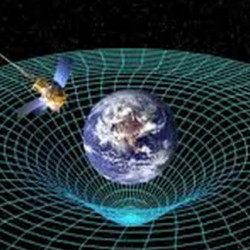
Visualization of Earth's gravity warping spacetime with a satellite orbiting around it.

What Causes Gravity?

It may be hard to believe that the cause of gravity continues to remain one of the great mysteries of science, even to this day. This article will briefly explore our understanding of gravity.

We are all familiar with the effects of gravity. The story of Newton being hit on the head by an apple leading to his discovery of gravity is often taught to school children. In short, gravity is a natural phenomenon by which all physical bodies attract each other. For example, the Earth attracts you and keeps you grounded. When you weigh yourself, you are actually measuring the effect gravity has on your body. Although this seems obvious, science still continues to debate what causes gravity.

In 1687, English mathematician Sir Isaac Newton published Principia and wrote, “ “I deduced that the forces which keep the planets in their orbs must [be] reciprocally as the squares of their distances from the centers about which they revolve: and thereby compared the force requisite to keep the Moon in her Orb with the force of gravity at the surface of the Earth; and found them answer pretty nearly.” This became known as Newton’s inverse square law of gravity. Although Newton was unable to define the exact nature of the gravitational force, Newton’s law of universal gravitation became widely accepted right up to the beginning of the 20th century. It is often taught in high school science classes and for most applications is a good approximation regarding the behavior of gravity.

In 1915, Einstein published his theory of gravity within the framework of his now famous theory of general relativity. According to general relativity, the effects of gravitation are caused by a spacetime curvature and not a force, as Newton had asserted.  Einstein’s theory of general relativity was able to successfully account for several effects that were unexplained by Newton’s law, such as the anomalies in the orbits of Mercury. Einstein’s theory of general relativity proposed that spacetime is curved by matter, and that free-falling objects are moving along locally straight paths, called geodesics, in curved spacetime. A simple way to think about this is to think about a drum. Now think about pushing down in the center of the drum. This would cause the entire surface of the drum to become concave (i.e., curve inward). If you drop a marble on the drum, it will fall to the center due to the inward curvature of the drum’s surface. Although Einstein general theory of relativity is now a corner stone of modern physics, especially astrophysics, it still did not explain fundamentally why or how matter curves space, which still left the nature of gravitation a mystery. On a side note, while general relativity predicted numerous phenomena, such as  gravitational lensing (i.e., the bending of light by a large mass) and an effect of gravity on time known as gravitational time dilation (i.e., the slowing down of “clock” in a strong gravitational field), it was incompatible with the highly successful theory of quantum mechanics, which describes the behavior of atoms and subatomic particles.

Where does all this leave us? Currently, there is no widely accepted theory on the fundamental nature of gravity. However, there is no lack of proposed theories. The one that appears to have the most support is string theory. M-theory is the most comprehensive formulation of string theory. In general, M-theory asserts that the fundamental building blocks of all matter can be reduced to infinitely small building blocks of vibrating energy, having only the dimension of length, termed “stings.” Conceptually, the “strings” vibrate in multiple dimensions. The vibration of the string determines whether it appears as matter or energy. According to string theory, every form of matter or energy is the result of the string’s vibration. In addition, M-theory predicts there are eleven dimensions, ten spacial and one temporal, as opposed to the four dimensions implicitly predicted by relativity and quantum mechanics. One of the attractions of string theory is that it fundamentally explains gravity. At this point, you might think we have finally reached a conclusion regarding the nature of gravity, but there are problems. There is no scientific consensus that M-theory correctly describes reality. Its detractors, such as Richard Feynman, Roger Penrose and Sheldon Lee Glashow, have criticized M-theory for not providing experimental predictions at accessible energy scales. In essence, science has been unable to verify M-theory experimentally.

While scientists understand how gravity acts, they do not understand why it exists. For example, why are atoms mostly empty space, instead of being pulled into a solid mass by gravity? Why is the force that holds atoms together different from gravity? Modern physics holds that the gravitational force is mediated by a massless particle called the graviton, which is postulated to travel at the speed of light. However, there is no experimental evidence that the graviton exists. In essence, the effects of gravity have been known for thousands of years, likely by the earliest humans. Laws describing the behavior of gravity have been known for hundreds of years. The exact nature of gravity continues to be controversial. 

A bright sun shining through clouds at the end of a wooden bridge with railings extending into the sky.

Can Science Prove God Exists?

Is it possible to prove or disprove the existence of God using the natural sciences? This article will examine the evidence, not to prove or disprove God exists, but to address whether it is possible to prove or disprove God exists.

First, we need to start with a definition of God. God means different things to different people, cultures, and civilizations. We likely could fill hundreds of pages, and still not cover all the potential definitions. Therefore, in the interest of brevity and focus, we will not concentrate on the beliefs of any one religion, but rather on the general themes regarding the nature of God that weaves through numerous religions. For this reason, it would be better to not use the word God, since it is often associated with monotheism (one God), but rather the word “deity,” which encompasses polytheism (multiple Gods). The question becomes, what is the nature of a deity? Five key attributes of a deity are found in numerous religions throughout the world:

  1. It is an eternal, divinely simple (no parts), supernatural being (omnipreternatural).
  2. It knows all (omniscience).
  3. Its power is unlimited (omnipotence).
  4. It is everywhere (omnipresence).
  5. It is all good (omnibenevolence).

If we attempt to go beyond the five attributes described above, we inevitably get into specific religions. However, the five attributes are sufficient to make one pivotal point, namely that a deity is supernatural. What would this imply? It implies that a deity is beyond the realm of nature (physical reality). Therefore, any experiments we do in the physical world will give us physical data, not supernatural data. This is a critical point; it implies that scientific proof of the existence of a supernatural being is impossible. The reverse is true. It implies it is impossible to disprove the existence of a supernatural being. We could stop here because the objective was to answer the question: is it possible to prove or disprove the existence of God using the natural sciences? If you assume God is supernatural, item 1, using the natural sciences to prove or disprove God’s existence would appear futile.

Unfortunately, I think most scientists and lay people that attempt to prove or disprove the existence of God really don’t get this crucial point, but use natural evidence to make inferences. Let me frame the debate. From a historical broad-brush perspective, it comes down to two main camps:

  1. Evolutionism—asserts we are here because of evolution, not divine intervention. In a modern context, the evolution is viewed to have started with the Big Bang itself. This school has also been termed “Darwinian evolution” and “scientism.”
  2. Creationism—asserts we are here because of divine intervention, referred to as “intelligent design.” In a modern context, the Big Bang was “God’s” chosen method to create our universe, which ultimately resulted in our existence.

Although, both camps make excellent points, and may people are convinced by their logic, they are not strictly scientific proof. Is not possible to prove the existence of a supernatural being (i.e., a being outside the natural laws) using natural laws (i.e., science)? In the end, I judge it comes down to belief, not science. What do you believe?

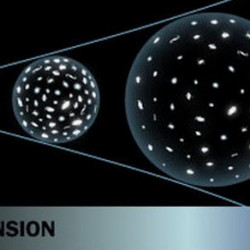
Illustration of cosmic expansion showing galaxies spreading apart over time in the universe.

How Is the Universe Going to End?

At the begging of the Twentieth Century, almost every scientist believed the universe was eternal. That is to say, the universe always was and always will be—it is static. In the context of an eternal universe, questions about a beginning or an ending are meaningless. By definition, an eternal universe has no beginning, and it will have no ending. This is what they taught our grandparents as schoolchildren. Overall, the eternal universe found acceptance in both science and religion. Science proclaimed that the universe simply existed, with no evidence to the contrary. Religious leaders simply proclaimed God made the universe, which seems to imply the universe had a beginning. However, since science had no evidence to the contrary, science and religion did not butt heads over this. At the turn of the Twentieth Century, science and religion appeared content with their assertions of the universe. Poetically, you might say all was well in heaven and on Earth.

A little over eighty years ago, our cosmic bubble of an eternal universe was shattered. In 1929, Edwin Hubble,  using the 100-inch Hooker telescope at the Mount Wilson Observatory, discovered that extremely distant galaxies are moving away from us. Indeed, he discovered the farther away the galaxy, the higher the apparent velocity it is moving away from us. Therefore, a galaxy twice as far from us is moving away at twice the speed of a galaxy half the distance from us. Hubble noted that the universe was expanding in all directions. This was a profound discovery that caught the greatest scientific minds of the time, including Einstein, off guard. Prior to Hubble’s discovery, the prevalent theory held by the scientific community was that the universe was in a steady state, not expanding or contracting. Even though, the evidence was mounting before Hubble conclusively proved the universe was expanding, most scientists held strongly to their paradigm of a steady-state universe.

Surprisingly, Hubble was not the first to discover the universe was expanding. In 1912, Vesto Slipher measured the first Doppler shift (the length of a light wave) of spiral galaxies, and discovered that almost all spiral galaxies were receding from Earth. Unfortunately, not much attention was paid to Slipher’s findings. Slipher himself did not understand the implications of his discovery. In addition, telescopes in 1912 were relatively poor quality, and the nature of what he was measuring was not clearly understood as spiral galaxies. In fact, the term that was used to describe spiral galaxies in 1912 was “spiral nebula” (an indistinct bright patch).

Einstein’s equations of general relativity also predicted the universe was expanding. However, Einstein was convinced that this prediction was wrong and modified the equations by adding the “cosmological constant.” With this newly added mathematical expression, the equations of general relativity predicted a static universe. Later, though, as the evidence that the universe was expanding become incontrovertible, Einstein labeled his “cosmological constant” his greatest blunder. in fact, Starting with Hubble’s discovery of an expanding universe in 1929, within thirty-five years, most of the scientific community did a complete reversal, turning their backs on a static universe and now embracing an expanding universe.

As scientists began to think about an expanding universe, they reasoned that eventually gravity would play into the equation, halt the expansion, and even reverse it. In other words, up to 2008, mainstream science believed that the expansion of the universe would eventually be slowed by gravity, then halted, and gravity would pull everything back together in what science termed a “Big Crunch.” However, when the expansion of the universe was measured in 1998, by Saul Perlmutter, Brian P. Schmidt, and Adam G. Riess, a startling discovery was made. The expansion was not slowing down. It was accelerating. Gravity did not appear to be playing a prominent role. In fact, a new and unknown force, termed “dark energy,” seemed to be in charge. This new force, dark energy, is still a mystery.

You may wonder at this point, what this all have to do with how the universe will end? Based on all known data, the accelerated expansion of the universe implies that eventually all galaxies will move away from us to the point they are beyond our cosmological horizon. We will no longer be able to see them. The Milky Way galaxy, the galaxy that is home to our planet Earth, will be completely alone. Eventually, all stars in the Milky Way galaxy, including our Sun, will exhaust their fuel and burn out. The Earth, itself, will be long gone by by the time the galaxy grows completely dim. Our Sun will eventually burn out in approximately five billion years. How long will it take for the Milky Way galaxy to to simply be reduced to cold remnants of rubble and dust? No one really knows. Most scientists agree it will take many billions of years, but no one knows the exact number of billions. Some theories calculate the end of the universe, but they hold little sway in mainstream science. All we know is that the universe is 13.8 billion years old, which suggests change on a cosmological scale moves slowly. The end is likely many billions of years in the future, but there is little doubt the universe will end and any remnants material, without stars to provide warmth, will be close or equal to absolute zero temperature. This may all sound like a grade B disaster movie. However, unlike many grade B disaster movies, this is real and doe not have a happy ending.

Close-up of an ornate astronomical clock with zodiac signs and intricate golden details.

Is Time Travel Possible?

Few topics in science capture the imagination like time travel. Science fiction, like H. G. Wells’ classic novel, The Time Machine, published in 1895, and science fact, like time dilation, continues to fuel interest in time travel. Let us start with the most important question: Is time travel possible?

Of course, time travel is possible. We are already doing it. At this point, I know my answer may come across a bit flippant. However, my answer has a kernel of truth. We are traveling in time. We continually travel from the present to the future. This is what philosophers refer to as the arrow of time. In our everyday experience, it moves in one direction, from the present to the future. I think, though, on a more serious note, what people want to know is can we travel back in time—or to a future date in time.

In theory, it is possible. Indeed, numerous solutions to Einstein’s special and general relativity equations predict time travel is possible. In general, no law of physics prohibits time travel. We will begin by considering two methods science proposes to travel in time .

Method 1: Time Travel to the Future – Faster-than-light (FTL)

Using faster than light or near the speed of light, time travel appears to offer methodologies grounded in science fact. Consider two examples:

1) Assume you build a spaceship capable of traveling near the speed of light. With such a spaceship, you literally can travel into the future. This may sound like science fiction, but it is widely accepted as scientific fact. Particle accelerators confirm it. We discussed it when we discussed time dilation and the twin paradox. All you need is the spaceship, and an enormous amount of energy to accelerate it near the speed of light. However, this is an enormous problem. From Einstein’s special theory of relativity, we know that as we begin to accelerate a mass close to the speed of light, it becomes more massive, and approaches infinity. Thus, to accelerate it close to the speed of light, we need an energy source that approaches infinity. Perhaps we would have to learn how to harness the energy of a star, or routinely create matter-antimatter annihilations to create energy. Today’s science is nowhere near that level of sophistication.

2) Assume you can move information (like a signal) faster than light. Theoretically, if we could send a signal from point A to point B faster than the speed of light, it would represent a form of time travel. However, a significant paradox occurs. Here is an example.
An observer A in an inertial frame A sends a signal to an observer B in an inertial frame B. When B receives the signal, B replies and sends a signal back to A faster than the speed of light. Observer A receives the reply before sending the first signal.

In 1907, Albert Einstein described this paradox in a thought experiment to demonstrate that faster-than-light communications can violate causality (the effect occurs before the cause). Albert Einstein and Arnold Sommerfeld in 1910 described a thought experiment using a faster-than-light telegraph to send a signal back in time. In 1910, no faster-than-light signal communication device existed. It still does not exist, but the possibility of its development is increasing. From quantum physics, it appears that certain quantum effects “transmit” instantaneously and, therefore, appear to transmit faster than the speed of light in empty space. One example of this is the quantum states of two “entangled” particles (particles that have physically interacted, and later separated). In quantum physics, the quantum state is the set of mathematical variables that fully describes the physical aspects of a particle at the atomic level. When two particles interact with each other, they appear to form an invisible bond between them. When this happens, they become “entangled.” If we take one of the particles, and separate it from the other, they remain entangled (invisibly connected). If we change the atomic state of one of the entangled particles, the other particle instantaneously changes its state to maintain quantum-state harmony with the other entangled particle. Significant experimental evidence indicates that separated entangled particles can instantaneously transmit information to each other over distances that suggest the information exchange exceeds the speed of light. Initially, scientists criticized the theory of particle entanglement. After its experimental verification, science recognizes entanglement as a valid, fundamental feature of quantum mechanics. Today the focus of the research has changed to utilize its properties as a resource for communication and computation.

Method 2: Time Travel to the Past – Using Wormholes

Scientists have proposed using “wormholes” as a time machine. A wormhole is a theoretical entity in which space-time curvature connects two distant locations (or times). Although we do not have any concrete evidence that wormholes exist, we can infer their existence from Einstein’s general theory of relativity. However, we need more than a wormhole. We need a traversable wormhole. A traversable wormhole is exactly what the name implies. We can move through or send information through it.

If you would like to visualize what a wormhole does, imagine having a piece of paper whose two-dimensional surface represents four-dimensional space-time. Imagine folding the paper so that two points on the surface are connected. I understand that this is a highly simplified representation. In reality, we cannot visualize an actual wormhole. It might even exist in more than four dimensions.

How do we create a traversable wormhole? No one knows, but most scientists believe it would require enormous negative energy. A number of scientists believe the creation of negative energy is possible, based on the study of virtual particles and the Casimir effect.

Assuming we learn how to create a traversable wormhole, how would we use it to travel in time? The traversable wormhole theoretically connects two points in space-time, which implies we could use it to travel in time, as well as space. However, according to the theory of general relativity, it would not be possible to go back in time prior to the creation of the traversable wormhole. This is how physicists like Stephen Hawking explain why we do not see visitors from the future. The reason: the traversable wormhole does not exist yet.

Hard as it may be to believe, most of the scientific community acknowledges that time travel is theoretically possible. If fact, time dilation of subatomic particles provides experimental evidence that time travel to the future is possible, at least for subatomic particle accelerated close to the speed of light. Real science is sometimes stranger than fiction. What do you believe?


A white military drone equipped with missiles flying against a clear sky.

The Robot Wars Are Coming

When I say “the robot wars are coming,” I am referring to the increase in the US Department of Deference’s use of robotic systems and artificial intelligence in warfare.

Recently, September 12, 2014, the US Department of Defense released a report, DTP 106: Policy Challenges of Accelerating Technological Change: Security Policy and Strategy Implications of Parallel Scientific Revolutions. Its authors, James Kadtke and Linton Wells II, delineate the potential benefits and concerns of Robotics, Artificial Intelligence and associated technologies, as they relate to the future of warfare, stating: “This paper examines policy, legal, ethical, and strategy implications for national security of the accelerating science, technology, and engineering (ST&E) revolutions underway in five broad areas: biology, robotics, information, nanotechnology, and energy (BRINE), with a particular emphasis on how they are interacting. The paper considers the time frame between now and 2030 but emphasizes policy and related choices that need to be made in the next few years.” Their  conclusions were shocking:

  • They express concerns about maintaining the US Department of Defense’s present technological preeminence, as other nations and companies in the private sector take the lead in developing robotics, AI and human augmentation such as exoskeletons.
  • They warn that “The loss of domestic manufacturing capability for cutting-edge technologies means the United States may increasingly need to rely on foreign sources for advanced weapons systems and other critical components, potentially creating serious dependencies. Global supply chain vulnerabilities are already a significant concern, for example, from potential embedded “kill switches,” and these are likely to worsen.”
  • The most critical concern they express, in my view, is “In the longer term, fully robotic soldiers may be developed and deployed, particularly by wealthier countries, although the political and social ramifications of such systems will likely be significant. One negative aspect of these trends, however, lies in the risks that are possible due to unforeseen vulnerabilities that may arise from the large scale deployment of smar automated systems, for which there is little practical experience. An emerging risk is the ability of small scale or terrorist groups to design and build functionally capable unmanned systems which could perform a variety of hostile missions.”

It becomes obvious by reading this report and numerous similar reports, that the face of warfare is rapidly changing. It’s hard to believe we’ve come to this point, if you consider that 15 years ago Facebook and Twitter did not exist and Google was just getting started. However, even 15 years ago, drones played a critical role in warfare. For example, it was a Predator mission that located Osama bin Laden in Afghanistan in 2000. While drones were used as early as World War II for surveillance, it wasn’t until 2001 that missile-equipped drones were completed with the deployment of Predators drones, armed with Hellfire missiles. Today, one in every three fighter planes is a drone. How significant is this change? According to Richard Pildes, a professor of constitutional law at New York University’s School of Law, “Drones are the most discriminating use of force that has ever been developed. The key principles of the laws of war are necessity, distinction and proportionality in the use of force. Drone attacks and targeted killings serve these principles better than any use of force that can be imagined.”

Where is this all headed? Within the near future, the US military will deploy completely autonomy “Kill Bots.” There are robots that are programmed to engage and destroy the enemy without human oversight or control. Science fiction? No! According a 2014 media release from officials at the Office of Naval Research (ONR), a technological breakthrough will allow any unmanned surface vehicle (USV) to not only protect Navy ships, but also, for the first time, autonomously “swarm” offensively on hostile vessels. In my opinion, autonomous Predator drones are likely either being developed or have been developed, but the information remains classified.

Artificial intelligence and robotic systems are definitely changing the face of warfare. Within a decade, I judge, based on the current trends, that about half of the offensive capability of the US Department of Deference will consist of Kill Bots in one form or another, and a large percentage of them will be autonomous.

This suggest two things to me regarding the future of warfare:

  1. Offensively fighting wars will become more palatable to the US public because machines, not humans, will perform the lion’s share of the most dangerous missions.
  2. US adversaries are also likely to use Kill Bots against us, as adversarial nations develop similar technology.

This has prompted a potential United Nations moratorium on autonomous weapons systems. To quote the US DOD report DTP 106, “Perhaps the most serious issue is the possibility of robotic systems that can autonomously decide when to take human life. The specter of Kill Bots waging war without human guidance or intervention has already sparked significant political backlash, including a potential United Nations moratorium on autonomous weapons systems. This issue is particularly serious when one considers that in the future, many countries may have the ability to manufacture, relatively cheaply, whole armies of Kill Bots that could autonomously wage war. This is a realistic possibility because today a great deal of cutting-edge research on robotics and autonomous systems is done outside the United States, and much of it is occurring in the private sector, including DIY robotics communities. The prospect of swarming autonomous systems represents a challenge for nearly all current weapon systems.”

There is no doubt that the robot wars are coming. The real question is: Will humanity survive the robot wars?