Monthly Archives: December 2014

Nature of Light

Can Anything Travel Faster Than the Speed of Light?

Can anything travel faster than the speed of light? To answer this question, let us understand the nature of light. Here are three salient facts about light:

1. First, light can exhibit both the properties of a wave and a particle. For all of the Nineteenth Century, and for the early part of the Twentieth Century, most scientists considered light “a wave,” and most of the experimental data supported that “theory.” However, classical physics could not explain black-body radiation (the emission of light due to an object’s heat). A light bulb is a perfect example of black-body radiation. The wave theory of light failed to describe the energy (frequency) of light emitted from a black body. The energy of light is directly proportional to its frequency. To understand the concept of frequency, consider the number of ocean waves that reach the shore in a given length of time. The number of ocean waves than reach the shore, divided by the length of time you measure them, is their frequency. If we consider the wave nature of light, the higher the frequency, the higher the energy.

In 1900, Max Planck hypothesized that the energy (frequency) of light emitted by the black body, depended on the temperature of the black body. When the black body was heated to a given temperature, it emitted a “quantum” of light (light with a specific frequency). This was the beginning of Quantum Mechanics. Max Planck had intentionally proposed a quantum theory to deal with black-body radiation. To Planck’s dismay, this implied that light was a particle (the quantum of light later became known as the photon in 1925). Planck rejected the particle theory of light, and dismissed his own theory as a limited approximation that did not represent the reality of light. At the time, most of the scientific community agreed with him.

If not for Albert Einstein, the wave theory of light would have prevailed. In 1905, Einstein used Max Planck’s black-body model to solve a scientific problem known as the photoelectric effect. In 1905, the photoelectric effect was one of the great unsolved mysteries of science. First discovered in 1887 by Heinrich Hertz, the photoelectric effect referred to the phenomena that electrons are emitted from metals and non-metallic solids, as well as liquids or gases, when they absorb energy from light. The mystery was that the energy of the ejected electrons did not depend on the intensity of the light, but on its frequency. If a small amount of low-frequency light shines on a metal, the metal ejects a few low-energy electrons. If an intense beam of low-frequency light shines on the same metal, the metal ejects even more electrons. However, although there are more of them, they possess the same low energy. To get high-energy electrons, we need to shine high-frequency light on the metal. Einstein used Max Planck’s black-body model of energy, and postulated that light, at a given frequency, could solely transfer energy to matter in integer (discrete number) multiples of energy. In other words, light transferred energy to matter in discrete packets of energy. The energy of the packet determines the energy of the electron that the metal emits. This revolutionary suggestion of quantized light solved the photoelectric mystery, and won Einstein the Nobel Prize in 1921. You may be surprised to learn that Albert Einstein won the Nobel Prize for his work on quantizing light—and not on his more famous theory of relativity.

2. Second, the speed of light in a vacuum sets the speed limit in the universe. Nothing with a (rest) mass travels faster than light in a vacuum. In addition, this is a constant, independent of the speed of the source emitting the light. This means that the light source can be at rest or moving, and the speed of light will always be the same in a vacuum. This is counterintuitive. If you are in an open-top convertible car speeding down the highway, and your hat flies off, it begins to move at the same speed as the car. It typically will fall behind the car due to wind resistance that slows down its speed. If you are in the same car, and throw a ball ahead of the car, its velocity will be equal to the speed of the car, plus the velocity at which you throw it. For example, if you can throw a ball sixty miles per hour and the car is going sixty miles per hour, the velocity of the ball will be one hundred twenty miles per hour. This is faster than any major league pitcher can throw a fastball. Next, imagine you are in the same car and have a flashlight. Whether the car is speeding down the highway or parked, the speed of light from the flashlight remains constant (if we pretend the car is in a vacuum). The most elegant theory of all time, Einstein’s special theory of relativity, uses this property of light as a fundamental pillar in its formulation.

3. Third, the quanta of light have no rest mass. This last property of light may explain why light in a vacuum sets the upper limit of speed in the universe. According to Einstein’s theory of special relativity, any object with (rest) mass becomes infinitely massive as it approaches the speed of light. By inference we can argue that it would take infinite energy to accelerate a mass to the speed of light.

However, there are other physical entities that have speeds that may equal or even exceed the speed of light. For example, the universe is considered to be expanding faster than the speed of light by numerous cosmologists. Another physical process known as quantum entanglement may also take place at or even faster than the speed of light. Quantum entanglement refers to two particles (photons, for example) which interact and become entangled, such that even when separated the quantum state of one particle will dictate the quantum state of the other particle. For example, if one photon has an angular momentum defined as spin up, the other particle will have an angular momentum of spin down, to conserve spin. If you change the angular momentum of either particle, the other particle appears to instantaneously change, such that they continue to conserve spin. The effects of gravity also appear to propagate at the speed of light. Today, science still questions the nature of gravity. In classic physics, gravity was thought of as an invisible field between two or more masses. However, some physicists speculate the existence of a particle called a graviton, which is a hypothetical elementary particle that mediates the force of gravitation. If gravitons exist, physicists speculate that they travel at the speed of light.

What does all this mean? Basically, it means that light (photons) may not be the only entities that travel at the speed of light in a vacuum.

Digital representation of a human head with numbers and data streams symbolizing artificial intelligence and data processing.

Will Science Make Us Immortal?

Several futurists, including myself, have predicted that by 2099 most humans will have strong-artificially intelligent brain implants and artificially intelligent organ/body part replacements. In my book, The Artificial Intelligence Revolution, I term these beings SAH (i.e., strong artificially intelligent human) cyborgs. It is also predicted that SAH cyborgs will interface telepathically with strong artificially intelligent machines (SAMs). When this occurs, the distinction between SAMs and SAHs will blur.

Why will the majority of the human race opt to become SAH cyborgs? There are two significant benefits:

  1. Enhanced intelligence: Imagine knowing all that is known and being able to think and communicate at the speed of SAMs. Imagine a life of leisure, where robots do “work,” and you spend your time interfacing telepathically with other SAHs and SAMs.
  2. Immortality: Imagine becoming immortal, with every part of your physical existence fortified, replaced, or augmented by strong-AI artificial parts, or having yourself (your human brain) uploaded to a SAM. Imagine being able to manifest yourself physically at will via foglets (tiny robots that are able to assemble themselves to replicate physical structures). According to noted author Ray Kurzweil, in the 2040s, humans will develop “the means to instantly create new portions of ourselves, either biological or non-biological” so that people can have “a biological body at one time and not at another, then have it again, then change it, and so on” (The Singularity Is Near, 2005).

Based on the above prediction, the answer to the title question is yes. Science will eventually make us immortal. However, how realistic is it to predict it will occur by 2099? To date, it appears the 2099 prediction regarding most of humankind becoming SAH cyborgs is on track. Here are two interesting articles that demonstrate it is already happening:

  1. In 2011 author Pagan Kennedy wrote an insightful article in The New York Times Magazine, “The Cyborg in Us All” that states: “Thousands of people have become cyborgs, of a sort, for medical reasons: cochlear implants augment hearing and deep-brain stimulators treat Parkinson’s. But within the next decade, we are likely to see a new kind of implant, designed for healthy people who want to merge with machines.”
  2. A 2013 article by Bryan Nelson, “7 Real-Life Human Cyborgs” (www.mnn.com/leaderboard/stories/7-real-life-human-cyborgs), also demonstrates this point. The article provides seven examples of living people with significant strong-AI enhancements to their bodies who are legitimately categorized as cyborgs.

Based on all available information, the question is not whether humans will become cyborgs but rather when a significant number of humans will become SAH cyborgs. Again, based on all available information, I project this will occur on or around 2040. I am not saying that in 2040 all humans will become SAH cyborgs, but that a significant number will qualify as SAH cyborgs.

In other posts, I’ve discussed the existential threat artificial intelligence poses, namely the loss of our humanity and, in the worst case, human extinction. However, if ignore those threats, the upside to becoming a SAH cyborg is enormous. To illustrate this, I took an informal straw poll of friends and colleagues, asking if they would like to have the attributes of enhanced intelligence and immortality. I left out the potential threats to their humanity. The answers to my biased poll highly favored the above attributes. In other words, the organic humans I polled liked the idea of being a SAH cyborg. In reality if you do not consider the potential loss of your humanity, being a SAH cyborg is highly attractive.

Given that I was able to make being a SAH cyborg attractive to my friends and colleagues, imagine the persuasive powers of SAMs in 2099. In addition, it is entirely possible, even probable, that numerous SAH cyborgs will be world leaders by 2099. Literally, organic humans will not be able to compete on an intellectual or physical basis. With the governments of the world in the hands of SAH cyborgs, it is reasonable to project that all efforts will be made to convert the remaining organic humans to SAH cyborgs.

The quest for immortality appears to be an innate human longing and may be the strongest motivation for becoming a SAH cyborg. In 2010 cyborg activist and artist Neil Harbisson and his longtime partner, choreographer Moon Ribas, established the Cyborg Foundation, the world’s first international organization to help humans become cyborgs. They state they formed the Cyborg Foundation in response to letters and e-mails from people around the world who were interested in becoming a cyborg. In 2011 the vice president of Ecuador, Lenin Moreno, announced that the Ecuadorian government would collaborate with the Cyborg Foundation to create sensory extensions and electronic eyes. In 2012 Spanish film director Rafel Duran Torrent made a short documentary about the Cyborg Foundation. In 2013 the documentary won the Grand Jury Prize at the Sundance Film Festival’s Focus Forward Filmmakers Competition and was awarded $100,000.

At this point you may think that being a SAH cyborg makes logical sense and is the next step in humankind’s evolution. This may be the case, but humankind has no idea how taking that step may affect what is best in humanity, for example, love, courage, and sacrifice. My view, based on how quickly new life-extending medical technology is accepted, is that humankind will take that step. Will it serve us? I have concerns that in the long term it will not serve us, if we do not learn to control the evolution of SAMs, or what is commonly called the “intelligence explosion.” However,  I leave the final judgement to you.

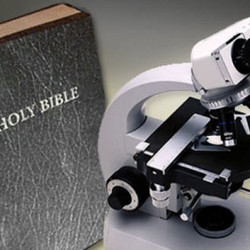
A Holy Bible placed next to a microscope on a wooden surface, symbolizing the intersection of science and faith.

Can Science Replace Religion?

Stephen Hawking, the world’s most famous scientist, made a startling statement on September 2, 2010, one week prior to the release of his new book, The Grand Design. He declared the “Almighty” irrelevant. Dr. Hawking believes that M-theory may hold the ultimate key to understanding everything, even the birth of the universe. Therefore, the need for religion becomes unnecessary. Of course, critics ask where M-theory came from. This is surprising since Dr. Hawking is on record saying, “Even if there is only one possible unified theory, it is just a set of rules and equations. What is it that breathes fire into the equations and makes a universe for them to describe?” To my mind, this is the right question.

Dr. Hawking is just one scientist, albeit highly famous. In general, what do scientists believe? Numerous studies, regarding scientists in the United States, indicate about a third are atheists, a third agnostic, and a third believe in God or a higher power. Similar studies of the general population suggest that three-fourths of the population believes in God or a higher power. (Survey 2005-2007 by Elaine Howard Ecklund of University at Buffalo, The State University of New York). What does this mean? A majority in the scientific community no longer look to religion for answers, but to their science.

The elegance and orderliness of scientific theories and mathematics becomes seductive and, in effect, replaces a need for a higher deity. However, this is not to say there is any unified conspiracy on the part of the scientific community to replace religion with science. In fact, without intention, science and religious ethics appear to have much in common. Einstein wrote in “Essays in Physics” (1950), “However, all scientific statements and laws have one characteristic in common: they are “true or false” (adequate or inadequate). Roughly speaking, our reaction to them is “yes” or “no.” The scientific way of thinking has a further characteristic. The concepts which it uses to build up its coherent systems are not expressing emotions. For the scientist, there is only “being,” but no wishing, no valuing, no good, no evil; no goal. As long as we remain within the realm of science proper, we can never meet with a sentence of the type: “Thou shalt not lie.” There is something like a Puritan’s restraint in the scientist who seeks truth: he keeps away from everything voluntaristic or emotional.”

However, regardless of the inherent ethics, shared by science and religion, one thing that stands in the center of this passionate debate is the existence of miracles. For something to be a true miracle, it must be outside the natural laws of science. In effect, natural law is suspended, and a miracle happens. A majority of scientists have difficulty believing this. Einstein summed this up in the following statement, “Development of Western science is based on two great achievements: the invention of the formal logical system (in Euclidean geometry) by the Greek philosophers, and the discovery of the possibility to find out causal relationships by systematic experiment (during the Renaissance).” To illustrate the difficulty of suspending natural laws, consider this example. If I told you apples fall up instead of down, would you believe me? Probably not. You probably would not even argue with me. My guess is that you would likely be dismissive, and ignore me. Yet, at the heart of various religions is the belief in miracles.

Is it possible to suspend natural laws? I suspect most scientists would answer a resounding “No!” However,what may have been considered a miracle just a hundred years ago is easily explained by today’s science. Television would be an example. In 1914, it would have appeared miraculous to watch television. It involved principles of science and engineering that were not understood at that time. I point this out because I don’t think that miracles can be used to prove or disprove the existence of a deity. Consider this example: Advanced aliens may have a science that appears to suspend natural laws. Perhaps they know how to create “worm holes” and travel vast distances, faster than the speed of light. To our observations, they may be violating another pillar of modern physics, namely the speed of light in a vacuum is the upper limit of velocity in the universe. However, simply because we do not understand their science does not mean that they have suspended natural law. They simply have learned secrets about nature we have not discovered. They know how to harness more energy than we do, which allows them to apparently violate nature laws and create miracles. This may make them appear god-like, but they are not the deity worshiped by the major religions of the world.

I judge that many in the scientific community believe that science will ultimately be able to answer all questions, and they are willing to replace religion with science. I do not share this view. Often, it appears that every significant scientific breakthrough results in an equally profound mystery. I have termed this irony of scientific discovery the Del Monte Paradox, namely:

Each significant scientific discovery results in at least one profound scientific mystery.

Here is an example to illustrate this paradox. Consider the discovery of the Big Bang theory. For this discussion, please view it as a scientific framework of how the universe evolved from a highly dense energy point to the universe we experience today. While the scientific community generally accepts the Big Bang theory, it is widely acknowledged that it does not explain the origin of the energy that was required to create the universe. Therefore, the discovery of the Big Bang theory left science with a profound mystery. Where did the energy originate to create a Big Bang? This is arguably the greatest mystery in science, and currently an area of high scientific focus.

In the final analysis, I don’t think it will come down to science proving or disproving a deity exists. I don’t think it will come down to science discovering a theory of everything. I think it will come down to what it has always come down to over the centuries, namely, faith. To answer the title question, can science replace religion, I offer these thoughts. If you believe that science will ultimately be able to answer every question and enable humans to become god-like, then it is logical to assume science can replace religion. If you believe that science will never be able to answer all questions and ultimately we will   be left with a profound mysteries, then I think its possible to make a case that science will not be able to replace religion. Whatever your believe, I respect your right to formulate your own beliefs.


Abstract digital artwork featuring swirling golden and orange lines against a dark purple and black background.

Is String Theory Pseudoscience?

Is string theory pseudoscience? To address this questions, let’s start by understanding what constitutes science and distinguishes it from pseudoscience.

Let’s start by defining science. Science is the intellectual and practical activity encompassing the systematic study of the structure and behavior of the physical and natural world through observation and experiment. The important words in this definition are “observation” and “experiment.” In other words, real science, and scientific theories, requires its hypotheses and associated predictions to be observable and/or be experimentally verified. One example of a solid scientific theory is Einstein’s special theory of relativity. It has withstood over one hundred years of observation and experimental scrutiny. In fact, it is generally held as the “gold standard” that all theories of science should be measured against.

With the above understanding, if I were to propose a new theory that by its inherent nature had at its core hypotheses that we are unable to experimentally verify and yielded predictions we would not be able to observe or measure, I believe many would consider such a theory to be pseudoscience. Pseudoscience is a system of theories, assumptions, and methods erroneously regarded as scientific, but are not verified, or verifiable, by experiment or  observation.

Now let’s examine string theory. String theory is built on the idea that elementary particles are not point-like objects, but are the vibration modes of one-dimensional “string-like” entities of energy. Proponents of string theory generally argue that it offers a theory of gravity and may provide a solution to the problem of reconciling Einstein’s general relativity with quantum mechanics. Therefore, if it were a valid theory, it would represent a leap in the physical sciences. However, there in lies the key question. Is it a valid theory?

Let start with its hypotheses. Can we measure or observe the one-dimensional vibrating strings of energy that form the core hypotheses of string theory? The answer is no, and that is an emphatic no. We cannot measure them with today’s science, and it is unlikely that we will ever be able to measure them. According string theorist the one-dimensional vibrating strings of energy are about equal to the Planck length, which is the smallest length science theorizes to exist. It is equal to 1.616199(97)×10^−35 meters and is defined from three fundamental physical constants, which I won’t to into here for the sake of brevity. The problem is that today’s science is unable to measure anything smaller than 10^-18 meters, which is billions of times larger than a Planck length. Many in the science community do not think we will ever be able to measure a Planck length, regardless of improvements in measurement technology. Therefore, the first significant problem with string theory is that its hypotheses are not verifiable.

Let’s next look at a significant predictions of string theory. In its current form, M-theory (i.e., membrane-theory, the most comprehensive form of string theory), it predicts there are 11 space-time dimensions, in serious disagreement with our senses and the most recent observations using particle accelerators. There is no experimental evidence of additional dimensions beyond the 4 space-time dimensions of Einstein’s general relativity.

There are arguably other issues with string theory, but the above two points, the lack of experimental verification of its hypotheses and its most fundamental prediction of 11 dimensions, serve to make an important point. It fails to pass the definition of science. String theory doesn’t  provide an intellectual and practical activity encompassing the systematic study of the structure and behavior of the physical and natural world through observation and experiment. It is not only unverified, but appears to be unverifiable at its core.

It’s natural to ask, why has string theory gained such a following in the scientific community. First, modern theoretical physics is based on two incompatible theories, Einstein’s theories of relativity and quantum mechanics. As I mentioned in a previous post, some progress has been made to reconcile them, but no progress has been made with regard to a unified theory of gravity. This has caused serious issues in the scientific community and it is only human to seek a theory that offers to resolve the issue. However, in this case, we are taking a theory that is flawed and unverifiable to attempt to reconcile relativity and quantum mechanics, both of which have been widely successful as theories within their specific context. Next, numerous formidable physicists, like Stephen Hawking and Brian Greene, have written best selling books based on string theory. To the average popular science reader, their books are exciting and their standing in the scientific community suggests their books are science fact. How is it possible that Dr. Hawking and Dr. Greene are in such strong support of a questionable theory. I think this has to do with the mathematical elegance of M-theory. It is relatively easy to become enamored with the mathematical formulations and loose sight of the fundamentals. Unfortunately, I think this has happened. Dr. Hawking has gone as far as saying we no longer need a God since we now have M-theory. Opponents rightly ask, where did M-theory come from? I am not going to get into the religious aspects. I only point this out to delineate how deeply some of today’s most respected physicists have embraced string theory.

Where do I stand? Obviously, today’s theoretical physics is based on two incompatible theories, Einstein’s relativity and quantum mechanics. Although, both theories work extremely well in the specific contexts, relativity at the macro level and quantum mechanics at the micro or quantum level (i.e., the level of atoms and subatomic particles), they do not come together to provide cogent theory of gravity. Even though string theory offers a speculative path to resolve the incompatibilities, at its core it appears to be pseudoscience. At best, it is a conjecture, which means it falls into the category of opinion.

I offer this sober warning to those that plan on making a career in science. Before you decide to become a string theorist and spend your career working to understand M-theory mathematics, be sure that you agree with the fundamental hypotheses and predictions of string theory. Don’t fall hopelessly in love with the elegant mathematics. Just because you can publish your theoretical string theory results in respectable scientific journals and participate in professional conferences doesn’t legitimize string theory. Much like a recovering alcoholic, science must admit there is a problem and not grasp at the current fad of string theory. It is better to admit we don’t have a solution than to forward what is likely the most legitimized pseudoscience of modern times, string theory.

A glowing sign with the word 'TRUTH' illuminated against a sunset backdrop.

Science Versus Truth

Many people, even some scientists, believe science equates with truth, especially with regard to the behavior of nature. Let’s examine whether this hypothesis is correct.

Modern physics is based on Einstein’s special and general theories of relativity and quantum mechanics. Each theory models and predicts the behavior of reality within specified contexts. The theories of relativity work well in explaining and predicting the behavior of reality at the macro level (i.e., typically the level of our everyday world), even as objects approach the speed of light. Quantum mechanics works well in explaining and predicting the behavior of reality at the micro level, often termed the quantum level (i.e., the level of atoms and subatomic particles). However, the two theories are incompatible. For example, the theories of relativity describe the behavior of reality at the macro level with certainty, but are unable to  explain reality on the quantum level. Quantum mechanics is able to describe the behavior of reality at the micro level in terms of probabilities, but again is unable to provide an adequate model of how gravity works at the quantum level.

Physicists have been working to reconcile relativity and quantum mechanics for over a century. To date, some progress has been made. For example, special relativity was merged with electromagnetism. This resulted in the theory of quantum electrodynamics (QED) or relativistic quantum field theory. QED is widely considered to be the most precise theory of natural phenomena ever developed. In the 1960s and 1970s, physicists attempted to unify the weak, the strong, and the gravitational forces. This resulted in another set of theories that merged the strong and weak forces called quantum chromodynamics (QCD) and quantum electroweak theory. However, no theory has successfully reconciled quantum mechanics and general relativity with regard to gravity. This incompatibility and the vastly different models of reality posed by the theories of relativity and quantum mechanics forces many in the scientific community to question their overall validity. In response, some physicists have forwarded a completely different model of reality based on string theory. In essence, string theory is a a theoretical framework in which the point-like particles of particle physics are replaced by one-dimensional objects of vibrating energy called strings. The most comprehensive string theory is termed M-theory, which stands for membrane theory. While many highly esteemed physicists, like Stephen Hawking, have championed M-theory, there is no experimental proof that it correctly models nature.

What does all this say about science and it relationship to truth? Science attempts to explain (i.e., model) and predict reality, but the best theories of modern physics are either inconsistent or not experimentally verified. In science, we have models, laws and mathematics that strive to explain and predict reality. However, our view of reality continues to evolve as our understanding of science evolves. For example, Newtonian mechanics works well for most problems in our everyday world, but fails to work when objects move close to the speed of light. Einstein’s theories of relativity evolved to solve relativistic problems (i.e., objects moving at speeds close to the speed of light). In principle, we can replace Newtonian mechanics with the theories of relativity, but reality has not changed. The only thing that has changed is our model of reality and the mathematical equations we use to predict nature’s behavior.

In conclusion, what can we say about science versus truth. If we define truth as the actual way nature behaves, then we must  admit that science does not equate with truth. Science is continually evolving to more closely model what nature is actually doing. The mathematics of science are continuously being refined to more closely predict how nature will behave. What is true in science? Scientific facts are true. For example, we can scientifically measure the gravitational attraction between two masses. However, scientific theories that explain this attraction may be wrong. For example, Newtonian mechanics explains gravity in terms of a gravitational field. General relativity, which superseded Newtonian mechanics, explains gravity as the distortion of space caused by a mass. Although the facts of science are indisputable, the theories used to explain them are not.